A performance improvement plan template is the document HR uses when a manager has decided someone may need to leave but the company is not ready to terminate yet. That is what it is. Strip the language about coaching and growth and the PIP is what it has always been: contemporaneous documentation that the employee was warned, given a chance, supported, and measured against a written standard before the employer acted. Pretending otherwise is how PIPs get drafted in ways that fall apart the moment a tribunal or an employment lawyer reads them.
This guide gives you three ready-to-customise performance improvement plan templates (one for performance issues, one for attendance, one for behavioural conduct), a 30/60/90 framework for the review cadence, and the six elements every PIP needs to survive a termination dispute. The structure is built around the question the employer's lawyer will ask in week 12: was the employee given a fair, specific, written chance to improve, and is there a paper trail to prove it. If you want to skip the reasoning and put the structure on a form your manager and HR lead can co-sign today, clone the Good Form PIP template and customise it in five minutes.
The short version:
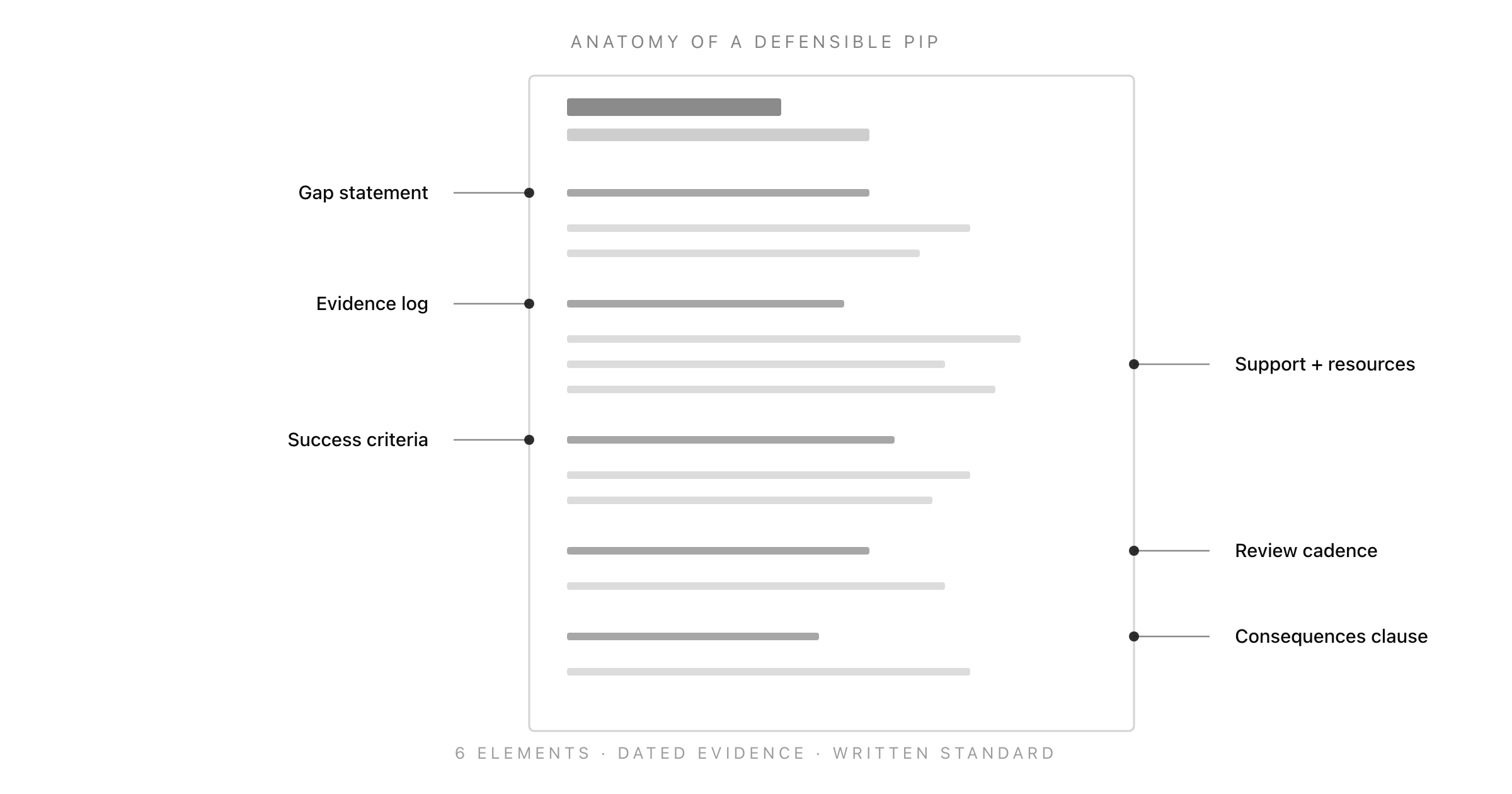
- A defensible performance improvement plan template has six elements: a gap statement, an evidence log, written success criteria, support and resources, a review cadence, and a consequences clause. Missing any one is a litigation risk.
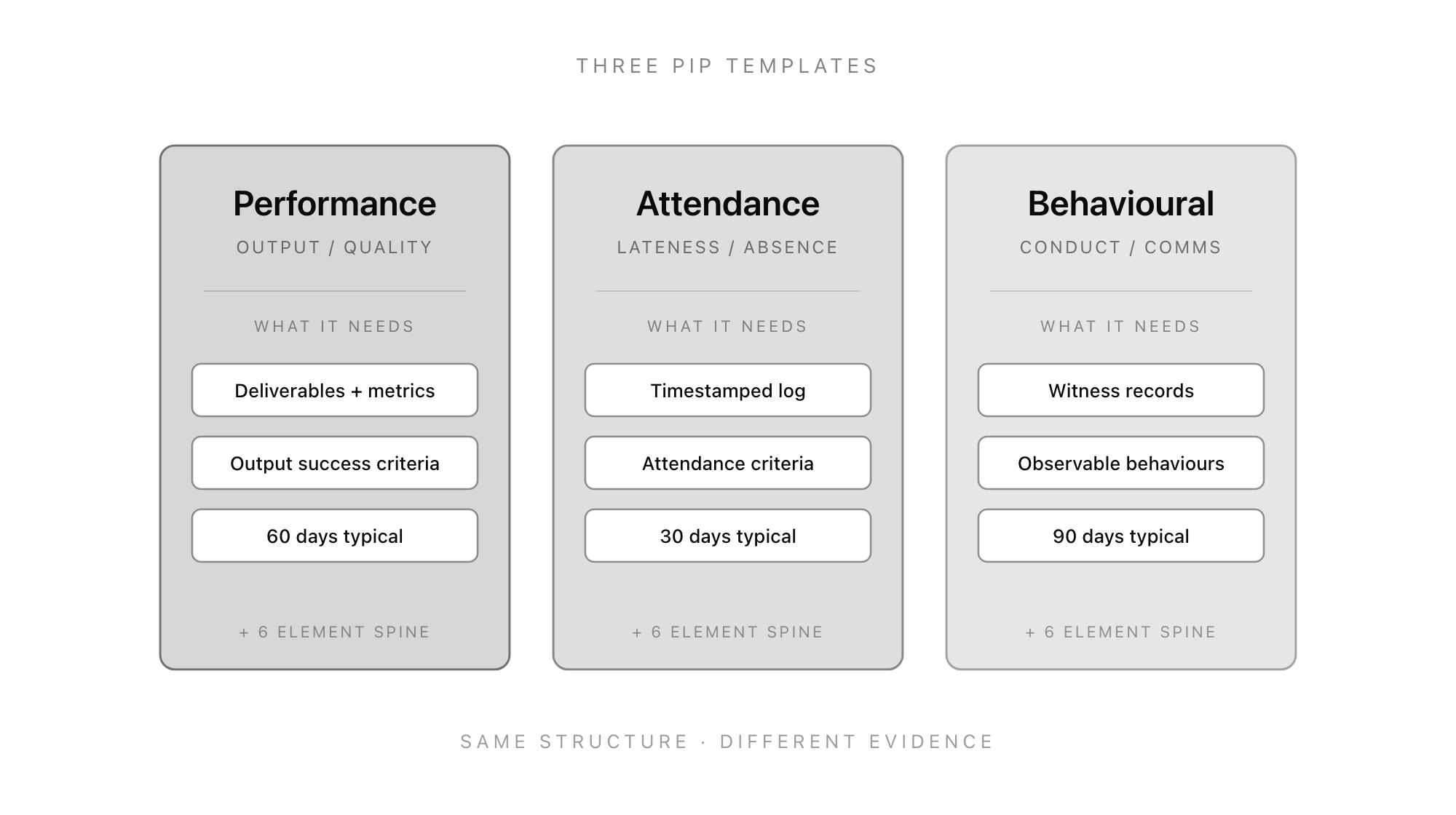
- Three PIP types cover the cases small companies actually run: performance (missed deliverables, quality issues), attendance (lateness, absence, availability), and behavioural (conduct, communication, peer relationships). Each shares the same spine but the success criteria, evidence type, and timeline differ.
- The 30/60/90 day framework is not magic. It is the minimum window an employment lawyer will tell you produces a defensible record. Shorter and the plan looks like a setup. Longer and the business is paying for unaddressed performance.
- The single biggest mistake is vague success criteria. "Improve quality" is not a criterion. "Zero customer-reported defects on shipped work for two consecutive sprints" is a criterion. The PIP is only as strong as the standard it sets.
- Clone the Good Form PIP template → so the issuance and every fortnightly check-in is timestamped, structured, and retrievable. The tribunal does not care that the meeting happened. It cares whether you can prove what was said.
What a Performance Improvement Plan Actually Is (and Isn't)
A performance improvement plan template is not a coaching tool. It is not a development plan. It is not an annual review variant. Treating it as any of those produces a document that fails in both directions: it does not improve performance and it does not defend the employer if termination follows.
Three things a PIP is not:
- A development plan. Development plans assume the employee is meeting expectations and the goal is growth. PIPs assume the employee is below expectations and the goal is meeting them. The grammar is different. Mixing them dilutes both.
- A first warning. By the time HR is drafting a PIP, the manager should already have had at least two informal documented conversations about the gap. If the PIP is the first time the employee hears there is a problem, the timeline is wrong.
- A formality before a predetermined firing. This is the version employment lawyers see most often, and it is also the version that loses tribunals. A PIP written in bad faith reads in bad faith. The success criteria are unattainable, the support is theatre, the review meetings are short and one-sided. Every element shows up in disclosure.
What a PIP is: a written, time-bound, mutually-acknowledged plan that states (a) the specific gap between current performance and the role standard, (b) what success looks like in measurable terms, (c) what the employer will do to support improvement, (d) when the plan will be reviewed, and (e) what happens if the criteria are not met. Done well, a PIP either rescues an underperforming hire or produces the documentation an employer needs to defend a fair-dismissal decision. Done badly it does neither.
The Six Elements Every Performance Improvement Plan Template Needs
Every defensible PIP, regardless of type, contains the same six sections. The differences between performance, attendance, and behavioural PIPs are in the content of each section, not the structure.
1. The Gap Statement
One paragraph, factual. States the role, the standard the role requires, and the specific way the employee's recent performance has fallen below that standard. No adjectives. No characterisation. No history beyond the period under review.
Bad: "Sarah has been struggling with her workload and not meeting expectations." Good: "Sarah is employed as a Senior Account Executive. The role requires a quarterly closed-revenue target of £180,000 and a pipeline-coverage ratio of 3x. In Q1 2026 Sarah closed £92,000 (51% of target) with a pipeline-coverage ratio of 1.4x. This is the second consecutive quarter below target."
The gap statement is the foundation. If it cannot be written in one factual paragraph using numbers, dates, and named outputs, the manager has not yet identified the actual problem and a PIP is premature.
2. The Evidence Log
A bulleted list of specific, dated incidents that illustrate the gap. Three to six items. Each item names a date, the incident, and the consequence.
This is the section managers most often skip or fudge. The temptation is to write "consistent pattern of missed deadlines" instead of listing four specific deadlines that were missed and on which dates. The general statement is the one that gets contested. The list is the one that gets accepted.
The evidence log is also where contemporaneous records matter. A meeting that happened but was not written up at the time is weaker evidence than a Slack message at 4:47pm on the day. This is why the Good Form PIP template and the structured 1:1 records HR uses have value beyond the conversation itself: they create the paper trail before anyone needs it.
3. Success Criteria
Specific, measurable, time-bound statements of what "meeting the standard" looks like. Each criterion has a metric, a target, and a deadline. The PIP fails or succeeds on this section more than any other.
The test for whether a success criterion is good enough: could two different managers, looking at the same outputs in 30 days, independently agree on whether the criterion was met? If not, the criterion is too vague.
Bad: "Improve quality of work." Better: "Reduce customer-reported defects." Good: "Zero customer-reported defects on shipped work in any two-week sprint during the 90-day plan period, measured by the support-ticket queue tagged 'engineering-defect'."
Three to five criteria is the typical range. Fewer than three and the plan does not cover the gap. More than five and the employee cannot focus on improvement.
4. Support and Resources
What the employer will do, and by when, to give the employee a fair chance to meet the criteria. This is the section that defends the employer against the "I was set up to fail" defence.
Examples of legitimate support: weekly one-to-ones with the manager (with a structured agenda), pairing with a senior colleague, access to specific training, a temporary reduction in adjacent responsibilities, mentor introductions, escalation routes for blockers. Each support item names the person responsible, the cadence, and what counts as having delivered it.
The pattern that fails is "manager will provide regular coaching" with no detail on what coaching, how often, or what is captured from each session. The pattern that holds up is "Manager (Anna) and employee (Sarah) will meet for 45 minutes every Tuesday at 10am for the duration of the plan, agenda set 24 hours in advance, action notes recorded in shared doc within 24 hours of the meeting."
5. Review Cadence
The fixed dates on which the manager and employee will sit down to formally review progress against each criterion. For a 30-day PIP, weekly. For a 60-day PIP, fortnightly. For a 90-day PIP, every two to three weeks.
Each review meeting has the same structure: review of evidence against each criterion, open issues, support adjustments, and a written status (on track, at risk, off track) for each criterion. The meeting is captured on a structured form so the record is consistent across the plan period.
The review cadence is the second-most-skipped element after evidence. A PIP that is "reviewed at the end of the period" is a PIP that produces no progress data, no opportunity for course correction, and no defensible record of what happened during the plan. It is also a PIP that gets thrown out when contested.
6. Consequences Clause
Plain language stating what happens if the criteria are met (the plan is closed and normal expectations resume) and what happens if they are not (further formal action up to and including termination of employment). The clause does not promise termination on failure. It states termination as a possible outcome.
The legal language matters here and varies by jurisdiction. In the UK the standard wording acknowledges the relevant disciplinary policy and the employee's right to representation. In the US (at-will states) the wording reserves the employer's discretion. Get this clause reviewed by the company's employment counsel before any PIP is issued. The cost of the review is much lower than the cost of an unfair-dismissal claim.
The Three Performance Improvement Plan Templates
Every variant uses the six-element spine above. The variants differ in the content of each section: what the gap is, what evidence is collected, what success looks like, and what support is appropriate.
Template 1: The Performance PIP (Output, Quality, or Productivity Gap)
The most common PIP type. The gap is in the volume, quality, or timeliness of work output. Evidence is documents, deliverables, metrics, and customer feedback. Success criteria are output-based.
Performance Improvement Plan, [Employee Name], [Role]
Plan period: [Start date] to [End date] (60 days)
Issued by: [Manager Name], [HR Lead]

1. Gap statement
[One paragraph: role, standard, current performance with specific numbers]

2. Evidence log
- [Date]: [Incident, e.g. "Missed deliverable: Project X scoping doc due, submitted 9 days late at draft quality"]
- [Date]: [Incident]
- [Date]: [Incident]
- [Date]: [Incident]

3. Success criteria
- Criterion 1: [Specific metric, target, deadline. e.g. "Ship all assigned tickets within agreed estimates ±20%, measured weekly"]
- Criterion 2: [Specific metric, target, deadline]
- Criterion 3: [Specific metric, target, deadline]

4. Support and resources
- Weekly 1:1 with manager, Tuesdays 10:00, structured agenda
- Pairing with [senior colleague] on [specific work] for [duration]
- Access to [training resource], expected completion by [date]
- Reduction in [adjacent responsibility] for plan duration

5. Review cadence
- Week 2: progress check, written status per criterion
- Week 4: mid-plan review, support adjustments if needed
- Week 6: pre-final review, decision orientation
- Week 8: final review and decision

6. Consequences
Successful completion closes this plan and normal performance expectations
resume. If the success criteria are not met by the end of the plan period,
or if there is a serious decline in performance during the plan, further
formal action will be considered, up to and including termination of
employment, in line with the [company disciplinary policy reference].

Acknowledged:
[Employee signature, date]
[Manager signature, date]
Template 2: The Attendance and Reliability PIP
Used when the gap is lateness, unauthorised absence, or availability rather than work output. Evidence is a timestamped attendance log. Success criteria are attendance-based and have a different shape from output criteria.
The trap with attendance PIPs is failing to consider whether the underlying cause is something an employer is legally required to accommodate (disability, mental health, caring responsibilities, religious observance). A PIP issued without a prior conversation about reasonable adjustments is a PIP that fails on procedural grounds.
Performance Improvement Plan, [Employee Name], [Role]
Plan period: [Start date] to [End date] (30 days)
Issued by: [Manager Name], [HR Lead]

1. Gap statement
[Role, standard working pattern, current attendance with specific dates and patterns]

2. Evidence log
- [Date]: [Late arrival, X minutes, no advance notice]
- [Date]: [Unauthorised absence, no contact until Y]
- [Date]: [Departed early without manager approval]
- [Date]: [Unresponsive on agreed core hours]

3. Success criteria
- Criterion 1: 100% attendance at agreed working hours for the plan period, with the standard exceptions for illness (notified to manager by 09:00 of the day) and pre-approved leave
- Criterion 2: All future absences notified to manager by phone or Slack DM no later than 09:00 on the day, including a return-to-work estimate
- Criterion 3: Responsiveness on core team channels (Slack, calendar) during agreed working hours

4. Support and resources
- Weekly 1:1 with manager, Mondays 09:30
- Confidential conversation with HR about any underlying support needs that may affect attendance, with appropriate adjustments offered
- Confirmation of working pattern in writing, including any flexibility already granted

5. Review cadence
- Week 1: attendance check (run weekly through plan)
- Week 2: progress meeting
- Week 3: pre-final review
- Week 4: final review and decision

6. Consequences
[As Template 1]

Acknowledged:
[Employee signature, date]
[Manager signature, date]
Template 3: The Behavioural / Conduct PIP
Used when the gap is in how the employee works rather than what they produce. Communication, collaboration, professional conduct, peer relationships. This is the hardest PIP type to write defensibly because evidence is interpersonal and partly subjective.
The discipline here is to convert behavioural concerns into observable behaviours with witnesses or written records. "Disrespectful in meetings" is not actionable. "Interrupted [colleague] three times in the 14 March stand-up after being asked twice not to" is actionable.
Performance Improvement Plan, [Employee Name], [Role]
Plan period: [Start date] to [End date] (90 days)
Issued by: [Manager Name], [HR Lead]

1. Gap statement
[Role, behavioural standards expected, specific behaviours that have fallen below standard]

2. Evidence log
- [Date]: [Specific observable behaviour, witnesses or written record, impact on team]
- [Date]: [Specific observable behaviour, witnesses or written record, impact on team]
- [Date]: [Specific observable behaviour, witnesses or written record, impact on team]
- [Date]: [Specific observable behaviour, witnesses or written record, impact on team]

3. Success criteria
- Criterion 1: No further incidents of the specific behaviours identified in the evidence log, observed in any team setting during the plan period
- Criterion 2: [Specific positive behaviour expected, e.g. "Active listening in meetings, evidenced by manager observation in weekly stand-ups and feedback from at least two named peers at the 6-week mark"]
- Criterion 3: [Specific commitment, e.g. "Complete agreed communication-skills module by week 4 and submit a one-page reflection"]

4. Support and resources
- Weekly 1:1 with manager, structured agenda including behaviour observations
- Optional access to coaching (external) for the duration of the plan
- Mediated conversation with directly affected colleagues if employee requests one
- Clear written articulation of the expected behaviours

5. Review cadence
- Week 2: initial check, evidence of new behaviour patterns
- Week 4: mid-plan review with feedback from at least one peer source (anonymised)
- Week 6: progress meeting
- Week 8: pre-final review
- Week 10: final review with HR and manager
- Week 12: closure or escalation

6. Consequences
[As Template 1]

Acknowledged:
[Employee signature, date]
[Manager signature, date]
The 30/60/90 Day Framework: Why Timeline Matters
The duration of a PIP is not arbitrary. It signals seriousness, fairness, and the time required for genuine improvement. Each window has a typical use case.
30-day PIPs are appropriate when the gap is well-defined and improvement is observable quickly. Attendance, basic process compliance, missed deadlines on short-cycle work. The compressed timeline forces focus and produces a clear signal in either direction within a month. Anything more nuanced than a binary improvement question and 30 days is too short.
60-day PIPs are the default for performance gaps where output is on a 2-4 week cycle and a meaningful improvement signal needs at least two cycles of work to emerge. Most engineering, design, and operations PIPs sit here.
90-day PIPs are appropriate for sales (where the cycle is a quarter), behavioural change (which is slower than output change), and senior roles where the work is strategic and a single project takes longer than 6 weeks. The risk of 90-day PIPs is fatigue: both manager and employee start to drift, the plan becomes background noise, and the documentation degrades. This is why 90-day PIPs need the most rigorous review cadence.
What rarely works: PIPs shorter than 30 days. They look like a setup. The evidence log of a 14-day PIP cannot support a fair-dismissal defence in most jurisdictions and in most cases.
Common Mistakes That Nullify a Performance Improvement Plan
The PIP is only useful if it is procedurally clean. Six failure modes account for most of the unfair-dismissal claims that follow a PIP.
- Vague success criteria. Already covered. The single largest cause of failed PIPs.
- No evidence log. A PIP that asserts a gap without listing dated incidents has no foundation. Every incident-free assertion is a vulnerability in disclosure.
- No reasonable-adjustment conversation. Particularly fatal in attendance PIPs. The employer must explore whether the gap is connected to anything that triggers an accommodation duty before issuing the plan.
- Reviews that do not happen or are not recorded. A PIP "in progress" with no written meeting records produces a black box that the tribunal will read against the employer.
- Moving the goalposts mid-plan. Adding criteria, raising thresholds, or changing measurement methods after the plan starts is treated as bad faith. If the plan needs adjustment, it needs a written amendment signed by both parties.
- Termination before the plan ends. Unless there is a separate gross-misconduct trigger, terminating during a PIP voids the procedural defence the PIP was designed to create. Wait for the end. Document the end. Then act on the documentation.
Putting the PIP on a Form, Not a Word Doc
Most companies still run PIPs as a Word document attached to an email and printed for signature, with the fortnightly review meetings captured as free-text notes that may or may not exist in someone's notebook. The result is a paper trail that is incomplete on the day it is needed.
The PIP and the review meetings that go with it are exactly the use case structured forms were built for: identical fields every time, timestamps the system writes itself, signatures captured digitally, and a single retrievable record across the whole plan period. The Good Form performance improvement plan template puts the six-element spine on a single form, so the document and the running record live together. The same approach applies whether you are using one of the three templates above or writing your own.
Clone the performance improvement plan template in Good Form →
It opens directly in the editor with all six sections wired up: gap statement, evidence log, success criteria, support and resources, review cadence, and the acknowledgement clause. Customise it for your jurisdiction in five minutes, share with the manager and HR lead, and have a defensible record from day one. Pair it with the other HR forms in the Good Form library (performance review, exit interview, employment verification) and the entire HR-form surface area runs through one consistent intake layer.
A Note on Jurisdiction
The templates above are jurisdiction-neutral. Specific legal language differs between the UK (where the ACAS Code of Practice on Disciplinary and Grievance Procedures sets the procedural standard), the US (where state at-will rules and EEOC requirements interact), the EU (where works-council and consultation duties apply in larger employers), and elsewhere. Run any PIP through company employment counsel before issuing it. The templates are a structural starting point, not a legal one.
The structure is what travels. The legal wording is what changes.