A well-run exit interview is the cheapest retention research your company will ever do. A badly run one produces a folder of polite fictions that nobody reads. The difference is almost entirely in the exit interview questions themselves, and in whether you ask them in a one-on-one conversation with a manager in the room or in an async, private form the person fills out the week after they leave. This guide gives you the questions that actually work, organised by what they uncover, along with a template you can clone and run through Good Form the next time someone resigns.
We'll cover the three goals of an exit interview, 25+ questions grouped by theme, why async beats live, common mistakes, how to analyse the responses once they start rolling in, and a downloadable Good Form template at the end.
The short version:
- Async, written, and private. Always. Managers in the room corrupt the data.
- Ask about the job, the manager, the comp, the culture, and the future. Five themes, roughly five questions each.
- Skip "what could we have done better?" It gets vague answers. Ask specific counterfactuals.
- Aggregate across leavers, not per-leaver. One person's grievance is anecdote; three in a row is a pattern.
- Clone the Good Form exit interview template → and run it on your next departure.
What Exit Interviews Are For (and What They're Not)
Three goals, in decreasing order of what the evidence supports.
- Surface systemic issues. The real prize. Exit data aggregated over 6-12 months tells you which managers consistently bleed talent, which departments churn, and which parts of your employee experience are driving people away.
- Give the leaver closure. A decent exit process is part of a respectful offboarding. People talk about how they were treated on the way out. Glassdoor reviews are written in the week after departure.
- Retain specific individuals. Almost never works. By the time someone's resigning, the retention conversation should have happened months ago. Treating the exit interview as a last-ditch retention pitch wastes the other two goals.
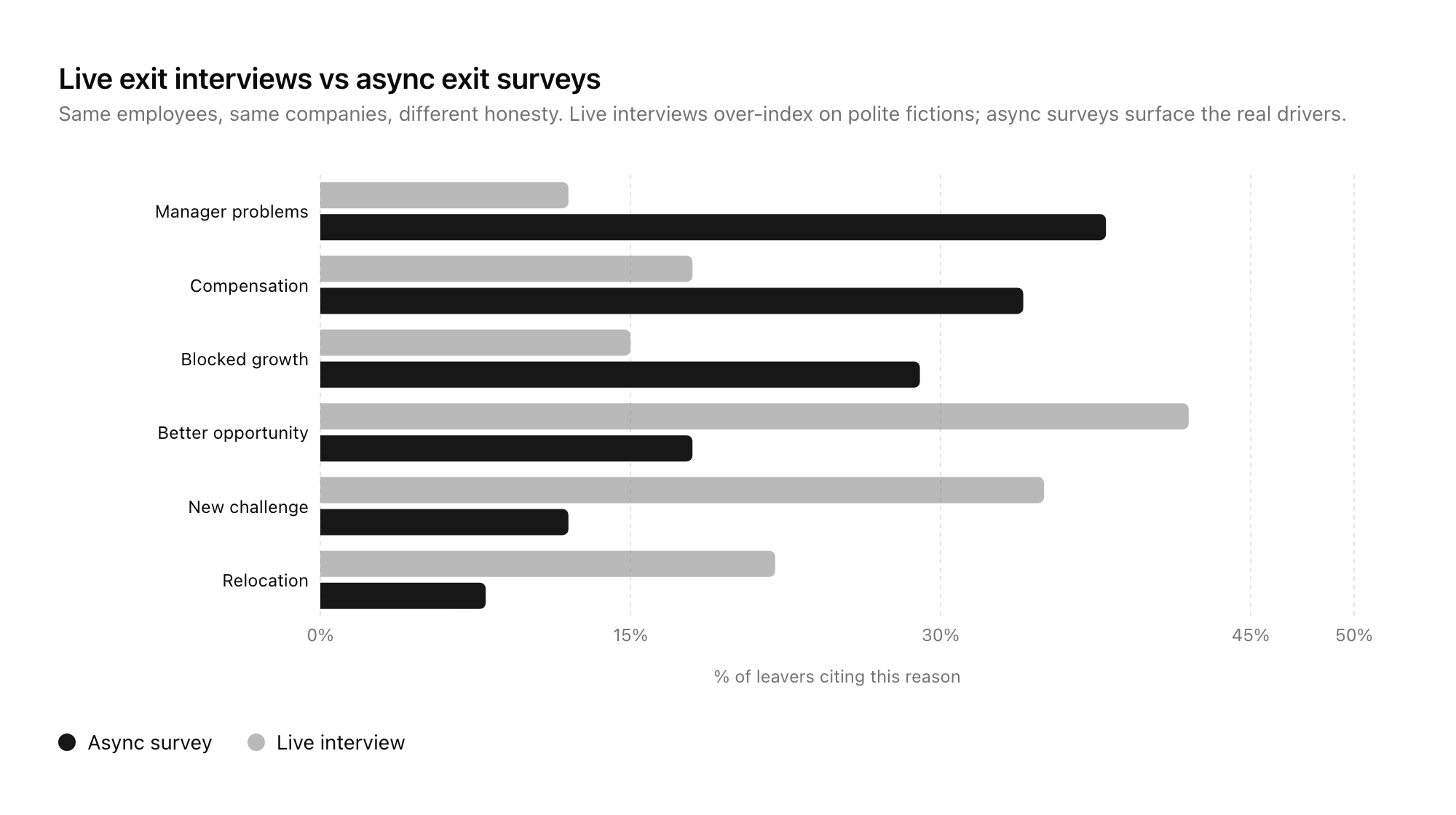
Notice the gap in the chart above. In live, in-person exit interviews, the most common answers are variations on "I got a better opportunity" and "I need a new challenge." In async, anonymous exit surveys conducted 1-2 weeks after departure, the top answers shift dramatically toward specific manager issues, compensation gaps, and blocked career growth. Same employees, same companies, different data. The format determines the honesty.
The 25+ Exit Interview Questions, By Theme
Five themes, roughly five questions each. Don't use all 25+; pick the 15-20 that fit your org. Rotate the set quarterly.
Theme 1: The Role Itself
What the day-to-day job was actually like.
- How did your actual responsibilities compare to what you were promised when you were hired?
- What part of the job did you enjoy most?
- What part of the job did you dislike most?
- Were your working hours sustainable?
- Did you feel you had the tools and resources you needed to do your job well?
Theme 2: The Manager
The single biggest retention variable in most orgs. Ask directly, and never in the manager's presence.
- How would you describe your manager's strengths?
- What could your manager have done differently that would have made you more likely to stay?
- Did you feel your manager gave you useful feedback?
- Did you feel your manager advocated for you internally (promotions, raises, projects)?
- If a friend told you they were considering joining this team under this manager, what would you tell them?
Theme 3: Compensation and Progression
Money and career path. Skip at your peril.
- How did your compensation compare to what you could earn elsewhere?
- Did you have a clear path to your next role at this company?
- Was your last raise or promotion cycle transparent and fair?
- What was the single biggest factor in accepting your new offer (if applicable): comp, role, company, location, manager?
- If comp had been 20% higher, would you have stayed?
Theme 4: Culture and Environment
The invisible stuff that makes people want to come to work.
- How would you describe the culture here to someone who doesn't know the company?
- Did you feel psychologically safe raising concerns or disagreeing with decisions?
- Was the workload distributed fairly across the team?
- Did you feel included and respected across identity lines (gender, race, background, neurodivergence)?
- How did the company handle stress and pressure?
Theme 5: Looking Forward
Signal about what to fix.
- What would have kept you here another year?
- What one change do you think the company needs most?
- Would you recommend this company as a place to work? (Yes / Probably / Probably not / No)
- Would you ever consider returning? (Open door for boomerangs.)
- Is there anything you wanted to say that we haven't asked?
Five themes, 25 questions. You can comfortably run 15 of them as a 15-20 minute async form.
Why Async Beats Live (and What the Research Says)
Almost every retention-research paper on exit interviews over the last 20 years concludes the same thing: the format distorts the data. In a live interview with a manager or HR partner, leavers soften their answers for three reasons:
- Social desirability. Nobody likes giving hard feedback face to face, especially to someone they may need as a reference.
- Reference risk. An honest answer that sounds too critical can cost a reference check. Leavers know this.
- Time pressure. 30 minutes in a meeting room pushes people toward short, tidy answers. The real story has more texture.
A well-designed async exit survey fixes all three:
- Social desirability is lower when nobody's watching you type.
- Anonymity (or at least pseudonymity) cuts reference risk.
- The form can sit open for a week. Leavers come back and add detail when it occurs to them.
Done well, async exit surveys return 2-3x more specific, actionable feedback than live exit interviews with the same questions. There's no good reason in 2026 to still be running them in person unless you specifically need the closure / relationship moment with the leaver.
Common Mistakes
Patterns we see in broken exit interview processes:
- Running it the day someone resigns. Emotions are too fresh. Run it at day 7-14 after departure, not day 0.
- Asking only vague questions. "What could we have done better?" gets "more growth opportunities" in response. Ask specific counterfactuals: "If comp had been 20% higher, would you have stayed?"
- Keeping results manager-level confidential. The data is most useful aggregated across managers. Hiding it protects bad managers.
- Only interviewing "regrettable" attrition. You learn just as much from people who were underperforming or mid-tier. Survey everyone who leaves.
- Not closing the loop. If exit data showed comp was a top issue and you didn't adjust bands, the next round won't be more honest.
- Manager in the room. Never. Don't make us say it again.
How to Analyse the Responses
One exit interview is anecdote. Ten is data. Here's the rhythm that works.
- Stand up a rolling report. Quarterly, look at every response from the last 90 days. Do not read them one at a time as they come in; you'll lose the pattern.
- Tag by theme. Role, manager, comp, culture, growth. Count the mentions. The themes that come up most often are your real attrition drivers, not the "official" ones from last year's retention deck.
- Segment by manager and team. If one manager's leavers consistently cite that manager, you have data. Have the conversation.
- Quote-extract. Pull the 5-10 most specific, vivid quotes per quarter for the leadership read-out. Abstract stats don't move decisions; exact words do.
- Report back externally. Send departing employees a short note six months later: "Here's what we heard and here's what we changed." It closes the loop and it feeds back into honesty for the next cohort.
Frequently Asked Questions
What questions should I ask in an exit interview?
Fifteen questions across five themes: the role, the manager, compensation and progression, culture, and looking-forward. The full list of 25+ is in the section above. Pick 15 and run them as an async form.
Are exit interviews actually useful?
Yes, if you run them async with the right questions and analyse the results in aggregate. No, if you run them in-person with the outgoing manager in the room and use them as a last-ditch retention conversation.
Should exit interviews be anonymous?
Completely anonymous is ideal but often impractical (small teams make anyone identifiable). A reasonable middle: confidential-by-policy, with the clear commitment that responses won't reach the leaver's former manager with names attached. Good Form lets you set this up natively.
How soon after someone leaves should the exit interview happen?
Day 7-14 after their last day. Not the day of resignation (too emotional, too invested in not burning bridges) and not six months later (too detached).
What's the best format for an exit interview?
An async written survey, sent by email or via a secure link, left open for 7 days. Optional follow-up conversation with HR after the form comes back, if the responses suggest it's needed.
What's a regrettable vs non-regrettable departure and why does it matter?
"Regrettable" attrition is the loss of an employee you'd have wanted to keep. "Non-regrettable" is a performance-managed exit or a poor culture fit leaving. Many companies only exit-interview the regrettable ones. Don't. The data from non-regrettable departures is just as useful because it tells you about your hiring filters, onboarding, and culture gaps.
Your Exit Interview Form Template, Ready to Clone
We've built an exit interview form template in Good Form that implements everything above: 15 questions across five themes, anonymous submission, a rolling report view aggregated across leavers, and a simple export for your quarterly retention review.
Clone the Good Form exit interview template →
If you're redesigning your wider talent ops, the same principles apply at the other end of the funnel: our guides to interview feedback forms and job application form templates cover the hiring-side equivalents. The difference between a good people function and a great one is how tightly this feedback loop is closed.