The best job description examples do one thing the generic ones do not: they make a specific, qualified person read the page and think, "that is my job." Most job descriptions fail at exactly this. They list "various responsibilities," ask for a "team player with excellent communication skills," and offer a "competitive salary," and the result is a posting that could describe ten thousand roles and attracts almost no one worth interviewing. A good example is the opposite. It is concrete enough that the right candidate recognises themselves in it and the wrong ones screen themselves out.
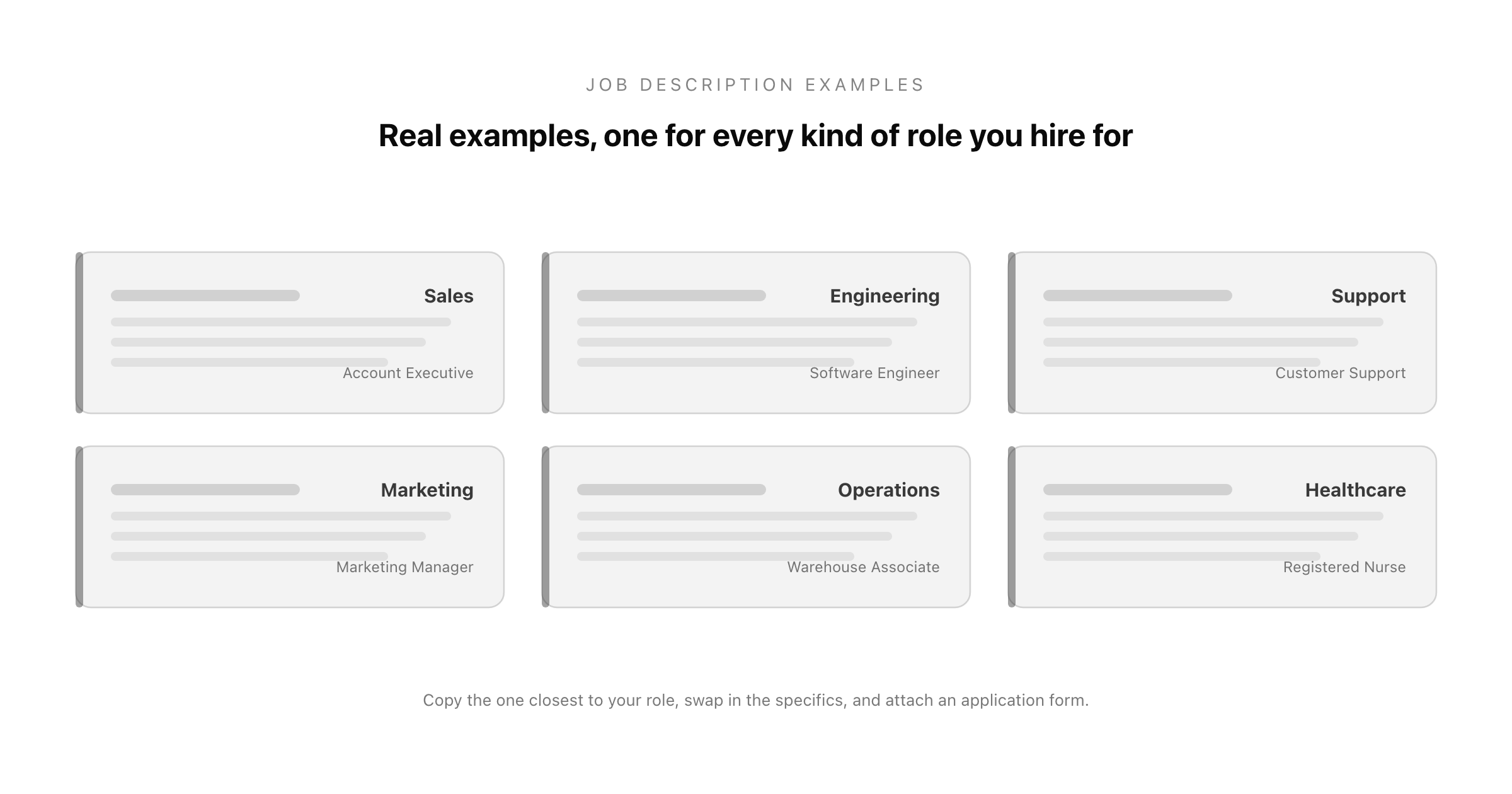
This guide gives you six real job description examples, one for each of the kinds of role most teams actually hire for, plus the anatomy every strong one shares, the phrases that quietly kill applications, and how to turn any of these into a live posting with an application form attached. Copy the one closest to your role, swap in your specifics, and you have a job description that does its real job: bringing the right people to your door.
What Every Good Job Description Example Has in Common
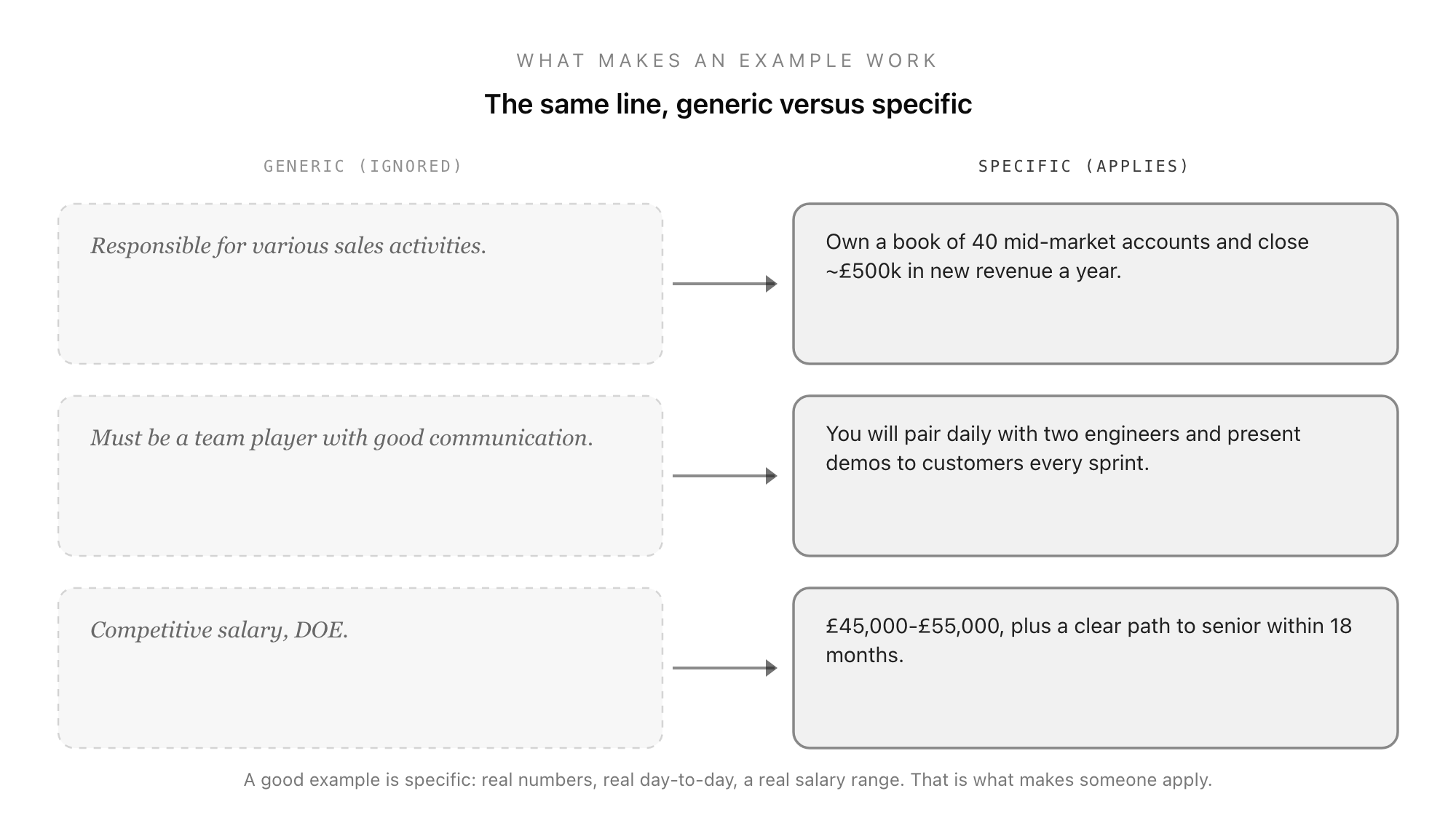
Before the examples, the pattern that runs through all of them. A job description example is worth copying only if it is specific. The single biggest difference between a posting that attracts and one that gets ignored is whether it uses real numbers, real day-to-day detail, and a real salary range, or hides behind vague corporate filler.
Every strong job description, whatever the role, contains the same core sections: a clear job title, a one-paragraph summary of the role and why it matters, a short list of the actual responsibilities (what the person will really spend their days doing), the requirements split into genuine must-haves and nice-to-haves, and the practical details of pay, location, and how to apply. We cover the full anatomy and the eight-section structure in depth in the job description template guide; the examples below put that structure to work.
Two rules make any of these examples land. First, describe the actual work, not an idealised version of it. "You will own the onboarding flow and cut drop-off" beats "responsible for improving user experience." Second, be honest about the hard parts. A job description that admits what is difficult about a role attracts people who want that challenge and repels those who do not, which is exactly what you want a filter to do.
Job Description Example 1: Sales (Account Executive)
Account Executive, Mid-Market
We are looking for an Account Executive to own a book of mid-market accounts end to end, from first conversation to signed contract. You will carry a quarterly revenue target, run your own pipeline, and work closely with our sales engineers on technical deals. This is a role for someone who wants to close, not just qualify.
What you will do:
- Own a book of roughly 40 mid-market accounts and close approximately £500,000 in new revenue a year.
- Run the full sales cycle: prospecting, discovery, demos, negotiation, and close.
- Partner with a sales engineer on technical evaluations and proof-of-concept work.
- Keep an accurate pipeline and forecast in the CRM every week.
What we are looking for:
- Two or more years closing B2B deals in the £10,000 to £100,000 range (must-have).
- A track record of hitting or beating quota (must-have).
- Experience selling to [your buyer, e.g. HR or IT leaders] (nice-to-have).
The details: £45,000 to £55,000 base, plus uncapped commission (on-target earnings around £90,000). Hybrid, two days a week in our [city] office.
Why it works: it names the number of accounts, the revenue target, and the real on-target earnings. A strong closer reads that and knows exactly what success looks like.
Job Description Example 2: Engineering (Software Engineer)
Software Engineer (Full-Stack)
We are a small product team looking for a full-stack engineer to ship user-facing features end to end. You will not be handed tickets to implement in isolation; you will help decide what to build, then build it, with real ownership over a slice of the product.
What you will do:
- Ship features across the stack, from the database to the interface, in [your stack, e.g. TypeScript, React, and Postgres].
- Pair daily with two other engineers and present demos to customers every sprint.
- Own the quality of what you ship, including tests and the on-call rotation for your area.
- Have a real say in technical decisions and the product roadmap.
What we are looking for:
- Three or more years building and shipping web applications (must-have).
- Comfort working across the whole stack rather than a single layer (must-have).
- Experience in an early-stage product team (nice-to-have).
The details: £60,000 to £75,000 depending on experience, plus equity. Remote within [region], or hybrid if you prefer.
Why it works: it tells an engineer what the day actually looks like (pairing, demos, on-call, real ownership) instead of a wish-list of twenty technologies.
Job Description Example 3: Customer Support (Support Specialist)
Customer Support Specialist
We are looking for a Support Specialist who genuinely likes solving problems for people. You will be the first human our customers talk to when something is not working, and you will own their problem until it is fixed.
What you will do:
- Answer customer questions across email and live chat, aiming for a first response within two hours.
- Take real ownership of issues: reproduce the problem, fix it or escalate it, and follow up.
- Turn the questions you see most often into help-centre articles.
- Feed recurring pain points back to the product team so they get fixed at the source.
What we are looking for:
- One or more years in a customer-facing support role (must-have).
- Clear, warm written English (must-have).
- Familiarity with a helpdesk tool like Zendesk or Intercom (nice-to-have).
The details: £26,000 to £30,000. Fully remote within [region]. Shifts between 8am and 6pm, no nights or weekends.
Why it works: it sets a concrete standard (two-hour first response), promises no unsociable hours, and makes ownership central rather than "handling tickets."
Job Description Example 4: Marketing (Marketing Manager)
Marketing Manager
We are hiring our first dedicated Marketing Manager to own how we tell our story and bring in leads. This is a broad, hands-on role for someone who wants to build a function, not inherit one.
What you will do:
- Own the content and SEO engine: plan it, write or commission it, and measure it.
- Run our email and social channels and report on what is actually driving signups.
- Partner with sales on the campaigns that fill the pipeline.
- Set the marketing budget and decide where it goes.
What we are looking for:
- Three or more years in B2B marketing, ideally at a startup or scale-up (must-have).
- A portfolio showing content or campaigns you can point to results from (must-have).
- Hands-on SEO experience (nice-to-have).
The details: £45,000 to £55,000, plus equity. Hybrid, two days in [city].
Why it works: it is honest that this is a build-it-yourself role and asks for evidence (a portfolio with results) rather than a list of tools.
Job Description Example 5: Operations (Warehouse Associate)
Warehouse Associate
We are looking for reliable Warehouse Associates to pick, pack, and ship customer orders accurately and on time. This is a hands-on role in a fast-moving team where the work is physical and the standards are high.
What you will do:
- Pick and pack customer orders to a 99 percent accuracy standard.
- Receive and check incoming stock and keep the warehouse organised.
- Operate handheld scanners and basic warehouse equipment (training provided).
- Help hit the daily dispatch cut-off so orders ship same day.
What we are looking for:
- Reliability and good timekeeping (must-have).
- Comfort with physical work, including lifting up to [X] kg and being on your feet (must-have).
- Previous warehouse or logistics experience (nice-to-have).
The details: £12.50 per hour, overtime paid at 1.5x. Full-time, Monday to Friday, 7am to 3pm. [City] warehouse.
Why it works: it is specific about the physical demands and the exact hours and pay, which is exactly what hourly candidates need to know before they apply.
Job Description Example 6: Healthcare (Registered Nurse)
Registered Nurse, [Ward or Unit]
We are looking for a compassionate, registered nurse to join our [unit] team and deliver excellent patient care. You will work alongside a supportive multidisciplinary team in a role where your clinical judgement genuinely matters.
What you will do:
- Assess, plan, deliver, and evaluate care for patients on the [unit].
- Administer medication and treatments safely and accurately.
- Keep clear, accurate patient records.
- Support and mentor junior staff and student nurses.
What we are looking for:
- Current registration with the [relevant body, e.g. NMC] (must-have).
- Post-registration experience in [relevant area] (must-have where required).
- A commitment to compassionate, patient-centred care (must-have).
The details: [Band and salary range]. Full-time or part-time, with shift patterns discussed at interview. [Location].
Why it works: it leads with the care and the team, is precise about the non-negotiable registration requirement, and is flexible where it can afford to be (hours).
Turning a Job Description Example Into a Live Posting
A job description is only useful once it is in front of candidates and collecting applications. This is the step where many small teams lose people: they write a good description, then send applicants off to email a CV to a generic inbox, where strong candidates drop out and the ones who do apply arrive in an inconsistent, hard-to-compare mess.
The fix is to attach a proper application form to whichever example you adapt. Instead of "email your CV to jobs@," you collect every applicant through one structured form that captures the same fields every time, screens on your must-haves, and gives you a consistent, side-by-side set to review. It also lets you apply the same standards from the description to every application, which is the foundation of a fair process. The Good Form job application template does exactly this: it pairs with any of the descriptions above so the role you just wrote goes live with an application form already attached.
Start with the job application form template in Good Form →
You can build it in minutes with the free form builder, customise the fields for the specific role, and share a single link on your careers page, LinkedIn, or a job board. Pair the description with a solid intake form and the other hiring forms in the Good Form library (interview feedback, second-interview scorecard, reference check), and your whole pipeline, from the job description a candidate first reads to the offer, runs through one consistent layer.
The lesson across all six examples is the same one: specificity is what attracts. Vague job descriptions protect you from having to decide what the role really is, and they cost you the exact candidates you most want. Copy the example closest to your role, replace every placeholder with a real number, a real responsibility, and a real salary range, and you will write a description that the right person cannot help but apply to.