Behavioral interview questions are the ones that start with "Tell me about a time you..." and they rest on a simple, well-supported idea: the best predictor of how someone will behave in the future is how they behaved in the past. Instead of asking a candidate how they would handle a hypothetical, you ask them to walk you through something they actually did, then you listen for the evidence. Done well, behavioral interviewing is one of the most reliable tools a hiring team has. Done badly, it becomes a series of rehearsed stories that everyone "passes" and no one can compare. This guide is for the interviewer: what behavioral questions are, a question bank you can use, how to score answers with the STAR method, and how to keep the whole loop fair with a structured scorecard.
The difference between a good behavioral interview and a bad one is rarely the questions. It is whether you ask every candidate the same things and score their answers the same way. That is what turns a set of nice conversations into a defensible decision. If you want to capture that scoring cleanly as you go, clone the Good Form behavioral interview scorecard.
The short version:
- Behavioral questions ask about the past, not hypotheticals. "Tell me about a time you..." beats "What would you do if..." because past behavior is harder to fake and more predictive.
- Pick questions from competencies, not at random. Decide the four or five traits the role needs, then ask one behavioral question per competency.
- Score answers with STAR. A complete answer covers the Situation, Task, Action, and Result. The structure is also your scoring rubric.
- Listen for "I", not "we". The Action is where you learn what the candidate personally did. Vague, team-credit answers are a signal, not a gap to fill in for them.
- Ask everyone the same questions. Consistency is what makes candidates comparable and the decision defensible.
- Behavioral vs situational. Behavioral asks what they did; situational ("How would you handle...") asks what they would do. Behavioral is stronger for experienced hires; situational helps for early-career candidates with less history.
- Record scores on a structured form. A shared scorecard beats Slack threads and memory, and gives you a record that holds up if a decision is ever questioned. Clone one here.
What Are Behavioral Interview Questions?
A behavioral interview question asks a candidate to describe a specific past experience: "Tell me about a time you disagreed with your manager," "Describe a situation where you missed a deadline," "Give me an example of a time you led a project under pressure." The premise, drawn from decades of selection research, is that past behavior predicts future behavior more reliably than self-assessment or hypotheticals do. Anyone can tell you they are a great team player; it is much harder to invent a detailed, consistent story about a specific time they resolved a real team conflict.
This is what separates behavioral questions from two other common types. Hypothetical or situational questions ("How would you handle an angry client?") ask the candidate to imagine a future scenario, which tends to surface their theory of good behavior rather than their actual track record. Credential questions ("What was your role at your last job?") establish facts but not judgment. Behavioral questions sit in the most useful spot: concrete, evidence-based, and hard to fake.
They are also the backbone of the structured interview, the format that selection research consistently finds outperforms unstructured "let's just chat" interviews. A structured interview asks predetermined questions in a consistent order and scores them against a defined rubric, and behavioral questions are what you put inside that structure.
Choose Questions by Competency
The most common mistake is collecting a long list of clever-sounding questions and asking a different subset of each candidate. That makes comparison impossible. Instead, work backward from the role. Decide the four or five competencies that actually matter for this job, then write one behavioral question for each.
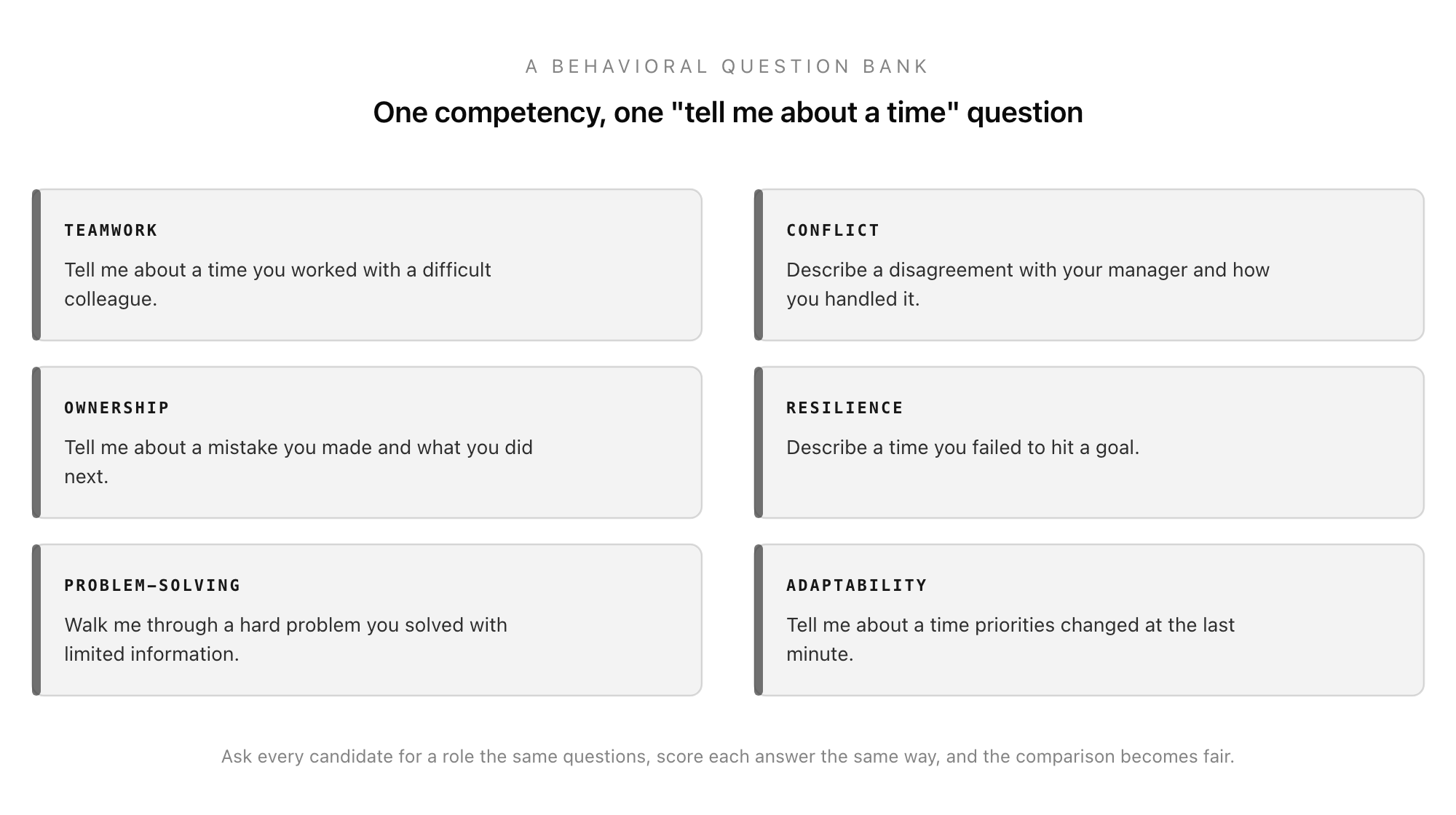
Common competencies and a behavioral question for each:
- Teamwork: "Tell me about a time you worked with a difficult colleague."
- Conflict: "Describe a disagreement with your manager and how you handled it."
- Ownership: "Tell me about a mistake you made and what you did next."
- Resilience: "Describe a time you failed to hit a goal."
- Problem-solving: "Walk me through a hard problem you solved with limited information."
- Adaptability: "Tell me about a time priorities changed at the last minute."
- Leadership: "Tell me about a time you had to influence someone without authority over them."
- Communication: "Describe a time you had to explain something complex to a non-expert."
The point is not the exact wording. It is that you choose deliberately, ask the same questions of every candidate for the role, and score each answer against the same standard. That is the difference between an interview that compares people and one that just collects impressions.
How to Score Answers: The STAR Method
The STAR method is the standard lens for evaluating a behavioral answer, and it doubles as your scoring rubric. STAR stands for Situation, Task, Action, and Result, and a strong answer moves through all four.
- Situation sets the scene: the context, when and where, who was involved. Listen for a real, specific moment rather than a generic "I always..."
- Task is what the candidate was responsible for: the goal, what they were accountable for, what made it hard. Listen for their role, not the whole team's.
- Action is the heart of the answer: the specific steps they took, why they chose them, how they handled obstacles. This is where you listen for "I", not "we". Candidates who only ever say "we" are either modest or hiding a thin individual contribution, and your follow-up question ("What specifically did you do?") is how you find out which.
- Result is the outcome: what happened, the measurable impact, and what they learned. A surprising number of answers trail off before the result, which is itself informative.
The most useful reframe for a new interviewer is this: a missing part of STAR is a scoring signal, not a gap for you to fill in. If a candidate never gets to the Result, do not mentally supply a happy ending. Note it, ask one neutral follow-up, and score what they actually gave you. The STAR structure is what keeps you scoring the evidence rather than your gut feeling about the person.
STAR Method Examples
A weak answer to "Tell me about a time you handled a conflict": "I'm good with people, so I just talk things through and it usually works out." No situation, no specific action, no result. Nothing to score.
A strong answer: "On a launch last year (Situation), I owned the timeline while a designer and I disagreed on scope (Task). I set up a 30-minute call, laid out the trade-offs against the deadline, and proposed cutting one feature to protect the date (Action). We shipped on time and the cut feature went out two weeks later (Result)." That answer has all four parts, uses "I", and ends in a measurable outcome. It scores high not because the story is impressive but because it is complete and specific.
Behavioral vs Situational Questions
The two are often confused. Behavioral questions ask what the candidate did ("Tell me about a time you led a project"). Situational questions ask what they would do ("How would you lead a project that was falling behind?").
Behavioral questions are generally stronger because real history is harder to fabricate than a hypothetical. But situational questions have their place: they are useful for early-career candidates who simply do not have a long track record to draw on, and for probing judgment in scenarios specific to your role. A good loop often uses mostly behavioral questions with one or two situational ones, scored the same structured way. For the broader picture of what to capture after each round, see our guide to the interview feedback form.
Make the Comparison Fair: Score on a Structured Form
All of this falls apart if the scores live in interviewers' heads, Slack threads, and half-remembered hallway conversations. The fix is the same one that makes any hiring step defensible: capture the scores on a shared, structured form, the same one for every candidate.
A good behavioral interview scorecard does three things. It lists the competencies and questions for the role so every interviewer covers the same ground. It gives each answer a rating on a consistent scale (a 1-to-4 scale avoids the fence-sitting middle of a 1-to-5). And it asks for a short STAR-anchored note so the score is backed by evidence rather than a number floating on its own. Done this way, the panel's scores are comparable, the decision is auditable, and a rejected candidate who pushes back meets a clear, consistent record rather than a vibe.
This is exactly what Good Form is built for. You can clone the behavioral interview scorecard template and send it to your panel in minutes: it captures the candidate and role, a rating and STAR-anchored note per competency, and an overall recommendation, so the whole loop scores the same way and the comparison is fair. Pair it with a sharp job description at the top of the funnel and a clean exit interview at the other end, and you have a hiring process that is consistent from first contact to last day. Start with the questions, score them with STAR, and let the form do the remembering.