The best interview questions are not clever brain-teasers or trick questions. They are the ones that reliably tell you whether a candidate can do the job, will work well with your team, and is genuinely motivated to be there, asked the same way of everyone so you can actually compare. If you are the one running the interviews, the hard part is rarely thinking of questions; it is choosing the right set, asking them consistently, and scoring the answers so the decision holds up. This is a recruiter's guide to the best interview questions to ask candidates, organized by category, with the questions you should never ask and a way to keep the whole loop fair.
The single biggest upgrade most teams can make is to stop improvising. A structured interview, where you ask predetermined questions and score them against a rubric, consistently outperforms the free-flowing chat. The questions below are what you put inside that structure. To capture the scoring cleanly as you go, clone the Good Form interview scorecard.
The short version:
- Plan the set before the interview. Pick your questions in advance and ask the same core set of every candidate for the role. That consistency is what makes candidates comparable.
- Move through six categories: warm-up, role and competency, behavioral, situational, culture-add, and their questions for you.
- Behavioral questions are the most predictive. "Tell me about a time you..." beats hypotheticals because past behavior is harder to fake. See our full guide to behavioral interview questions.
- Screening and phone interviews get a shorter set. A few must-haves to filter, not the full loop.
- Know what you cannot ask. Age, race, religion, marital and family status, disability, and similar topics are off-limits and can create legal risk.
- Score as you go. Rate each answer on a consistent scale on a shared scorecard, not from memory after the fact. Clone one here.
Plan the Questions Before the Interview
The best interview is decided before anyone sits down. Start from the role: what are the four or five things a person genuinely must be able to do, and what traits predict success on your team? Write your questions to those, then ask the same core set of every candidate for that role. When everyone answers the same questions, scored the same way, you can compare them fairly. When you wing it, you end up comparing how much you liked chatting with each person, which is exactly where bias creeps in.
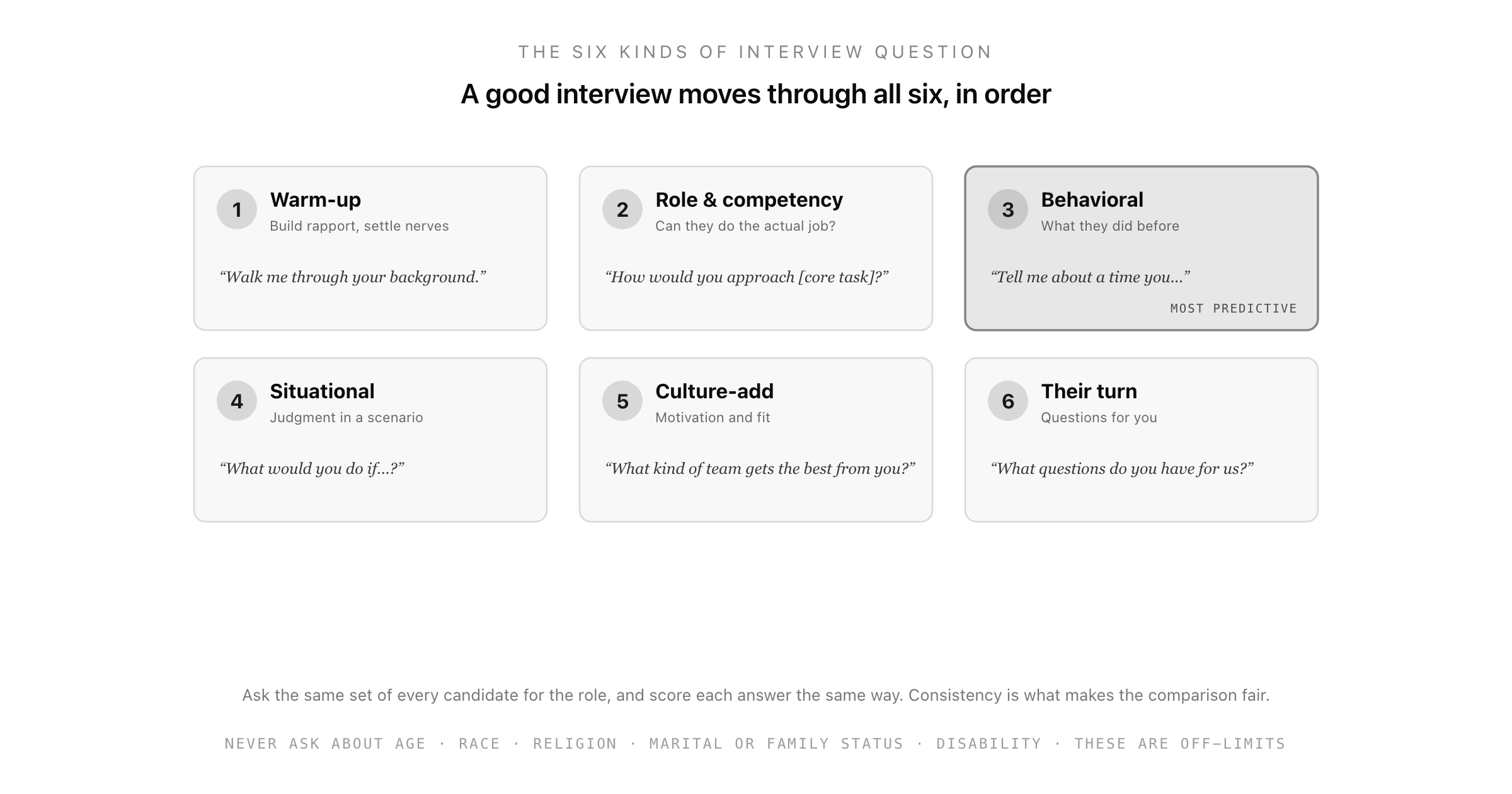
A good interview moves through six categories in roughly this order.
1. Warm-Up Questions
The first few minutes are about settling nerves and getting the candidate talking, not about scoring. A tense candidate underperforms, and you learn less. Keep these light and open.
- "Walk me through your background in your own words."
- "What attracted you to this role?"
- "What does a good day at work look like for you?"
You are listening for how they frame their own story, but mostly you are helping them relax into the conversation.
2. Role and Competency Questions
These get at the core question: can they actually do the job? Tie each one to a real responsibility of the role rather than a generic skill.
- "How would you approach [a specific, common task in this role]?"
- "Walk me through how you would handle [a typical problem this role faces]."
- "What does your process look like for [a key deliverable]?"
- "Which tools or methods do you reach for when [common situation], and why?"
For technical or skills-based roles, this is also where a short practical exercise or work sample fits, which predicts performance better than discussion alone.
3. Behavioral Questions (the Most Predictive)
Behavioral questions ask about real past experiences, because how someone behaved before is the best predictor of how they will behave again. They start with "Tell me about a time you..." and you score the answer with the STAR method (Situation, Task, Action, Result), listening for what the candidate personally did.
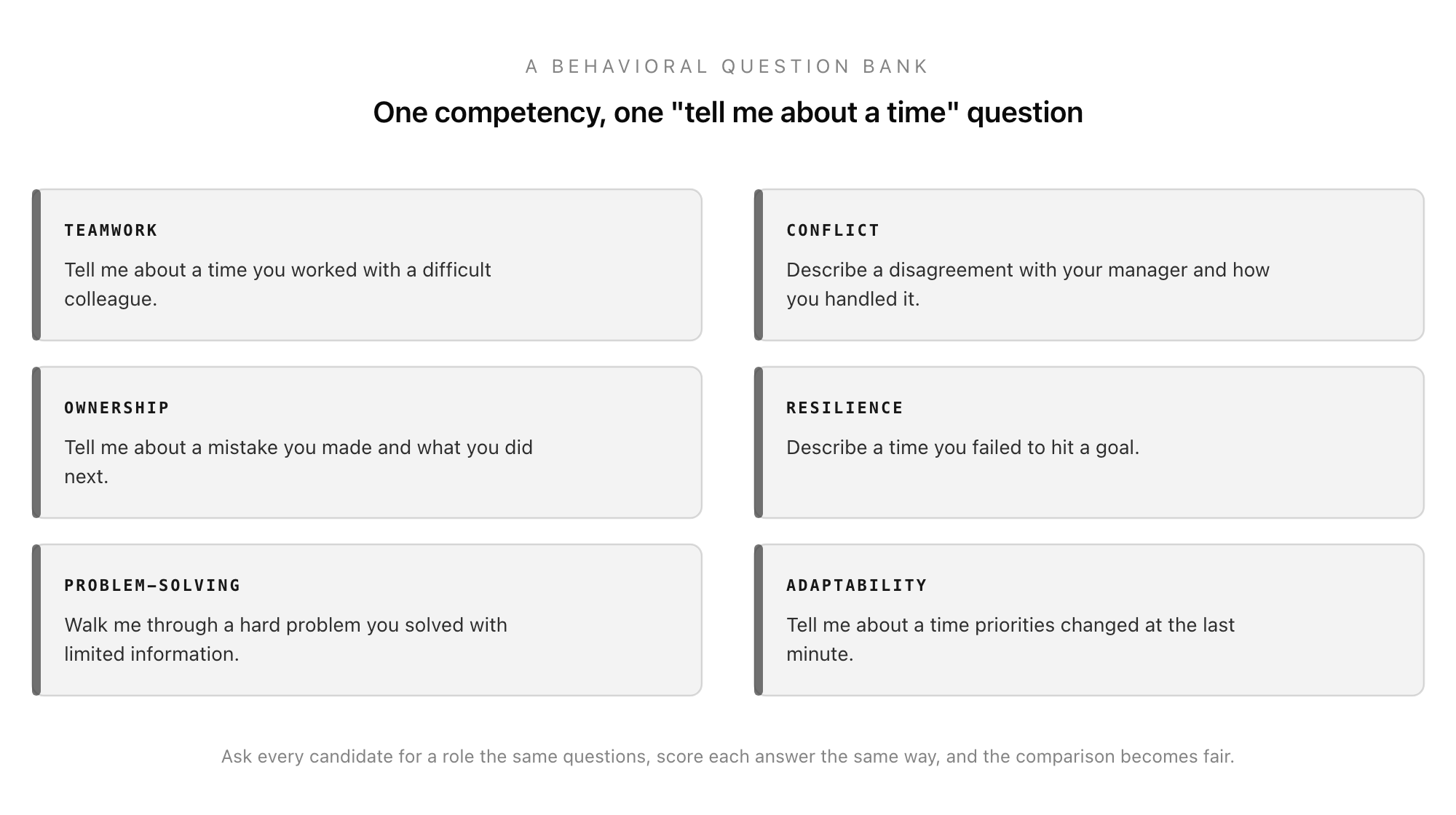
Pick one per competency that matters for the role:
- Teamwork: "Tell me about a time you worked with a difficult colleague."
- Conflict: "Describe a disagreement with your manager and how you handled it."
- Ownership: "Tell me about a mistake you made and what you did next."
- Resilience: "Describe a time you failed to hit a goal."
- Problem-solving: "Walk me through a hard problem you solved with limited information."
- Adaptability: "Tell me about a time priorities changed at the last minute."
For the full method, the scoring rubric, and how to handle vague answers, see our dedicated guide to behavioral interview questions. This is the category to weight most heavily.
4. Situational Questions
Situational questions pose a hypothetical: "What would you do if...?" They are weaker than behavioral questions because they surface a candidate's theory of good behavior rather than their track record, but they are useful for early-career candidates with little history, and for probing judgment in scenarios specific to your role.
- "What would you do if you were given a deadline you knew was unrealistic?"
- "How would you handle a customer who was upset about something that wasn't your fault?"
- "If two priorities conflicted and you couldn't reach your manager, how would you decide?"
Use a couple of these, not a whole interview of them.
5. Culture-Add and Motivation Questions
Notice the framing: culture-add, not culture-fit. "Fit" quietly rewards hiring people like the existing team, which narrows it. "Add" asks what someone brings that the team is missing. These questions get at motivation and how someone works.
- "What kind of team or environment gets the best work out of you?"
- "What are you looking for in your next role that you don't have now?"
- "Tell me about a piece of feedback that changed how you work."
- "What would make this role a great move for you in two years?"
You are listening for genuine motivation and self-awareness, not rehearsed enthusiasm.
6. Their Questions for You
Always leave real time for the candidate's questions, and treat their questions as data. Thoughtful questions about the work, the team, or how success is measured signal genuine interest and seriousness. No questions at all, or only questions about time off, can be telling. It is also simply fair: an interview is a two-way decision.
Screening and Phone Interviews: a Shorter Set
A first-round phone screen is a filter, not the full loop. Its job is to confirm the basics and decide whether to invest in a full interview, so use a short, consistent set:
- "What's prompting you to look for a new role right now?"
- "What are your salary expectations and your notice period?"
- "Which one or two things about this role most interest you?"
- One quick role-relevant must-have: "Do you have experience with [non-negotiable requirement]?"
Keep it to fifteen or twenty minutes and ask every screened candidate the same questions.
The Questions You Must Never Ask
Some questions are not just unhelpful, they are off-limits, because they invite discrimination and create legal risk. Avoid anything that probes:
- Age, date of birth, or graduation years used to infer age
- Race, ethnicity, or national origin
- Religion or religious practices
- Marital or family status, pregnancy, or plans to have children
- Disability or health conditions (you may ask whether someone can perform the job's essential functions, with reasonable accommodation)
- Citizenship beyond confirming they are legally authorized to work
The safe rule: keep every question tied to the candidate's ability to do the job. If a question would not help you predict job performance, do not ask it.
Score the Answers as You Go
The best questions are wasted if the answers live in your memory and a Slack thread afterward. Decide your scale before the interview (a 1-to-4 scale avoids the wishy-washy middle), rate each answer as you go, and jot a short note with a specific quote or example behind the score. Do it on a shared scorecard so every interviewer covers the same ground and the panel's ratings are actually comparable. For more on capturing this well, see our guide to the interview feedback form.
This is exactly what Good Form is built for. Clone the interview scorecard template and send it to your panel: it captures a rating and a note per competency plus an overall recommendation, so the whole loop scores the same way and the decision is fair and defensible. Pair it with a sharp job description up front, ask the same strong questions of everyone, and score as you go. That is the entire recipe for interviews that actually tell you who to hire.