An employee engagement survey is how you find out what your people actually think before they tell you by leaving. Done well, it surfaces the few things that are quietly eroding motivation while you can still fix them, and it tells your team that their experience is taken seriously. Done badly, as a long annual questionnaire that vanishes into a drawer and changes nothing, it does real harm: nothing erodes trust faster than being asked for honest feedback and then watching nothing happen. This is an HR guide to running an employee engagement survey that earns its place: what to measure, the questions to ask, how often to run it, how to get honest answers, and, the part most organisations skip, how to actually act on the results.
The single rule that separates a useful survey from a damaging one: never run a survey you are not prepared to act on. Everything below is in service of that. To get started quickly, you can clone the Good Form employee engagement survey template and send it to your team in minutes.
The short version:
- Engagement is not satisfaction. Satisfaction asks if people are content; engagement asks if they are committed and motivated. Measure the drivers of engagement, not just happiness.
- Measure a few clear drivers: role clarity, recognition, growth, manager support, and belonging, plus an overall eNPS question.
- Keep it short. A focused survey people will actually finish beats a 60-question one they abandon.
- Make it genuinely anonymous, or you will get the answers people think are safe, not the true ones.
- Run a short pulse survey often, and a deeper one less often. Cadence matters more than length.
- Share the results and act on one or two things. A survey you do not act on is worse than no survey. Start with a template.
What Is an Employee Engagement Survey?
An employee engagement survey is a structured set of questions that measures how committed, motivated, and connected your employees feel to their work and the organisation. It is worth being precise about the word, because an engagement survey is not the same as a satisfaction survey. Satisfaction asks whether people are content with their pay, conditions, and perks. Engagement asks something deeper and more predictive: are they motivated, do they put in discretionary effort, do they intend to stay, would they recommend this as a place to work? You can have satisfied employees who are quietly disengaged, coasting and updating their CV, which is exactly why engagement is the better thing to measure.
The reason it matters is practical. Engaged teams are more productive, more innovative, and far less likely to leave, and disengagement shows up in a survey months before it shows up in a resignation letter. The survey is an early-warning system and a steering wheel, but only if the questions measure the right things and the results lead to action.
What to Measure: The Engagement Drivers
A good engagement survey is built around the drivers of engagement, the handful of factors that research and experience repeatedly link to whether people are motivated and committed. Measuring drivers rather than vague mood gives you something you can act on. The core ones:
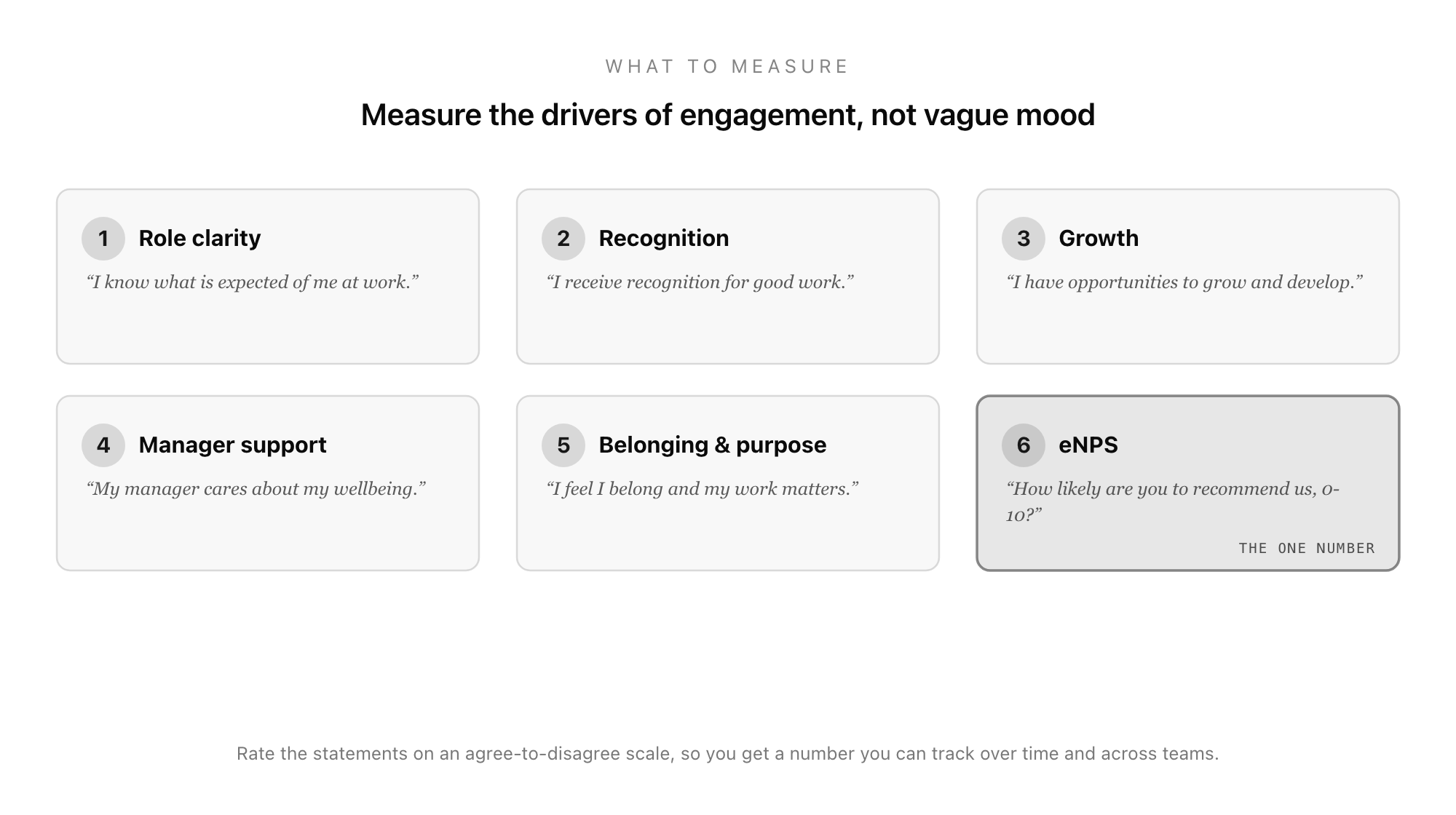
- Role clarity: Do people understand what is expected of them and how their work matters? ("I know what is expected of me at work.")
- Recognition: Does good work get noticed and valued? ("In the last week, I have received recognition for good work.")
- Growth and development: Are people learning and progressing? ("I have opportunities to grow and develop here.")
- Manager support: Do people feel supported by their direct manager? ("My manager genuinely cares about my wellbeing.")
- Belonging and purpose: Do people feel part of something and aligned with its purpose? ("I feel a sense of belonging at work," "I understand how my work contributes to our goals.")
Most strong surveys present these as statements rated on an agree-to-disagree scale (a five-point Likert scale: strongly disagree to strongly agree), because that produces a clear number you can track over time and across teams, rather than free text you cannot compare.
The Questions to Ask
Beyond the driver statements, a few specific question types earn their place.
The eNPS question
The employee Net Promoter Score (eNPS) is the single most useful overall metric: "On a scale of 0 to 10, how likely are you to recommend this organisation as a place to work?" Responses of 9 to 10 are promoters, 7 to 8 are passives, and 0 to 6 are detractors; your eNPS is the percentage of promoters minus the percentage of detractors. It is one number you can track every time you survey, and a falling eNPS is an early alarm worth heeding.
One or two open questions
Numbers tell you what; open text tells you why. Include a small number of open questions, not a wall of them: "What is one thing that would make this a better place to work?" and "What is working well that we should keep doing?" These often surface the specific, fixable issue a rating scale never could.
Keep the whole thing short
The temptation is to ask everything. Resist it. A survey of ten to twenty well-chosen questions that people actually finish thoughtfully beats a sprawling sixty-question one they click through to escape. Length is the enemy of honest, considered answers, and of your response rate.
Annual, or Pulse? Get the Cadence Right
How often you ask matters as much as what you ask. There are two complementary rhythms:
- The deeper survey, once or twice a year. A fuller engagement survey covering all the drivers, used to set a baseline and track the big trends over time.
- The pulse survey, often. A very short pulse survey (a handful of questions, sometimes just one or two) run monthly or quarterly, to catch shifts quickly between the big surveys. A pulse survey trades depth for frequency, and it keeps you from being blindsided in the eleven months between annual surveys.
The best programmes run both: an annual deep-dive for the full picture, and a light pulse in between to stay current. What you must avoid is the once-a-year-and-forget pattern, where the data is stale by the time anyone looks at it.
How to Get Honest Answers
A survey is only as good as the honesty of the answers, and honesty depends almost entirely on whether people feel safe. A few rules:
- Make it genuinely anonymous, and say so clearly. If employees suspect their answers can be traced back to them, they will give you the safe answer, not the true one, and your data becomes a measure of what people think you want to hear. Be careful with demographic filters that can de-anonymise small teams.
- Explain why you are asking and what will happen next. People answer more honestly when they believe it will lead somewhere.
- Time it sensibly. Avoid running it right after a difficult announcement or during the busiest week, when responses will be skewed or rushed.
- Make it easy. A clean, short, mobile-friendly form gets far better response rates than a clunky one, and response rate is itself a signal of engagement.
The Part Everyone Skips: Acting on the Results
This is where most engagement surveys fail, and it is the only part that actually matters. Collecting the data is the easy 20%; the 80% that creates value is what you do next.
- Share the results openly. Tell the team what you heard, including the uncomfortable parts. Hiding the results confirms the cynicism that makes people disengage in the first place.
- Pick one or two things and act. Do not try to fix everything; pick the highest-impact issue the data surfaced and make a visible change. One real improvement does more for trust than a dozen vague promises.
- Close the loop. Tell people what changed because of their feedback, explicitly. "You said X, so we did Y" is the single most powerful message an engagement programme sends, because it proves the survey is not theatre.
A survey you act on builds trust every cycle. A survey you ignore destroys it, and teaches your team that feedback is a formality. There is no neutral option: the act of asking creates an obligation to respond.
Run Your Engagement Survey on One Form
An engagement survey lives or dies on being easy to send, genuinely anonymous, and simple to compare over time. That is exactly what a good form gives you.
This is what Good Form is built for. You can clone the employee engagement survey template and send it to your team in minutes: it covers the core drivers as agree-disagree statements, the eNPS recommendation question, and a couple of open questions, in one clean, mobile-friendly, anonymous form. Because every cycle uses the same questions, you can track your scores over time and across teams and actually see whether the changes you made worked. Pair it with a structured exit interview when people do leave and a strong onboarding form when they arrive, and you have a clear read on the employee experience from first day to last. Ask the right questions, protect the anonymity, and above all, act on what you hear.