An employee write up form is the document that decides, in the moment nobody wants to think about, whether the company can stand behind the next decision it makes about a person's job. Promotion is fun to document. Termination is not. The write up sits between, and it is the single piece of paperwork most small teams either skip or write so badly that it works against them when it matters.
This guide gives you three ready-to-customise employee write up templates (verbal, first written, final written), the six-element spine every disciplinary action form needs, and the one language rule that decides whether the record holds up or hands the dismissed employee a free win at tribunal. The structure is built around the question an employment lawyer will ask when they read the file in week 12: was the conduct described as observable behaviour or as a character judgement, and was the employee given a fair chance to fix it. If you want to skip the reasoning and put the structure on a form your manager and HR lead can co-sign in five minutes, clone the Good Form employee write up template.
The short version:
- A defensible employee write up form has six elements: incident facts, the standard that was missed, corrective action, support offered, a stated next-step consequence, and dual signature with an acknowledgement-of-receipt clause. Missing any one is a litigation risk.
- Three templates cover almost every case: verbal warning (documented), first written warning, and final written warning. Each shares the same spine. The differences are in severity, the consequence stated, and who signs.
- The single biggest mistake is using character language. "Bad attitude", "unprofessional", "lazy" are not facts; they are judgements. They lose at tribunal. Replace every instance with what a camera would have recorded.
- Acknowledgement of receipt is not agreement. Every write up should make this distinction explicit so the employee signs the document even when they disagree with it. A signed-but-disputed write up is still admissible. An unsigned-because-they-refused one is messy.
- Clone the Good Form employee write up template → so each warning is timestamped, structured with the right fields by warning level, and retrievable when HR needs to assemble the record.
What an Employee Write Up Form Actually Is
An employee write up form is a contemporaneous record that a specific incident or pattern of conduct fell short of a stated standard, that the employee was told so in writing on a specific date, that a specific corrective action was set, and that the employee acknowledged receiving the document. It is a piece of evidence, not a piece of feedback.
Three things a write up is not:
- A coaching note. Coaching is forward-looking, two-way, and assumes the employee is meeting the standard. A write up is backward-looking, one-way (in tone, not in process), and assumes the standard has been missed. Mixing the two produces a document that does not coach and does not document.
- A surprise. By the time HR is producing a written warning, the employee should already have heard, in a previous conversation, that the issue exists. The write up is the formalisation of a conversation that has already happened. If the document is the first the employee is hearing of the gap, the timeline is wrong.
- A character assessment. This is the failure mode most small companies do not realise they have until the file is sitting in front of an employment lawyer. "Sarah has a bad attitude" is not a write up. "On 3 April 2026 in the Tuesday standup, Sarah said the words 'this is a stupid project and I do not see why we are doing it' in front of four colleagues" is a write up. The first is an opinion. The second is evidence.
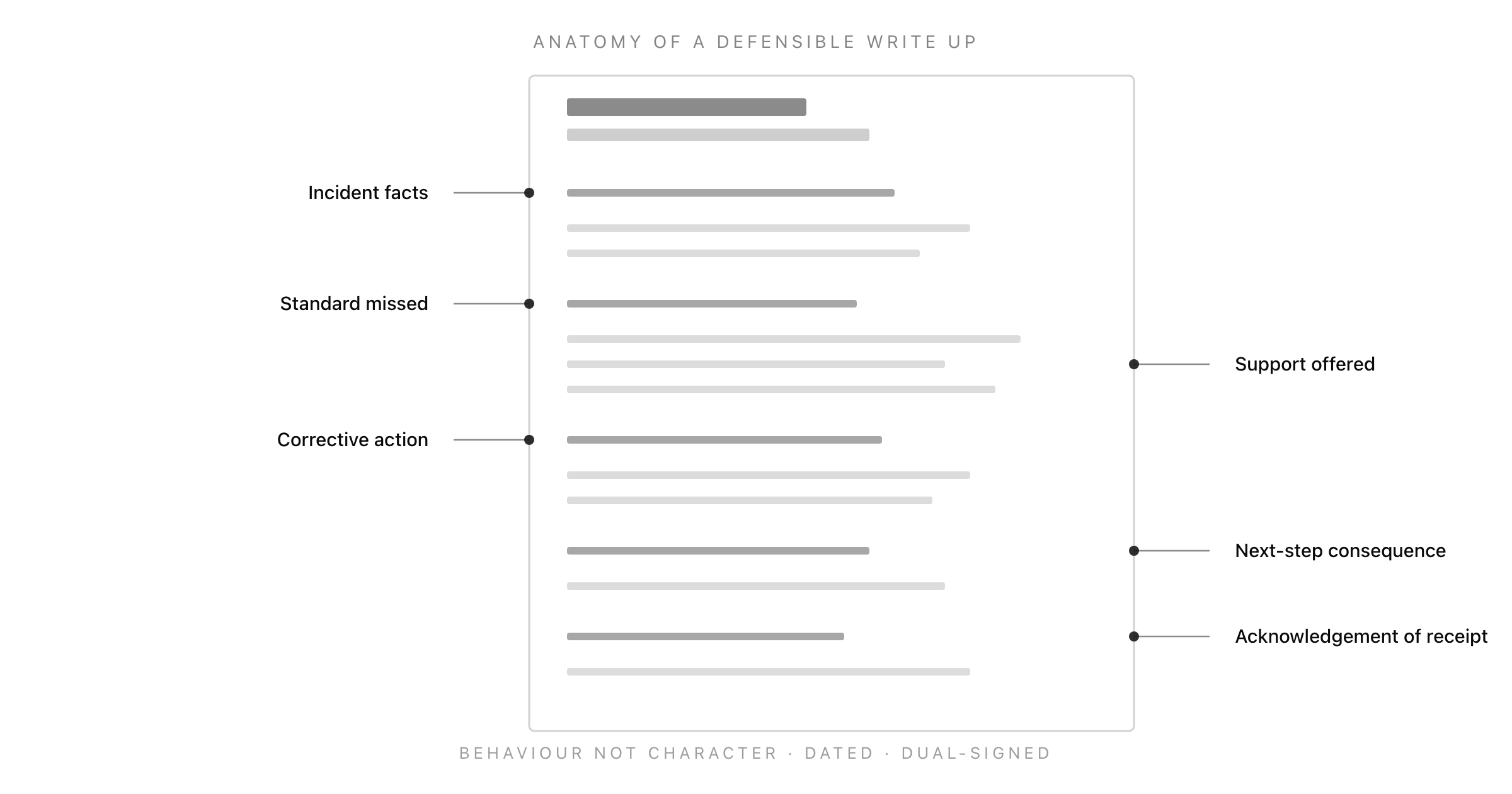
What a write up is: a dated, factual, time-bound document that records (a) what specifically happened, (b) what standard was missed, (c) what corrective action is required, (d) what support the company will provide, (e) what the next-step consequence is if the issue continues, and (f) that the employee received the document. Done well, a write up either resolves the issue or produces the documented chain that defends a fair-dismissal decision later. Done badly it neither corrects the behaviour nor protects the company.
The Six Elements Every Disciplinary Action Form Needs
Every defensible disciplinary action form, regardless of warning level, contains the same six elements. The differences between verbal, first written, and final written are in the severity, who co-signs, and what the stated consequence is. The structure does not change.
1. Incident Facts
Three to six bulleted items. Each item names a date, a time or shift if relevant, what was said or done, and any direct consequence. No adjectives. No characterisation. No history beyond the period under review.
This is the section managers most often fudge. The temptation is to write "consistent pattern of lateness" instead of listing five specific dates the employee was late and by how many minutes. The general statement is the one a tribunal contests. The list is the one a tribunal accepts.
Bad: "Mark has been showing up late and missing important meetings." Good: "On 14 April, 16 April, 21 April, 22 April, and 28 April 2026, Mark arrived between 23 and 41 minutes after his contracted 9:00 am start. On 16 April he missed the 9:30 am client review with [Client]. On 22 April he missed the standup the new joiner was told to attend on his first day."
The incident facts section is also where contemporaneous records matter. A meeting that happened but was not written up at the time is weaker evidence than a Slack message at 4:47 pm on the day. This is why structured 1:1 records and the Good Form employee write up template have value beyond the conversation itself: they create the paper trail before anyone needs it.
2. The Standard That Was Missed
One paragraph. States the policy, role description, or previously communicated expectation that the employee's behaviour fell short of, and where that standard is documented.
If the standard cannot be quoted from a written source, it has to be quoted from a previous conversation, and that conversation has to have a date. "We have always expected punctuality" is not a standard. "The handbook section 3.2 'Working Hours' states that scheduled start times are not flexible without prior approval, and Mark was reminded of this in his 11 March 2026 1:1" is a standard.
The test for whether the standard is documented well enough to support the write up: would a stranger reading only the written warning template and the cited source be able to identify what the employee was supposed to do. If not, the standard is too vague.
3. Corrective Action
Specific, observable, time-bound. What change is expected, by when, and how it will be measured. Each corrective action has a metric, a target, and a deadline.
Bad: "Improve attendance." Better: "Arrive on time." Good: "Arrive at the contracted 9:00 am start time on every scheduled shift for the next 30 days, with any variance pre-approved by Mark's manager at least 24 hours in advance."
Three is a typical number of corrective actions. One is sometimes enough for a single-issue write up. More than five is too many for the employee to focus on, and the warning becomes diluted.
4. Support, Training, or Resources
This is the section that decides, more than any other, whether the employee can credibly say "I was not given a chance". Naming the support the company will offer (a coaching session, a revised schedule, a mentor, a training module, an EAP referral) closes that off. Leaving the section blank invites the argument.
Support does not have to be expensive. The point is to demonstrate the company tried to fix the problem, not just to document it.
5. The Stated Next-Step Consequence
One sentence. What happens if the issue continues, in plain words. This is the section managers most often soften, and it is the section a tribunal looks at hardest.
A first written warning that says "if the issue continues, further action may be taken" tells the employee almost nothing. A first written warning that says "if any one of the corrective actions above is missed in the next 30 days, this will progress to a final written warning" tells them exactly what is at stake. The second is what makes the warning a warning. The first is what makes it advice.
For a final written warning, the consequence is termination. Say so. The whole point of the final written is that the employee is given one more chance with the explicit knowledge that the next step is dismissal. If the document does not say "termination of employment", the chance has not been given.
6. Acknowledgement of Receipt and Dual Signature
The employee signs. The manager signs. For a final written, HR co-signs. The signature line includes a clause that distinguishes acknowledgement of receipt from agreement with the contents. Like this:
"I acknowledge receipt of this employee write up form. Acknowledgement of receipt is not agreement with the contents; it confirms the conversation occurred and the document was provided."
That sentence is the difference between a write up an employee will sign and a write up an employee will refuse to sign. Most refusals come from people who think signing means agreeing. Once the form makes clear it does not, almost everyone signs. And a signed-but-disputed write up is still admissible. The employee can append a written response. The record stands.
The Three Employee Write Up Templates
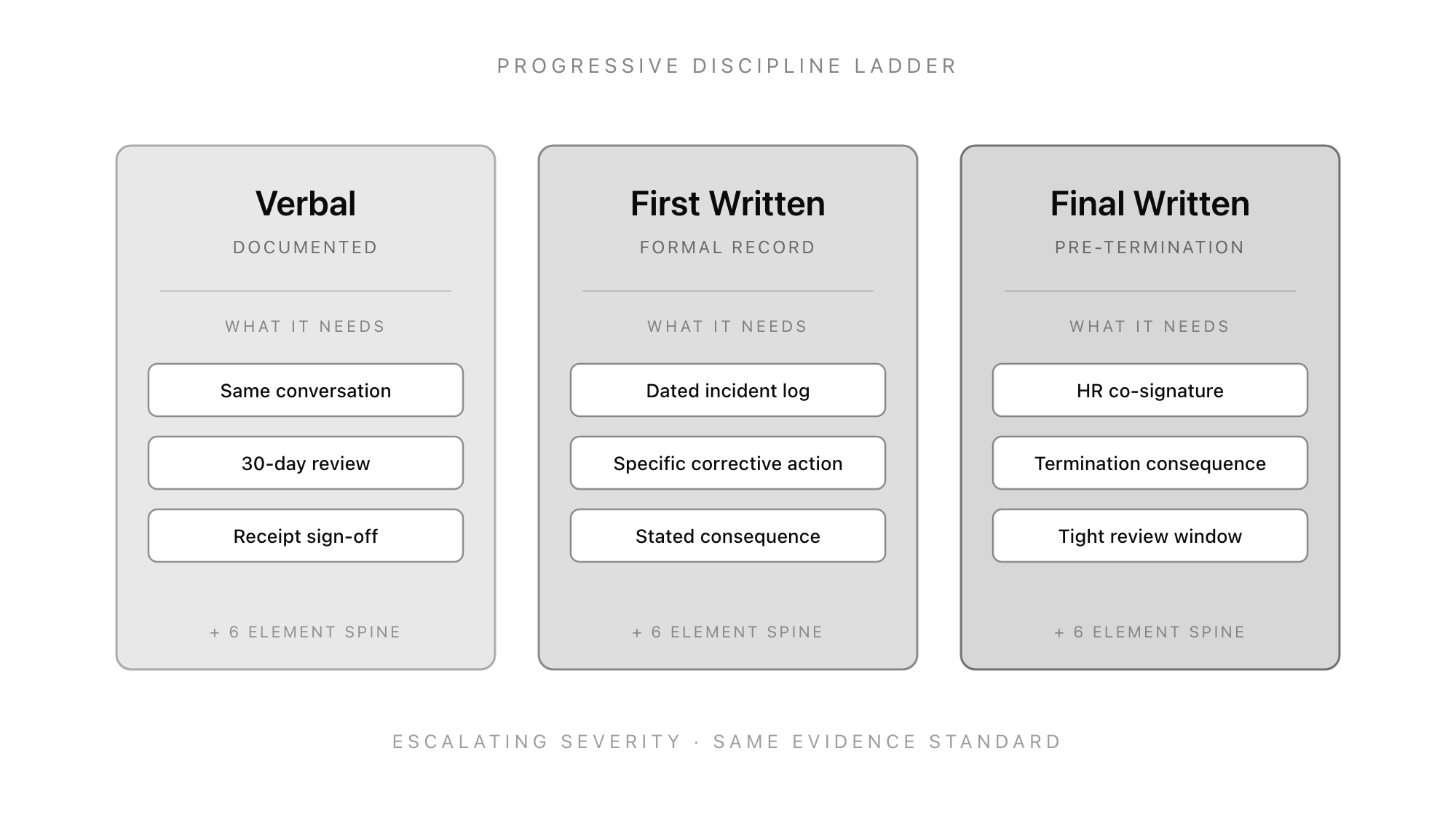
The three warning levels are not three different forms. They are the same form with the severity, signatures, and consequence calibrated to the stage. Use the same structure across all three so the file reads as a chain.
Template 1: Verbal Warning (Documented)
Use for: a single first incident, or a low-severity pattern that has not been addressed before.
Tone: a conversation that was had and recorded. The verbal warning is still written down on the form. The "verbal" part means it was delivered face to face. The form documents that the conversation took place.
Cadence: same day as the conversation. Do not let a verbal warning sit for two weeks before being written up. The contemporaneous nature of the record is most of the point.
Consequence: typically "if the issue continues, this will progress to a first written warning". The 30-day review window is short because the verbal warning is the cheapest stage at which to fix the issue.
Who signs: employee and manager. HR is informed but does not need to be present.
Template 2: First Written Warning
Use for: a repeat of a verbal-warning issue inside its review window, a single incident of moderate severity, or a pattern that has been informally raised before but not formally documented.
Tone: formal record. The first written warning is what HR will pull out 6 months later if a second incident occurs. The language has to be tight enough that 6 months later it still reads as fact.
Cadence: same day or next-day delivery. Sit-down meeting, ideally with HR present. Form provided in the meeting and signed in the meeting if possible.
Consequence: typically "if any one of the corrective actions above is missed in the next 30 to 60 days, this will progress to a final written warning". State the timeline. Open-ended warnings are weak warnings.
Who signs: employee, manager, and ideally HR as witness.
Template 3: Final Written Warning
Use for: a repeat of a first-written-warning issue inside its review window, or a single incident severe enough to skip first-written (gross misconduct in some jurisdictions allows this; check the law where you are).
Tone: pre-termination. The final written warning is the document that, if termination follows, will sit at the top of the tribunal bundle. Every word has to survive that reading.
Cadence: same day. HR present. Often immediately after an investigation meeting.
Consequence: termination of employment. Say so explicitly. "If [the corrective action] is not met by [date], your employment will be terminated." The whole point of the final written stage is that the employee has been told, on a dated piece of paper that they signed, exactly what the next step is.
Who signs: employee, manager, and HR (always).
The Behaviour-Not-Character Rule
The single most common reason employee write up forms fail in legal review is character language. A write up is a record of what someone did. It is not a record of who someone is.
This is not a stylistic preference. It is a legal mechanic. Adjectives describing a person ("disrespectful", "unprofessional", "rude", "lazy", "negative") are subjective. Two people in the same room can disagree about whether someone was being disrespectful. Two people in the same room cannot disagree about what specifically was said.
The rewriting rule is simple: write what a camera would have recorded. If you cannot describe the behaviour without using a judgement word, you have not yet identified what the actual behaviour was, and the write up is premature.
A few before-and-afters from real corrective action forms:
| Character language | Behaviour language |
|---|---|
| "Has a bad attitude in meetings." | "On 3 April in the standup, said 'this is a stupid project and I do not see why we are doing it' in front of four colleagues. On 9 April, sighed audibly and rolled eyes when [Manager] asked for a status update." |
| "Is unprofessional with clients." | "On the 7 April call with [Client], used the phrase 'that is not my problem' twice in response to a request for a delivery update. The client raised this with their account manager the next day." |
| "Is not a team player." | "On the 12 April collaborative document, removed two sections written by [Colleague] without notifying them. On 18 April, did not respond to three Slack messages from [Colleague] over four days asking for input on the shared deliverable." |
| "Has poor communication." | "On 5 April, did not reply to the client's deadline-clarification email for 6 days. On 11 April, told the team in standup that the deadline was 'sometime next week' when the client had requested 14 April." |
The rewritten version is longer. That is the point. Detail is what makes the record stick. A four-word characterisation can be argued away. A dated, specific incident cannot.
When to Skip Levels (and When Not To)
Most progressive discipline policies move through verbal → first written → final written → termination. Most jurisdictions allow skipping levels for sufficiently severe single incidents (theft, violence, harassment, gross safety breaches, gross insubordination). The condition for skipping is that the policy must say so, and the incident must be severe enough that any reasonable employer would have moved straight to the higher stage.
Skipping levels for non-gross-misconduct issues is the single fastest way to lose a tribunal. If the company's own policy describes a four-stage process and the file shows three stages or two, the dismissal is, in tribunal language, procedurally unfair.
The rule of thumb is this: if the incident is not severe enough that the dismissed employee's lawyer would say "yes, of course that warranted skipping levels", do not skip levels. Run the full ladder.
What an Employee Write Up Form Does Not Do
Three things a write up does not, on its own, accomplish:
- It does not protect the company from a discrimination claim. A perfectly written disciplinary record can still be evidence in a discrimination case if the same conduct from a different demographic was not written up. Consistency across the workforce is the safeguard, not the form itself.
- It does not replace the conversation. A write up that lands in the employee's inbox without a meeting first is a worse legal record than the same write up delivered in a meeting and signed in the room. The form documents the conversation; it does not substitute for it.
- It does not, by itself, justify termination. Three written warnings on file are part of the case for fair dismissal. They are not the whole case. The decision to terminate has its own meeting, its own form (see the employee termination form), and its own evidence chain. The write ups are inputs into that decision, not a substitute for it.
For where the write up sits in the larger disciplinary cascade, the performance improvement plan template guide covers the longer-form structured improvement plan that often follows a final written warning, and the employee termination form guide covers the separation packet that follows when the chain reaches its end.
Get the Template Live in Five Minutes
Every section above maps to a field on the Good Form employee write up template. Warning level (verbal / first written / final written), issue category, incident date, the standard missed, prior conversations, corrective action, support and resources, the review date, the stated next-step consequence, employee response, and the dual-signature acknowledgement-of-receipt clause are all there. Customise the wording for your handbook, send a private link to the manager, and the warning is dated, structured, and retrievable from the moment it is issued.
Clone the Good Form employee write up template →. The first form is free.