A termination form is the document that closes the employment relationship without leaving anything dangling. When it works, the final paycheck lands on the right day, the laptop comes back in working order, the COBRA notice goes out within the legal window, and nobody calls a lawyer six weeks later. When it does not work, payroll is short on a final-paycheck calculation, the ex-employee is locked out of email but still has a company laptop on their kitchen table, and the conversation that should have been a clean exit becomes a regulatory complaint.
This guide gives you a drop-in employee termination form, the four termination types it has to handle (voluntary resignation, involuntary, layoff, and mutual separation), the supporting termination letter for each, and the final-paycheck, COBRA, and property-return workflow that has to fire alongside it. If you want to skip the reasoning and put the form in front of a manager today, clone the Good Form employee termination template and customise it in five minutes.
The short version:
- A working termination form has twelve fields: employee identity, hire date, termination type, effective last day, final paycheck date and method, accrued PTO payout, equipment return checklist, COBRA or benefits transition, confidentiality acknowledgement, exit interview eligibility, and manager plus HR signatures. Anything fewer and HR is filling gaps from memory.
- Four termination types share the same spine: voluntary (resignation or retirement), involuntary (performance or conduct), layoff or reduction in force, and mutual or fixed-term contract end. Each type changes two or three fields, not the whole form.
- The termination letter is a separate document from the form, but they ship together. The letter states the decision, the effective date, the final-pay terms, and the post-employment obligations. Three short templates cover almost every situation.
- Final paycheck timing is the field most teams get wrong. Some states require same-day payment for involuntary terminations; others allow next-cycle. Always check the state rule and pre-fill the form with the correct deadline.
- Clone the Good Form employee termination template so the separation is documented, signed, and routed to payroll, IT, and benefits in one step instead of as five separate emails that arrive in a different order than they were sent.
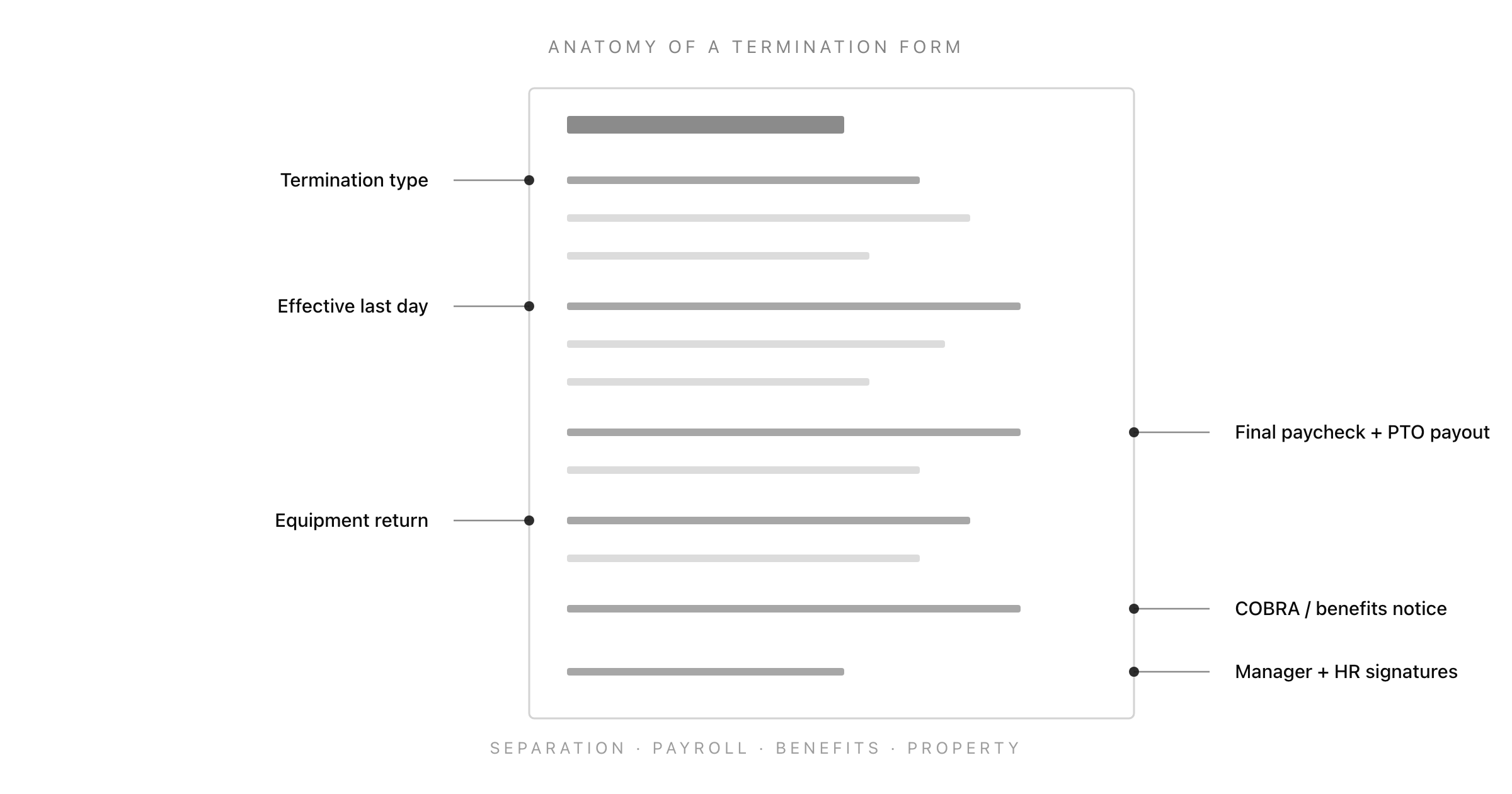
What an Employee Termination Form Actually Is
An employee termination form is the structured record that closes the employment relationship. It captures who is leaving, why, when, what they are owed, what they have to return, and what continues to bind them after the last day. It is the trigger document for payroll, IT, and benefits, and it is the artefact a future regulator or attorney will ask to see if the separation is ever questioned.
The four things a termination form is not:
- A firing decision. The decision happens before the form. By the time the form is filled in, the conversation has already been had. The form documents the decision, it does not make it.
- A termination letter. The form is structured data: fields, dates, checkboxes, signatures. The letter is prose, addressed to the employee, restating the decision in their language. Both are needed; they are different documents.
- An exit interview. The exit interview is a separate, optional, often async survey about why the employee is leaving and what should change. Conflating it with the termination form is a common mistake; it pollutes the legal record with unstructured opinion.
- A severance agreement. Severance is a contract with consideration on both sides. If severance is being paid, that is a separate agreement with its own signature flow, often with a 21- or 45-day review window depending on the employee's age and the jurisdiction.
What a termination form is: a single, signed, dated record of the separation that triggers everything downstream of it. Payroll uses it to schedule the final check. IT uses it to time the access revocation. Benefits uses it to fire the COBRA notice. HR uses it as the canonical record if anyone asks what happened. One form, multiple downstream workflows, all keyed off the same effective date.
The Twelve-Field Termination Form Spine
Every working termination form contains the same twelve fields. The differences between voluntary, involuntary, layoff, and mutual-separation versions are in two or three fields, not in the structure.
1. Employee Identity (Name, ID, Title, Department, Manager)
Five fields, all required except employee ID (which depends on whether your HR system uses one). The manager field is non-negotiable: most internal escalation flows route off it, and some state mandates require the immediate supervisor to be named on the separation record.
2. Hire Date
A date field. Required. Hire date drives length-of-service calculations for severance, accrued-PTO payout, and (in the US) ACA reporting for the year of separation. If hire date is missing from the form, every downstream calculation has to look it up separately.
3. Termination Type
A select field with seven options: voluntary resignation, involuntary (performance), involuntary (conduct), layoff or reduction in force, mutual separation, end of fixed-term contract, retirement.
This is the most important field on the form. The type drives the letter, the final-paycheck timing, the eligibility for unemployment benefits, the eligibility for severance, and the level of detail required in the reason summary. Keeping conduct and performance separated inside "involuntary" matters: many jurisdictions limit unemployment claims after conduct terminations but not after performance ones.
4. Effective Last Day of Work
A date field. Required. The single most consequential date on the form. Almost every downstream calculation keys off it: final paycheck date, benefits end date, COBRA election window start, equipment return deadline. If the effective date is wrong, every downstream artefact is wrong.
For voluntary resignations, this is typically the date the employee specifies in their resignation letter, subject to the company's notice-period policy. For involuntary terminations, it is typically the date of the termination meeting. For layoffs, federal WARN Act rules require 60 days' advance notice for covered employers (100+ employees), so the effective date should account for that window.
5. Final Paycheck Date
A date field. Required. The date the final paycheck will land in the employee's account.
This is where state law matters more than internal policy. Some states (California, Massachusetts, Colorado, others) require the final paycheck to be issued at the time of involuntary termination, on the same day. Other states allow next-regular-cycle payment. A handful require payment within 72 hours. The form should pre-fill the correct date based on the termination type and the employee's state of work, not the employer's HQ state.
6. Final Paycheck Method
A select field. Required. Four options: direct deposit (using the existing account on file), paper check at the last meeting, paper check mailed and dated, or same-day pay where state-mandated.
The default for voluntary separations is direct deposit. The default for involuntary terminations in same-day-pay states is a paper check handed over at the termination meeting. Mailing the final paycheck to the last-known address is acceptable only if the employee is no longer present and the local statute permits it.
7. Accrued PTO Payout
A number field, in hours. Optional only because some jurisdictions and some company policies do not require PTO payout on separation; in many US states it is mandatory. The form should calculate the dollar payout from the hours and the employee's regular rate, but the captured field is hours so payroll can verify the math.
The trap: forfeiture clauses. Some company policies forfeit accrued PTO on involuntary termination for cause. Some state laws override the company policy and require payout regardless. The form should flag the case where the policy and the law disagree, and HR should resolve it before the final check is cut.
8. Equipment Return Checklist
A multi-select field. Required. Standard options: laptop, monitor, peripherals, headset, mobile device, building or office key, access badge, credit or expense card, other property, or "no equipment issued".
Pair the checklist with a confirmation checkbox: "equipment has been returned in working order, or arrangements for return have been documented". The "arrangements documented" branch matters for remote employees who need a return shipping label, and it gives the form a defensible record if equipment is never returned.
9. Benefits Transition (COBRA or Equivalent Notice)
A select field. Required. Four options covering the standard cases: COBRA notice within 14 days, coverage continues to month-end with COBRA scheduled, not eligible (no group health), or state-continuation coverage applies.
The 14-day window is federal: the COBRA notice has to be sent within 14 days of the qualifying event for plans subject to it (most employer-sponsored group health plans for employers with 20+ employees). Smaller employers or fully insured plans may be subject to state mini-COBRA rules with different windows. The form does not have to interpret the rule; it has to flag the case so benefits can fire the right notice.
10. Confidentiality and IP Acknowledgement
A required checkbox. The clause confirms the employee understands their continued obligations under any signed confidentiality agreement, IP-assignment agreement, or non-solicit. The form does not re-litigate the agreements; it acknowledges they remain in force after the last day.
This field is the one most informal separation processes skip, and it is the one that becomes load-bearing if the ex-employee later starts a competing business or contacts the company's customers. A signed acknowledgement on the termination form is much harder to dispute than a verbal "we discussed it".
11. Exit Interview Eligibility
A select field. Optional. Four options: scheduled (date and link sent), async form sent, declined by employee, or not offered (typically for involuntary conduct cases).
Exit interviews are useful for voluntary separations and largely irrelevant for involuntary ones. The form should default the field based on the termination type, not require the manager to remember the policy. For the voluntary cases, the exit interview form is a separate document the employee fills in at their pace.
12. Manager and HR Signatures
Two name fields, two date fields. Required. Both signatures are required for the form to be considered complete. The manager signature confirms the operational facts of the separation (last day, equipment, role transition). The HR signature confirms the compliance facts (final-pay timing, COBRA scheduling, agreement acknowledgement).
A termination form signed by only one party is a draft, not a record.
The Four Termination Types and What Each One Changes
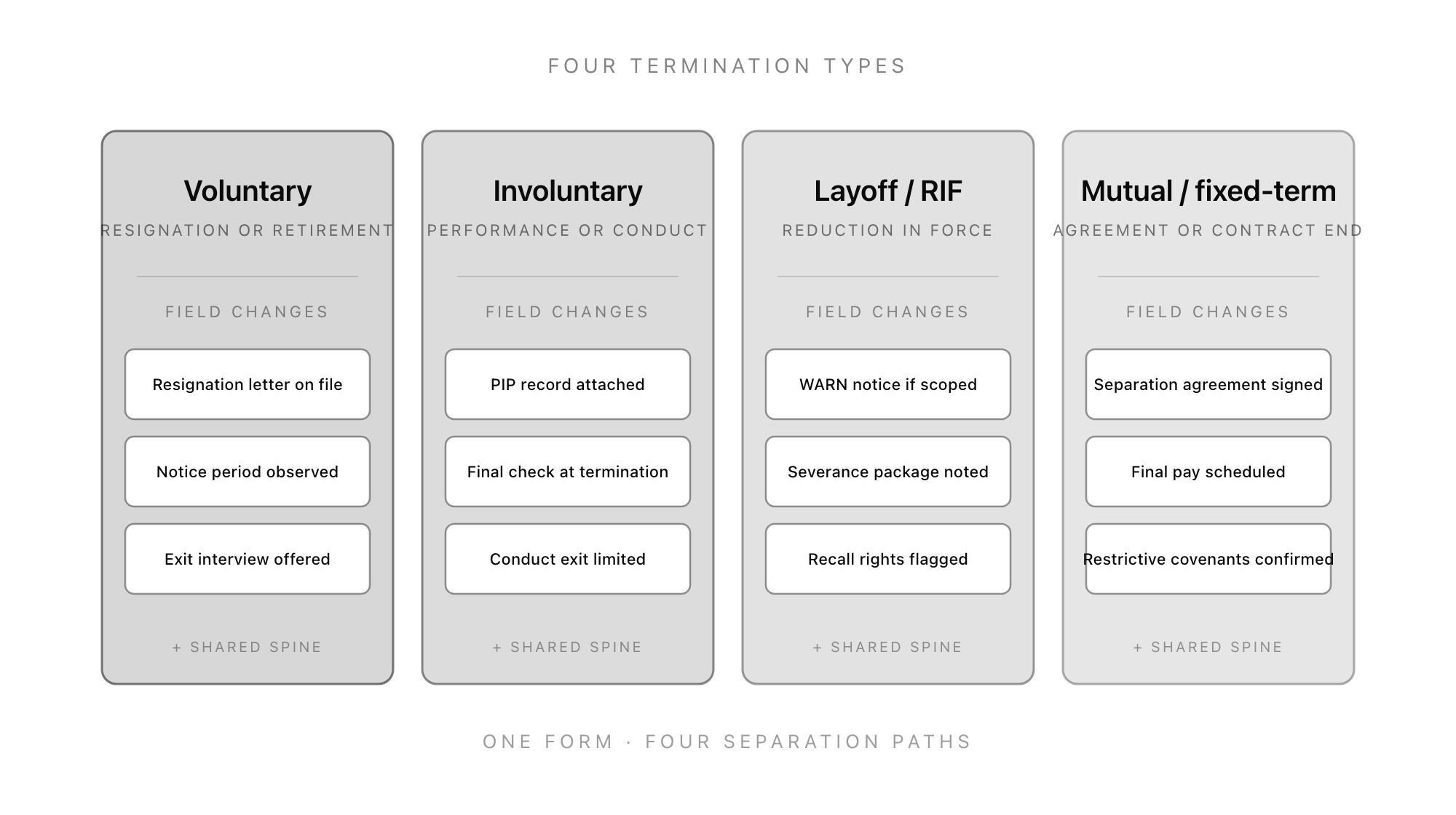
The same twelve-field spine handles voluntary resignations, involuntary terminations, layoffs, and mutual separations. What changes between them is two or three field defaults and the supporting documentation, not the form itself.
Voluntary Resignation or Retirement
The employee initiates the separation. The form should default to: notice period observed (usually 2 weeks), final pay on next regular cycle, exit interview offered, equipment returned by last day, COBRA notice in standard window. The supporting document is the employee's resignation letter, which goes into the file alongside the form.
Involuntary (Performance or Conduct)
The employer initiates the separation. The form should default to: notice period waived, final pay at termination (depending on state), exit interview not offered for conduct cases, equipment returned at the termination meeting, COBRA notice triggered immediately. The supporting documentation is the performance improvement plan record for performance cases or the conduct investigation summary for conduct cases. Without one of those, an involuntary termination is much harder to defend if challenged.
Layoff or Reduction in Force
The employer initiates a non-cause separation, often as part of a group reduction. The form should default to: WARN Act notice referenced for covered employers and group sizes, severance package documented (if offered), recall rights flagged (if applicable), final pay on next regular cycle, COBRA notice in standard window. Severance and recall rights are the fields that distinguish a layoff from any other involuntary separation; both have to be captured at the time of separation, not negotiated after.
Mutual Separation or Fixed-Term Contract End
Both parties agree to end the relationship, or a fixed-term contract reaches its end date. The form should default to: separation agreement on file, final pay scheduled, restrictive covenants explicitly confirmed (because the negotiated nature of mutual separations sometimes means standard restrictive covenants are modified). The supporting document is the separation agreement itself, which is a contract with its own consideration and signing flow.
The Termination Letter That Goes With the Form
The termination form is structured data. The termination letter is prose, addressed to the employee, that restates the decision in their language. They ship together, but they serve different audiences. Three short letter templates cover almost every situation.
Voluntary resignation acceptance letter. Confirms receipt of the resignation, restates the agreed last day, names the final-pay process and amount, lists what equipment is to be returned and by when, references the continuing confidentiality and IP obligations, and offers the exit interview link. Three to four short paragraphs is enough.
Involuntary termination letter. States the decision and the effective date in the first line. Names the final-pay terms and the date the final paycheck will be issued. References the COBRA notice that will be sent separately. Lists the equipment to be returned and the return method. References any continuing obligations (confidentiality, non-solicit). Avoids re-litigating the reasons; the reasons live in the manager's documentation, not in the letter. Three to four short paragraphs.
Layoff notice letter. States that the role is being eliminated and the effective date. Names the severance package (if any), the COBRA terms, and any extended benefits. Lists recall rights if applicable. Names the outplacement support if offered. Acknowledges the contribution. Avoids any language that turns the layoff into a performance critique; layoffs are role decisions, not employee decisions.
All three letters share the same backbone: decision, date, money, property, post-employment obligations, signature line. The decision and the date come first because everything downstream keys off them.
Common Mistakes (and How to Avoid Them)
A short list of mistakes that show up across small HR teams' termination processes.
- Letting the form be filled in after the meeting from memory. Drafting the form in advance and signing it during or immediately after the termination meeting catches more errors than retrospective filling. Names get spelled wrong, dates get nudged, equipment gets missed.
- Defaulting the final-pay date to the next regular payroll cycle without checking the state rule. Several US states require same-day payment for involuntary terminations. The form should pre-fill the correct date based on the employee's state of work, and HR should override only with documented reason.
- Skipping the confidentiality acknowledgement. The single most common omission. The acknowledgement is a one-checkbox addition that becomes load-bearing if the ex-employee starts a competing venture. Always require it, even for voluntary separations.
- Combining the form, the letter, and the exit interview into one document. Three different audiences, three different purposes, three different retention timelines. Keeping them separate makes each one more defensible.
- Forgetting the equipment return checklist for remote employees. Remote workers often have a laptop, a monitor, a headset, and various peripherals scattered across home offices. A checklist plus a return shipping label sent at the termination meeting collects almost everything; relying on the employee to remember does not.
- Treating involuntary conduct cases the same as performance cases. Conduct terminations have different unemployment-benefits implications, different references-policy treatment, and a different supporting documentation requirement. The form has to flag which one.
- Missing the COBRA notice deadline. Federal law allows 14 days from the qualifying event. The form's "termination type" plus "effective last day" together are what should trigger the benefits team's COBRA workflow; if the termination form lives only in HR and never reaches benefits, the deadline gets missed.
- No signature workflow. A typed name field is enough for most jurisdictions, but the form has to capture both manager and HR signatures with timestamps. A form signed by only one party is not a record.
The Bottom Line
A termination form is a small piece of HR infrastructure that becomes invisible when it works and very visible when it does not. The shape of the form is straightforward: twelve fields, one of four termination types, one signed letter alongside it, one workflow that fires payroll, IT, and benefits off the same effective date.
Most teams under-engineer this. They write a one-page memo, hand it to the employee, and treat the rest as ad-hoc emails between HR, payroll, and IT. That works until something is missed: a final paycheck cut on the wrong date, a COBRA notice sent on day 16, a laptop never returned, a non-solicit obligation never acknowledged. Each of those is the kind of small omission that becomes a real problem two months later.
If you want the form in production today, clone the Good Form employee termination template and customise the equipment list and the benefits-transition options to match your stack. If you want to see how the same approach applies to other HR forms, the employee onboarding form, the PTO request form, the exit interview questions, and the performance improvement plan template all use the same shape: a small set of well-shaped fields, one decision, and a paper trail that holds up.
Ending the relationship cleanly is the last reciprocal promise an employer makes to an employee. It deserves a form that respects that.