IRS Form 4868 is the one-page form that buys you more time to file your tax return. Its full name is the "Application for Automatic Extension of Time To File U.S. Individual Income Tax Return," and the word that does the heavy lifting in that title is automatic: you do not need a reason, an excuse, or the IRS's permission. File it by the April deadline and your filing date moves out six months, to October 15. That is the whole job of Form 4868, and it is genuinely useful when your paperwork is not ready in time.
The trap is in the word the form does not say. A tax extension is an extension of time to file, not an extension of time to pay. This is the 2026 walkthrough of the IRS form 4868 for anyone who needs more time: what the extension actually buys, when it is due, the line-by-line, the penalty math that explains why filing late is so much worse than paying late, and the three ways to file it. If you want a clean way to gather the numbers before you submit, clone the Good Form 4868 intake template.
The short version:
- Form 4868 is automatic. File it by the April deadline and your return is not due until October 15. No reason required.
- It extends filing, not paying. Your tax bill is still due in April. The extension does nothing to push back what you owe.
- Estimate, subtract, pay. Line 4 is your estimated total tax, Line 5 is what you have already paid, and Line 7 is the balance you send with the extension.
- The two penalties are different sizes. The failure-to-file penalty is 5% per month. The failure-to-pay penalty is 0.5% per month. Form 4868 removes the big one; it does not touch the small one.
- Paying online can be the whole filing. Make a payment through IRS Direct Pay and mark it as an extension payment, and the IRS files your extension for you. No separate form.
- Some people already have one. US citizens and residents out of the country on the due date, and military members in a combat zone, get extra time automatically.
- State extensions are separate. A federal Form 4868 does not extend your state return unless your state explicitly says it does.
What Form 4868 Actually Does (and the One Thing It Does Not)
Form 4868 does exactly one thing: it moves the date by which you have to file your federal income tax return from the April deadline to October 15. That is a real and valuable extension. If you are waiting on a late Schedule K-1, a corrected 1099, a tax document from a brokerage, or simply the time to do the return properly, filing an extension is far smarter than rushing a wrong return or filing nothing at all.
What it does not do is give you more time to pay. The IRS treats the date your tax is due and the date your return is due as two separate things. The extension moves the second one. The first one, the date your payment is due, stays put on the April deadline no matter what. This is the single most misunderstood fact about the tax extension, and it is the source of almost every nasty surprise people get in October.
So the correct way to think about Form 4868 is this: it is permission to send your paperwork late, on the condition that you still estimate and pay your bill on time. The form is built around that idea. Three of its seven main lines exist purely to work out how much you should pay now.
When Is the Tax Extension Due, and How Long Does It Last?
Form 4868 has to be filed by the original due date of your return, which is the April deadline (April 15 in most years, shifting to the next business day when the 15th falls on a weekend or holiday). You cannot file an extension after the deadline has passed; once you are late, the failure-to-file penalty is already running and an extension cannot reach back to stop it.
Once accepted, the extension runs for six months, which puts your new filing deadline at October 15 (again, shifting to the next business day if that date is a weekend or holiday). There is no second extension beyond that for most individual filers. October 15 is a hard wall.
That answers the two questions people search for most. When is the tax extension due? By the April filing deadline, the same day your return would otherwise be due. How long is a tax extension? Six months, ending October 15. It is automatic for that full period, so there is no partial extension and no need to ask for a specific length.
Form 4868 Line by Line
Form 4868 is one of the shortest forms the IRS publishes. It has two parts, and almost all the work is in five numbered lines.
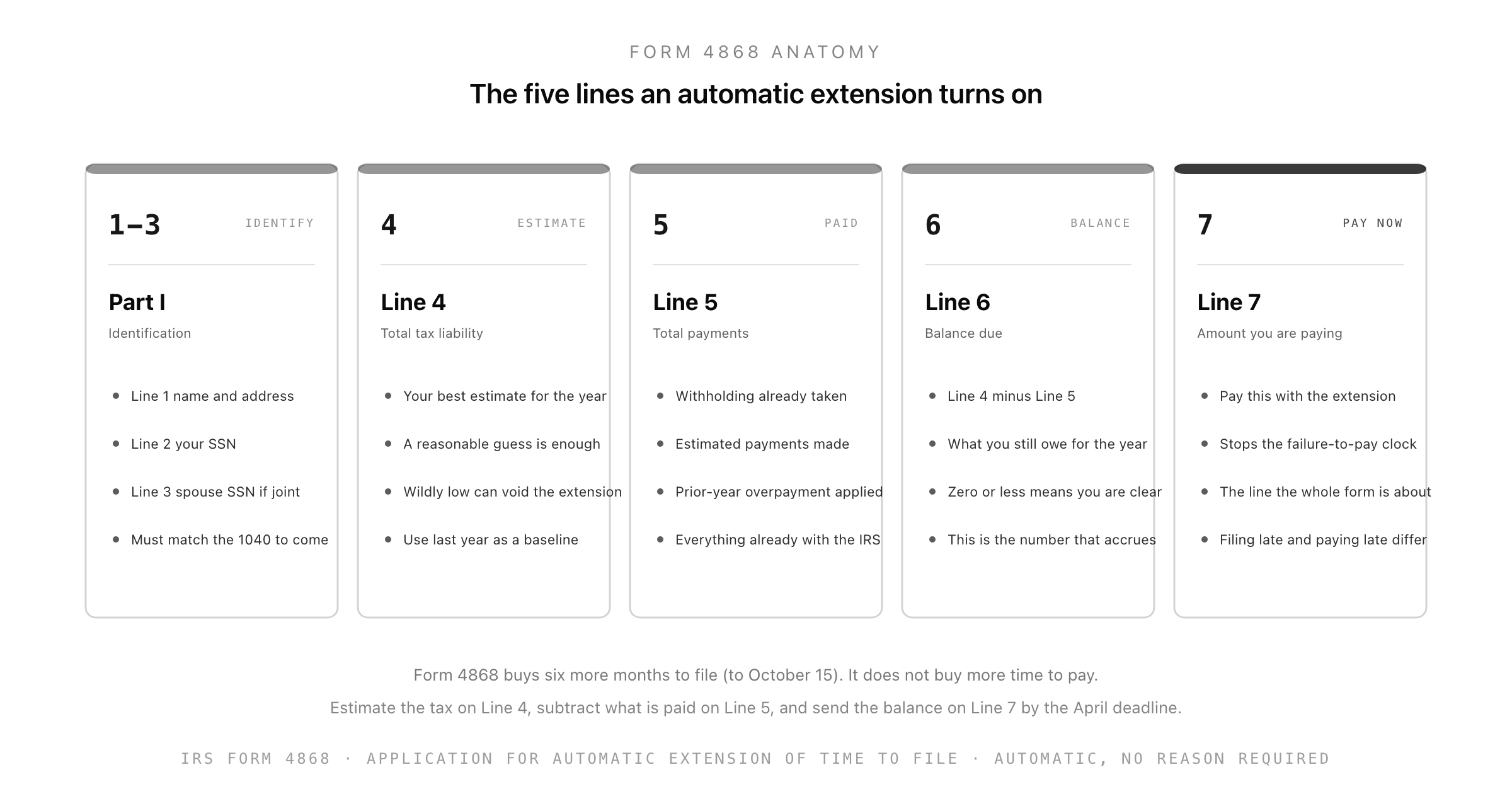
Part I, Identification (Lines 1 to 3). Your name and address on Line 1, your Social Security Number on Line 2, and your spouse's SSN on Line 3 if you are filing a joint return. ITIN holders enter their W-7 number where the SSN goes. These have to match the return you will eventually file, because that is how the IRS connects the extension to the right account.
Line 4, Estimate of total tax liability. This is your best honest estimate of the total tax you will owe for the whole year. It does not have to be exact, and you will not be punished for an estimate that turns out slightly off. What you cannot do is enter a figure with no reasonable basis, because a wildly low number entered just to reduce the apparent balance can invalidate the extension entirely. The easiest reliable baseline is last year's total tax, adjusted for anything you know has changed.
Line 5, Total payments. Everything already in the IRS's hands for this tax year: federal income tax withheld from your paychecks, any quarterly estimated payments you made, and any prior-year refund you chose to apply forward. Add it all up.
Line 6, Balance due. Line 4 minus Line 5. This is what you still owe for the year, and it is the number that accrues penalties and interest if it is not paid by April. If Line 6 is zero or negative, you are already paid up; the extension simply buys you filing time and there is no penalty exposure at all.
Line 7, Amount you are paying. The amount you are sending with the extension. Ideally this equals Line 6, so you walk into October owing nothing. Paying what you can here is the entire point of the exercise, because it is what stops the failure-to-pay clock and the interest. Lines 8 and 9 are simple checkboxes for taxpayers who are out of the country or filing Form 1040-NR.
The Penalty Math: Why Filing Late Costs Far More Than Paying Late
Here is the part that turns the abstract "file, not pay" warning into real money. The IRS charges two completely separate penalties, and they are wildly different in size.
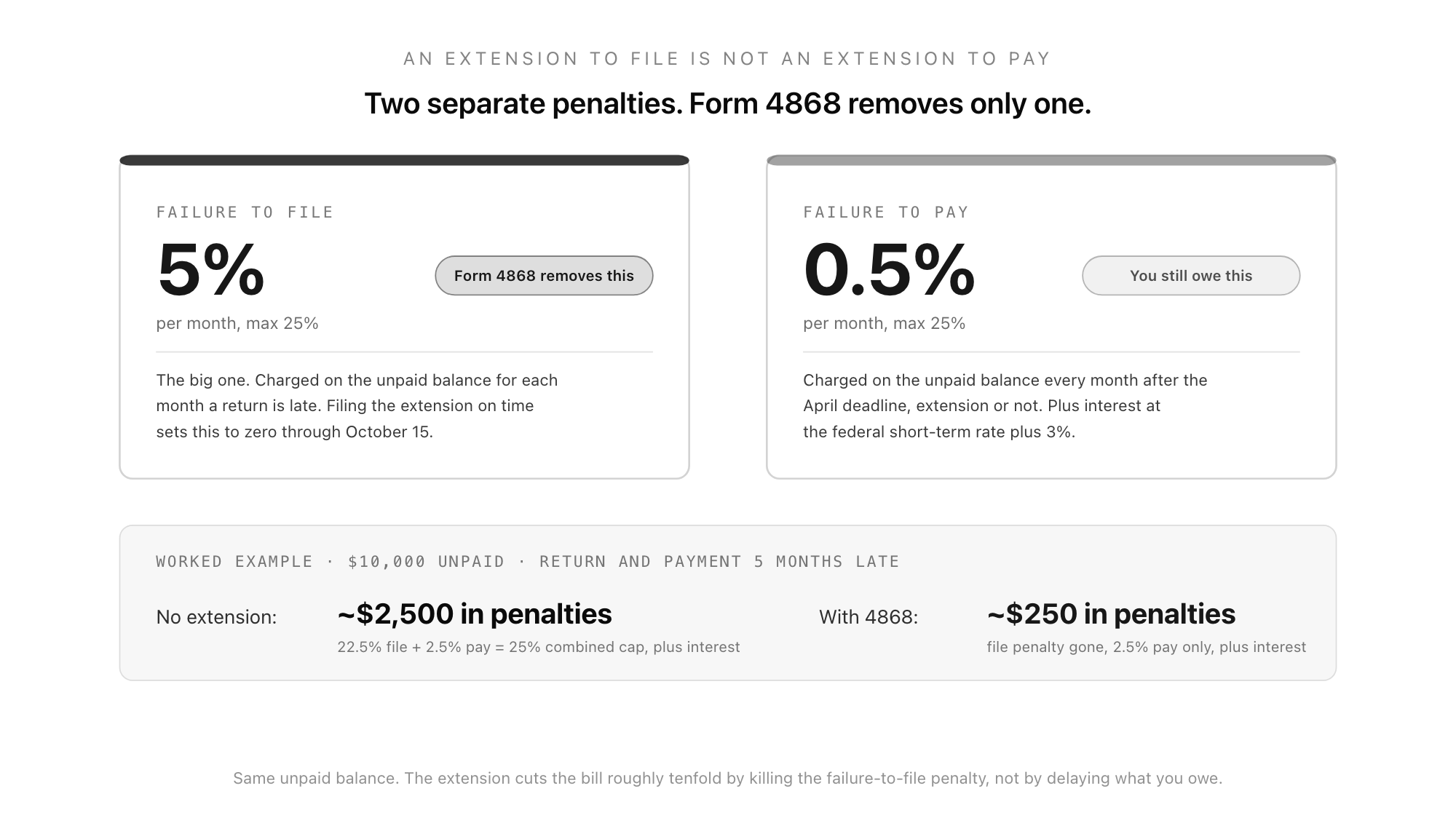
The failure-to-file penalty is 5% of the unpaid tax for each month your return is late, up to a maximum of 25%. This is the big one, and it is exactly the penalty Form 4868 removes. File the extension on time and this penalty cannot start until after October 15.
The failure-to-pay penalty is 0.5% of the unpaid tax per month, also capped at 25%, plus interest at the federal short-term rate plus 3%. This one runs from the April deadline regardless of any extension. Form 4868 does nothing to stop it.
The two are ten times apart in monthly rate, and that gap is the whole reason filing an extension matters even when you cannot pay in full. Take $10,000 of unpaid tax, with the return and the payment both five months late. Without an extension, the failure-to-file penalty dominates and the combined penalties hit the 25% cap, roughly $2,500 plus interest. With Form 4868 filed on time, the failure-to-file penalty is gone, leaving only the 0.5% per month failure-to-pay penalty, roughly $250 plus interest. Same unpaid balance, same five months late, and the extension cut the penalty bill by about ninety percent.
The lesson is blunt: even if you have no money to pay, file the extension anyway. It is free, it is automatic, and it removes the most expensive penalty the IRS can charge you. Then pay as much as you can, as soon as you can, to chip away at the smaller penalty and the interest.
Three Ways to File Form 4868
You have three routes, and one of them does not involve filling out the form at all.
1. Pay online and let the payment be the extension. This is the cleanest option. Make a payment through IRS Direct Pay, the Electronic Federal Tax Payment System, or by card, and mark it as an extension payment. The IRS treats that payment as your Form 4868 and files the extension automatically. You get a confirmation number and you never touch the paper form. If you owe anything, this route handles the payment and the extension in one step.
2. E-file the form. IRS Free File lets anyone e-file Form 4868 for free regardless of income, and every major tax software package can file it for you. E-filing gives you an electronic acknowledgment that the extension was received, which is worth having if there is ever a dispute about whether you filed on time.
3. Mail the paper form. You can still print Form 4868 and mail it to the address listed in the instructions for your state. If you go this way, the postmark date is what counts, so mail it well before the deadline and consider certified mail for proof. Include a check if you are paying by mail.
For most people, paying online and marking it as an extension is the fastest and safest path. It collapses two tasks into one and gives you a record of both.
Who Already Has an Extension Without Filing Anything
A few groups get extra time automatically and do not need to file Form 4868 at all, though filing it does no harm.
US citizens and resident aliens who are living and working outside the country on the regular due date get an automatic two-month extension to file and pay, to mid-June. Members of the military serving in a combat zone get a longer automatic extension tied to their service. And when the IRS issues disaster relief for a federally declared disaster area, affected taxpayers usually get postponed deadlines automatically based on their address, with no form required.
If you fall into one of these groups and still need time beyond the automatic window, you file Form 4868 to reach the October 15 date like everyone else. The checkboxes on Lines 8 and 9 of the form are there precisely to flag the out-of-country and 1040-NR situations.
Common Mistakes (and the State Extension Trap)
A handful of errors account for most of the trouble people get into with extensions.
Treating the extension as a payment delay. By far the most common and the most expensive. The extension moves your filing date, not your payment date. If you owe, estimate it and pay it in April.
Filing the extension late. An extension only works if it is filed by the original deadline. Once you are past April, the failure-to-file penalty is already running and there is nothing Form 4868 can do.
Entering a nonsense estimate on Line 4. A reasonable estimate is fine; a number with no basis is not. An estimate the IRS considers unreasonable can void the extension and expose you to the full failure-to-file penalty as if you never filed.
Forgetting the state return. This is the trap that catches people who do everything right federally. A federal Form 4868 does not automatically extend your state income tax return. Some states grant an automatic state extension when you have a valid federal one; others require their own separate extension form; and a few, like California, give an automatic filing extension but still expect payment by the original date. Check your state's specific rule before you assume you are covered. Searching for your state plus "tax extension" will get you the right answer quickly.
File the Extension, Then Build the Form That Collects the Numbers
If you are a preparer, a bookkeeper, or a small firm handling extensions for clients, the slow part is never the form itself. It is chasing each client for the estimate of tax, the payments already made, and the balance to send. Form 4868 takes two minutes once you have those three numbers, and forever once you do not.
That is the gap a good intake form closes. With Good Form, you can stand up a clean, shareable Form 4868 intake template that walks each client through their identification, their estimated total tax, their payments to date, and the amount they want to pay with the extension, so the numbers arrive structured and ready to file. It sits naturally alongside the rest of your federal-form workflow, from the W-9 you collect from contractors to the 1099-NEC you issue them at year end.
The extension is the easy, free, automatic part. The hard part is gathering the data, and that is exactly what a form is for. Create your free Good Form account and build the intake once, so every April the only thing left to do is file.