A grievance is a formal complaint an employee raises about something at work they believe is wrong or unfair. It might be about treatment by a manager or colleague, pay, working conditions, bullying, discrimination, or a breach of their contract. Every employer gets them eventually, and how you handle one says a great deal about the organisation: a grievance dealt with fairly and quickly can resolve a problem and rebuild trust, while one that is ignored, mishandled, or rushed can escalate into a resignation, a tribunal claim, or a wider breakdown in morale. This is a guide to what a grievance means at work, the procedure for handling one step by step, and how to keep the whole process fair and defensible.
The single most important principle: handle every grievance through the same consistent, documented procedure. Fairness is not just about reaching the right answer; it is about following a process that is, and is seen to be, even-handed. To capture a grievance cleanly from the start, you can clone the Good Form employee grievance form.
The short version:
- A grievance is a formal complaint about a work-related problem, raised by an employee who wants it addressed.
- Try to resolve it informally first. Many grievances can be settled by a conversation before they ever become formal.
- A formal grievance should be put in writing, setting out what happened and what resolution the employee is seeking.
- Hold a grievance meeting to hear the complaint, and let the employee be accompanied.
- Give a written outcome, explain the decision, and offer a right of appeal.
- Document every step and apply the procedure consistently. Start with a grievance form.
What Is a Grievance? The Meaning at Work
In a workplace context, a grievance is a formal complaint raised by an employee about something they believe is wrong, unfair, or in breach of their rights at work. The word can sound vague, so it helps to be concrete about what it covers. Common grievances include:
- Treatment: bullying, harassment, or unfair treatment by a manager or colleague.
- Discrimination: being treated less favourably because of a protected characteristic such as age, sex, race, religion, or disability.
- Terms and conditions: disputes about pay, hours, holiday, or a change to the contract.
- Working environment: health and safety concerns, or workload and working conditions.
- Organisational decisions: how a process such as a promotion, a rota, or a disciplinary was handled.
A grievance is, in effect, the mirror image of a disciplinary: a disciplinary is the employer raising a concern about an employee, while a grievance is the employee raising a concern about the employer or workplace. Both are forms of employee relations, and both demand a fair, consistent process. A grievance is not the same as everyday feedback or a passing complaint; it is a formal request to have a problem investigated and addressed.
The Grievance Procedure, Step by Step
Most organisations should follow a clear grievance procedure, and in many places following a fair process is not just good practice but carries legal weight (in the UK, for example, the ACAS Code of Practice sets the expected standard, and failing to follow it can increase tribunal awards). The procedure moves from informal to formal.
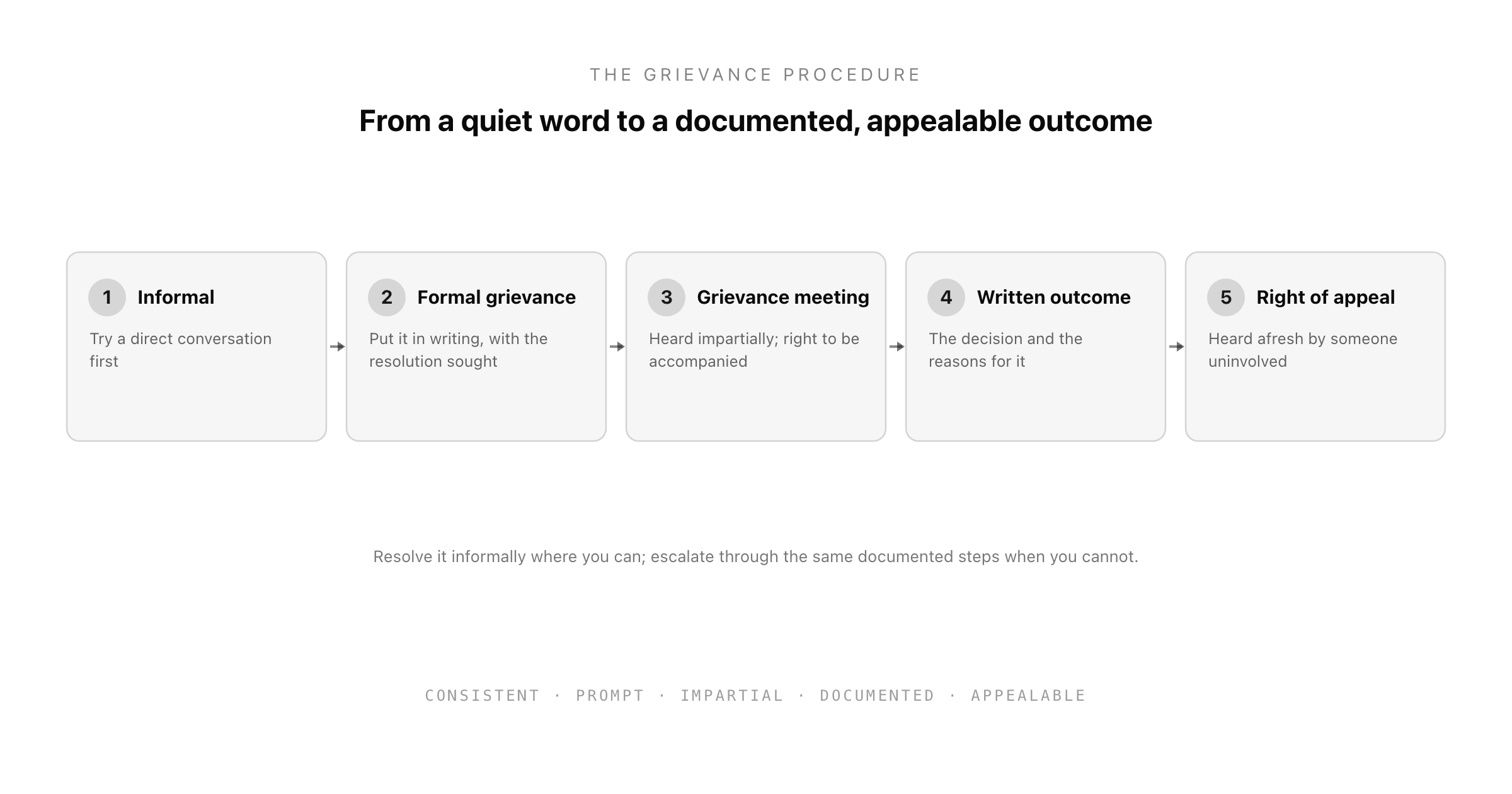
1. Raise it informally first
Many grievances can and should be resolved informally, through a direct conversation between the employee and their manager, before anything formal begins. A quiet word often fixes a misunderstanding faster and with less damage than a formal process. The formal route exists for when the informal one fails or the matter is too serious for it.
2. The formal written grievance
If the informal route does not resolve it, the employee raises a formal grievance in writing. This should set out clearly what the complaint is, the relevant facts and dates, who is involved, and, importantly, what resolution the employee is looking for. Putting it in writing is what turns a vague sense of unfairness into something specific that can actually be investigated and answered.
3. The grievance meeting
The employer arranges a grievance meeting (sometimes called a hearing) without unreasonable delay, to let the employee explain their complaint and respond to it. Two things matter here: the employee usually has the right to be accompanied by a colleague or trade union representative, and the person hearing the grievance should be impartial, ideally not the person the complaint is about. The meeting is for understanding the grievance fully, not for deciding on the spot.
4. The investigation and written outcome
The employer investigates as needed (gathering facts, speaking to anyone involved) and then gives the employee a written outcome: the decision, the reasons for it, and any action that will be taken. Even when a grievance is not upheld, explaining clearly why is part of a fair process.
5. The right of appeal
Finally, the employee must be given the right to appeal if they are unhappy with the outcome. The appeal should ideally be heard by someone not previously involved, who looks at the matter afresh. The right of appeal is a core part of what makes the procedure fair, and skipping it is one of the most common ways a process goes wrong.
What a Fair Grievance Process Looks Like
The steps are the skeleton; fairness is what makes the procedure actually work. A few principles run through the whole thing.
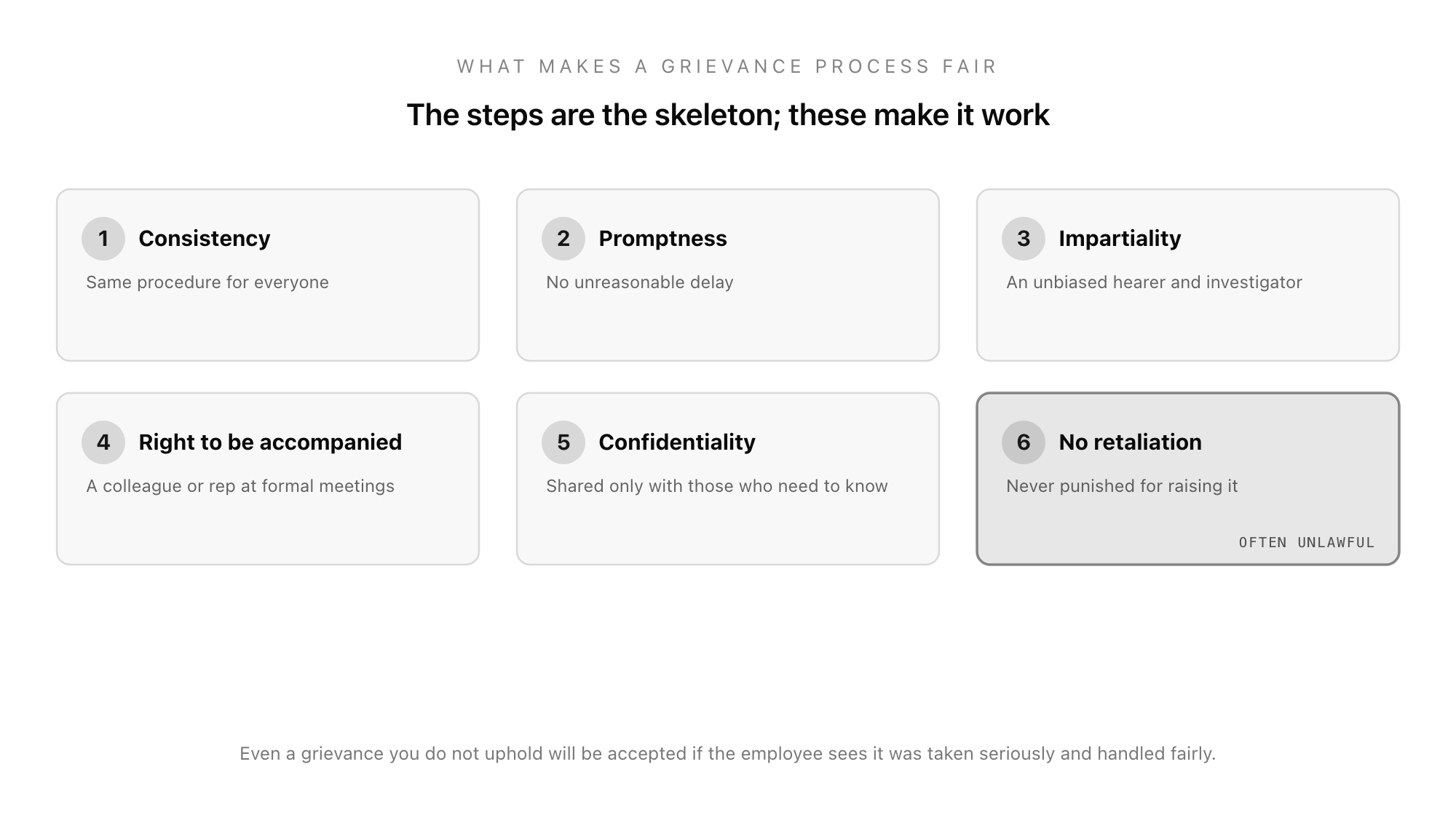
- Consistency. Apply the same procedure to every grievance, regardless of who raises it. Inconsistency is where claims of unfairness take root.
- Promptness. Deal with grievances without unreasonable delay. Letting one sit makes everything worse and signals that the complaint does not matter.
- Impartiality. The person hearing and investigating should be unbiased and, wherever possible, not the subject of the complaint.
- The right to be accompanied. Let the employee bring a colleague or representative to formal meetings.
- Confidentiality. Handle the grievance and its details discreetly, sharing only with those who need to know.
- No retaliation. An employee must never be punished for raising a grievance in good faith. Retaliation is not only unfair, it is often unlawful in its own right, and it turns one problem into a much bigger one.
Get these right and even a grievance you ultimately do not uphold will be seen as having been taken seriously, which is often what an aggrieved employee most wants.
Common Mistakes to Avoid
A few failures account for most grievance processes that go wrong:
- Ignoring it or dragging it out. Delay is the single most common and most damaging mistake.
- Letting the wrong person handle it. Having the subject of the complaint hear their own grievance destroys trust instantly.
- Skipping the written record. If it is not documented, it did not happen, as far as a tribunal is concerned. Record each step.
- No appeal. Denying a right of appeal undermines the whole process.
- Inconsistency. Handling similar grievances differently is how an unfairness claim is built.
Capture and Track Grievances on One Form
A grievance process falls apart when the original complaint lives in an email, the meeting notes are on someone's notepad, and the outcome is a verbal "we looked into it." The fix is the same one that makes any employee-relations process defensible: capture the grievance and every step on a consistent, structured record.
This is exactly what Good Form is built for. You can clone the employee grievance form and have employees raise grievances through it: it captures who is raising it, the nature and details of the complaint, who is involved, the dates, whether informal resolution was attempted, and the resolution they are seeking, all in one clear place from the start. Because every grievance comes in through the same form, you have a consistent record to investigate from and a defensible trail if the matter ever escalates. Pair it with a fair disciplinary and write-up process on the other side of employee relations and a clear incident report form for workplace events, and you have the whole employee-relations picture documented and consistent. Take every grievance seriously, follow the same procedure, and write it all down.