An incident report form is the document that decides, twelve weeks after a workplace event, whether the company can defend the decisions it made in the first hour. Lift-truck collision, a punch thrown in the breakroom, a chemical splash, a stairwell that nearly broke an ankle but did not, a laptop that walked out of the office on a Friday night. Each of these is a different kind of incident, and each needs the same kind of evidence. The companies that get this right do not write longer reports. They write tighter ones, in a structure that survives an HSE visit, an OSHA recordkeeping audit, an employment tribunal, or an insurance claim.
This guide gives you three ready-to-customise incident report templates (safety, behavioural, near-miss), the eight-element spine that every defensible workplace incident report form needs, and the one language rule that decides whether the record holds up or undoes the company's position. The structure assumes a small team without a full safety department, where the manager who writes the report is also the manager who responded to the incident. If you want to skip the reasoning and put the structure on a form your team can co-sign in five minutes, clone the Good Form workplace incident report template.
The short version:
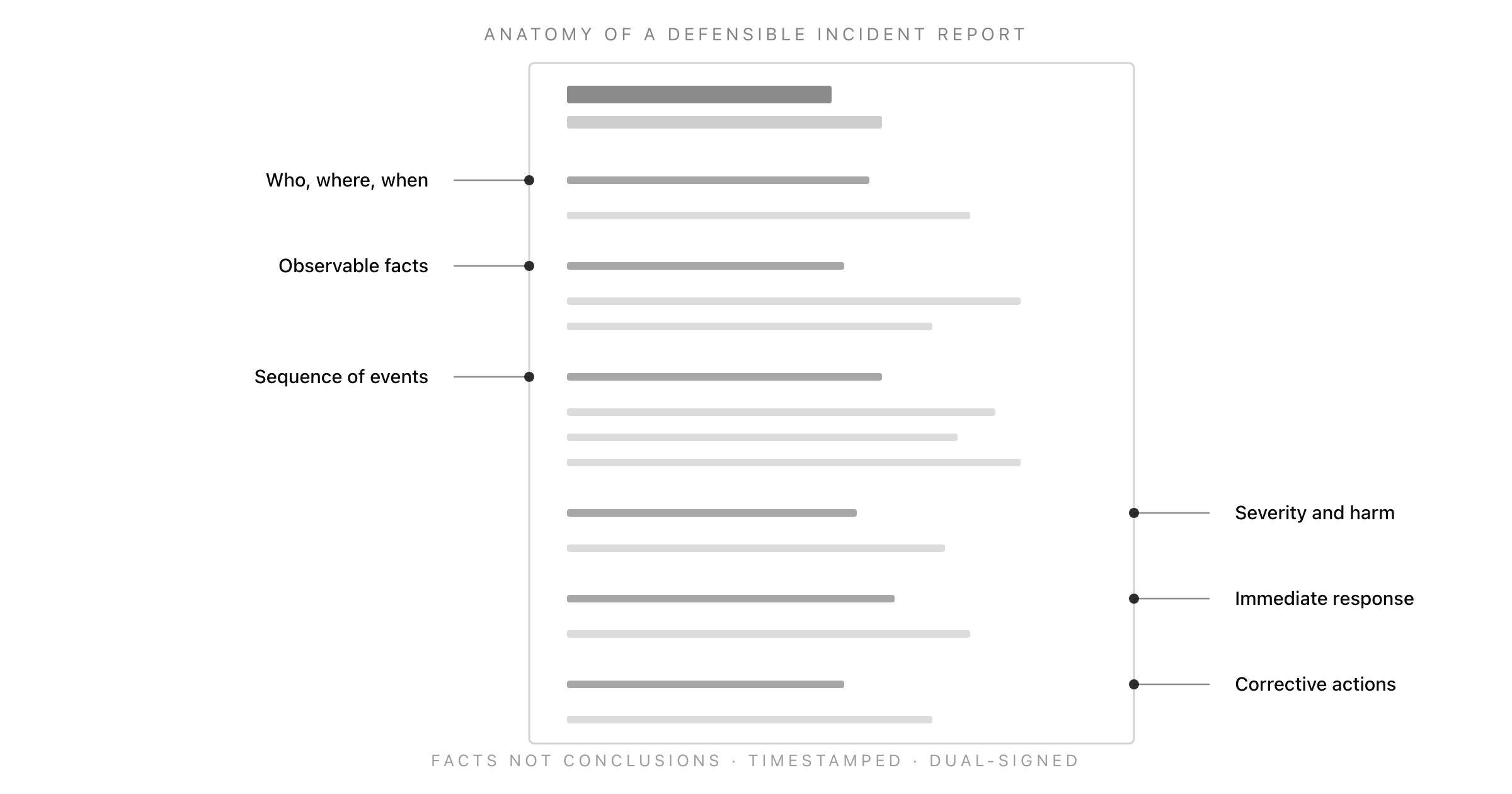
- A defensible incident report form has eight elements: who and where and when, witnesses, observable facts, sequence of events, severity and harm, immediate response, external notifications, and corrective actions. Missing any one creates a hole the next reader will fall through.
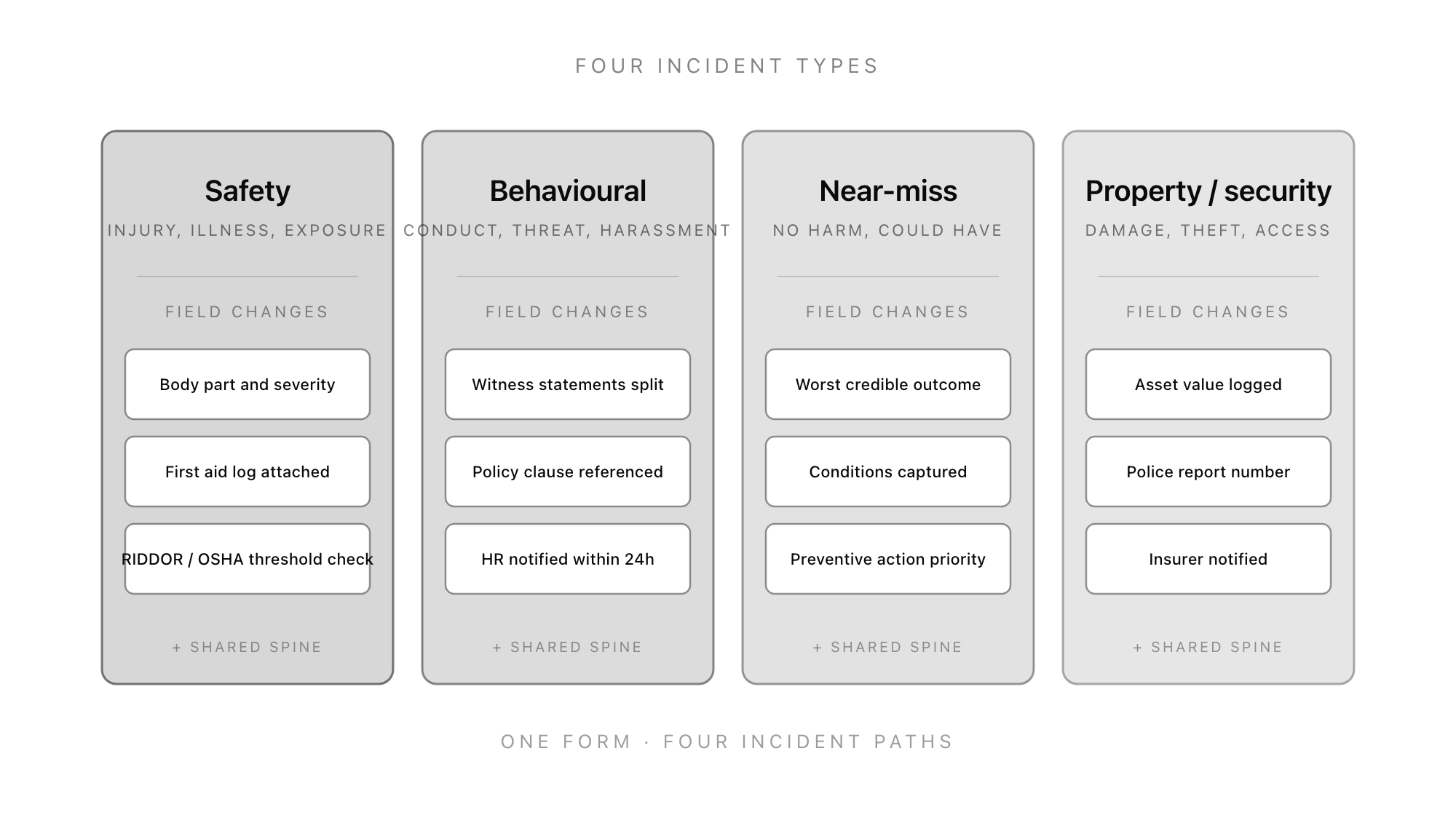
- Three template variants cover almost every workplace incident: safety (injury, illness, exposure), behavioural (conduct, threats, harassment), and near-miss (no harm, but the conditions could have produced harm). They share the spine; the differences are in two or three fields per type.
- The single biggest mistake is conclusion language. "Aggressive", "careless", "intentional", "reckless" are not facts; they are inferences. Replace every instance with what a camera would have recorded.
- Near-miss reports are the most under-used form in the file cabinet. They are the cheapest evidence a company can collect and the most predictive of the next serious incident, because the conditions are identical. The only barrier is that nobody is required to fill one out.
- Clone the Good Form workplace incident report template so each report is timestamped, structured by incident type, and retrievable when HR, an insurer, or a regulator needs to assemble the record.
What an Incident Report Form Actually Is (and What It Isn't)
An incident report form is a contemporaneous record that a specific event happened at a specific time and place, that a specific person observed and recorded it, that a specific response was made, and that specific follow-up actions were assigned with owners and deadlines. It is a piece of evidence and an input into the company's safety and HR systems, not a piece of feedback or a story.
Three things an incident report form is not:
- An accident investigation report. An investigation is a deeper, often multi-day analysis that goes beyond the report. It uses tools like a 5-Whys or a fishbone diagram, draws on multiple incident reports, and produces root-cause findings. The incident report is the raw input. Confusing the two leads to incident reports that are either too thin (no facts) or too speculative (causes proposed without evidence).
- A blame instrument. A workplace where filling out an incident report is treated as a confession produces fewer reports, not fewer incidents. The single most consistent finding in safety research is that under-reporting tracks with how punitive the response is. The form is a record of what happened; the discipline question, if there is one, is decided separately and sometimes weeks later, when the facts have been assembled.
- A finished document. Most incident reports are first drafts. Witness statements arrive late, severity is reassessed when the medical report comes back, corrective actions get added after the post-incident review. Build the form so it can be added to with a clear timeline of who added what when, rather than rewritten.
What an incident report form is: a dated, factual, time-bound document that records (a) who was involved and where the event happened, (b) what observable facts can be established, (c) the sequence in which they happened, (d) what harm was caused or could have been caused, (e) what was done in immediate response, (f) what statutory or external notifications were triggered, (g) what corrective action will follow, and (h) signatures from the reporter and the receiving manager. Done well it gives an investigator, an insurer, an OSHA auditor, or an employment lawyer the spine of a defensible record. Done badly it does the opposite: a thin or conclusion-heavy report can be more damaging than no report at all.
The Four Types of Incident Report Form (and the One Spine That Runs Through All of Them)
A workplace incident is rarely just one kind of event. A safety incident often has a behavioural component (someone ignored the lockout). A behavioural incident sometimes has a safety outcome (a shoving match in a kitchen turns into a burn). A near-miss usually feels like nothing at the time and only later turns into the predecessor of the serious incident that follows. The form has to handle all of these without forcing the reporter to pick a category before they have written the facts down.
The solution is one shared spine plus a small set of fields that change by incident type. Four type variants cover almost every workplace event. The illustration below shows what changes in each.
Safety incident
An event that caused or could have caused physical harm, illness, or exposure. The fields that change here are the body part affected and severity (a stock first-aid taxonomy is fine), the first-aid log reference, and whether the event meets a statutory reporting threshold (in the UK that is RIDDOR; in the US it is the OSHA recordable definition; in regulated sectors it can be sector-specific). The threshold check is the field most small companies forget to put on the form, which is how the deadline for the external notification gets missed.
Behavioural incident
An event involving conduct, threats, harassment, discrimination, or a policy violation that did not produce a safety outcome. The fields that change here are witness statements (which need to be recorded separately and not in the main account, so each witness's words are preserved), a reference to the specific policy clause that was violated (handbook section, code of conduct paragraph, or contract clause), and the HR-notification clock (most defensible policies set this at 24 hours from the report). For a behavioural incident that escalates into a disciplinary process, the report becomes the seed document; we cover what happens next in the employee write up form guide.
Near-miss
An event that did not cause harm but could have under different conditions. The fields that change here are the worst credible outcome (what would have happened if a single condition had differed: if the operator had been three feet closer, if the chemical had been a different substance, if the cyclist had been a foot to the left), the conditions that allowed the near-miss to remain a near-miss (luck is a condition; it just is not a controllable one), and the priority assigned to the preventive action. Near-miss reports are the highest-leverage entries in the system because the conditions are real and reproducible, but they are under-collected because nobody is required to file one. Treat them as low-friction.
Property and security incident
Theft, damage, unauthorised access, lost equipment, data loss without a privacy-incident threshold. The fields that change here are the asset value, any police or insurer reference numbers, and whether the event triggers a regulatory or contractual notification (a SaaS contract with a customer-data clause is the example most small teams miss). For data privacy incidents that do meet a statutory threshold (GDPR, CCPA, HIPAA), the form needs to flag handoff to a separate breach-response process, because the clocks and authorities are different.
The Eight-Element Spine Every Workplace Incident Report Form Needs
Every defensible workplace incident report form, regardless of incident type, contains the same eight elements. The variants change which fields elaborate on which element. The structure does not.
1. Who, Where, and When
Reporter name, role, and contact. Date and time of the incident itself, separately from the date the report was written. Specific location: building, floor, room, or street address. Names and roles of everyone directly involved.
The two failures here are vague time and vague location. "Late afternoon" is not a time; "16:42" is. "The warehouse" is not a location; "the main loading bay, position 3, second pallet aisle" is. If the time or location is approximate, write that explicitly: "between 16:30 and 17:00, approximate"; "in the kitchen, exact position uncertain". An honest approximation reads as honesty. A vague description without the qualifier reads as evasion.
2. Witnesses
Anyone who saw or heard part of the incident but was not directly involved. Capture each witness's name, role, and a one-sentence summary of what they observed. If at all possible, take a separate written statement from each witness in their own words and attach it to the file. Do not paraphrase witness accounts in the main narrative; that is the single most common reason a report falls apart in cross-examination.
3. Observable Facts
Three to eight bullet points. Each item names what was said, done, seen, smelled, or heard. No adjectives. No characterisation. The temptation, especially for behavioural incidents, is to write "Sarah became aggressive" instead of "Sarah raised her voice and said the words 'do not speak to me again'". The first is an opinion that anyone in cross-examination can challenge. The second is a quote that two witnesses can confirm. We come back to this in the language section below; it is the rule that decides whether the report holds up.
4. Sequence of Events
A chronological reconstruction of what happened, in numbered steps, with times where they can be established. The sequence is what the witness statements and the observable facts together produce, organised into a timeline.
The test for whether the sequence is solid: a stranger reading only the sequence section should be able to picture the incident in their head, in real time, with no narrative gaps. If a step is missing or an inference has been substituted for an observation, the picture breaks. That is where the report will be challenged.
5. Severity and Harm
What harm was caused, or for a near-miss, what harm could have been caused. Use a stock severity taxonomy (no harm, minor, moderate, serious, critical) and explain the criteria in the form description so two different reporters arrive at the same rating. Severity is reassessed when more information arrives; the form should support an "as-of" timestamp so you can tell the difference between the initial assessment and the later one.
6. Immediate Response
What was done in the first minutes and hours. Name the person, the action, and the time. First aid given, ambulance called, area secured, fire suppression activated, building evacuated, supervisor notified, HR notified, IT cut off network access, locks changed.
The immediate-response section is also where the company's procedures are tested. If the response was correct, document it; that is your evidence the procedure works. If the response was wrong (slow notification, wrong escalation path, missed step), document that too. A defensible record describes what happened; it is not a defence brief.
7. External Notifications
Statutory authorities, insurers, regulators, customers if a contract requires it, police if a crime was committed. Record what was reported, to whom, and when, with reference numbers. Some of these notifications have hard deadlines (RIDDOR major-injury within 10 days; OSHA fatal-injury within 8 hours; some data breaches within 72 hours); the form is the place those deadlines show up, because the report is what triggers the clock.
8. Corrective and Preventive Actions
Specific, observable, time-bound. Each action has an owner, a deadline, and a measure of completion. Three is a typical number for a single incident. More than five usually means the actions are too granular; fewer than two usually means the report has stopped at description without doing the work the report exists to do.
Preventive action is where the incident report becomes useful beyond the immediate event. A safety report that produces no preventive action is a record of an event that will repeat. A behavioural report that produces no preventive action is a record of a problem that will escalate. The corrective-action section is what turns the form from a logging exercise into a feedback loop.
The Document-the-Facts-Not-Conclusions Rule
This is the failure mode most small companies do not realise they have until the file is sitting in front of an investigator, a lawyer, or an OSHA inspector. It is also the rule that sounds the most obvious and is the hardest to apply in practice.
A fact is what a camera would have recorded. A conclusion is what an inference makes of the recording.
Compare:
-
Bad: "Mark was aggressive towards the supervisor."
-
Good: "Mark walked towards the supervisor, pointed his finger at her chest from a distance of approximately 30cm, and said the words 'you do not get to talk to me like that, ever'."
-
Bad: "The forklift driver was being careless."
-
Good: "The forklift driver had not engaged the parking brake before dismounting. The forklift was on a 2 percent gradient. The forklift moved approximately 1.5 metres before contacting a stack of pallets."
-
Bad: "Sarah ignored the safety procedure intentionally."
-
Good: "Sarah did not perform the lockout step before opening the cabinet. The lockout requirement is in handbook section 5.4, which Sarah signed acknowledgement of on 14 March 2025."
The conclusion versions feel stronger when you write them. They feel weaker when someone else reads them out in a deposition. "Aggressive", "careless", "intentional" are inferences a different person could disagree with. "Pointed his finger from 30cm", "did not engage the parking brake", "did not perform the lockout step" are observations two witnesses can confirm or contradict. The first version invites the question "how do you know?". The second version answers it.
The rule applies to the entire form, but it applies hardest to the observable-facts and sequence-of-events sections. If you can replace every adjective in those sections with a quote or a measurement, the report holds up. If you cannot, it does not.
How an Incident Report Connects to Discipline, Compensation, and Termination
The incident report is rarely a self-contained document. It is usually the seed for one or more downstream processes, and the form has to make the handoff clean.
For a safety incident with injury, the report is the trigger for the workers compensation claim, the medical-attention log, and the lost-time tracking. The incident report supplies the facts; the workers compensation form (which sits inside a separate carrier-defined process in most jurisdictions) consumes them. Keep them as separate documents that reference each other rather than one merged document.
For a behavioural incident, the report is the trigger for the disciplinary process. The handoff is from the incident report into the employee write-up form, then potentially into a performance improvement plan, and ultimately, if the conduct continues, into the termination form and letter. Each step uses facts from the incident report; the report itself is not the disciplinary document. Keeping the disciplinary decision separate from the incident facts is what makes it possible to revisit the facts later without re-litigating the discipline.
For a near-miss, the report is the input to the next safety review and, if the conditions reproduce, the predecessor evidence for the next serious incident. The single most useful sentence in a near-miss file is the one that says "this near-miss has the following conditions in common with [date] of [previous incident]". That sentence is what turns a stack of near-miss reports into a pattern.
Storage, Retention, and Who Can Read It
Incident report forms are sensitive documents. They contain personal information, medical information, witness names, and sometimes accusations that have not been substantiated. Treat them accordingly.
Three rules cover most of the access question:
- Reporter and named individuals can request a copy of their own statement. Witnesses cannot demand a copy of the full file; they get the statement they made and any direct response to it. This protects the integrity of further statements and reduces the chance that one witness's account influences another's.
- Managers and HR see the file on a need-to-know basis. Most teams default to wider access than they should. The line manager of the people involved, the HR lead, and the person leading any subsequent investigation are usually enough.
- Retention follows the longer of the regulatory minimum and the limitation period. OSHA requires injury logs to be retained for 5 years; some sectors require longer. UK employment claims have a 3-month limitation period for most categories; civil claims can run to 6 years. Default to 6 years for safety and behavioural reports; longer for serious incidents.
Use a structured form rather than a stack of free-text emails or a Slack thread. The structured form gives you the access controls, the retention schedule, the exportable record, and the audit trail. It also forces the writer to populate the spine fields, which is what makes the report defensible in the first place. The Good Form workplace incident report template is the structure laid out as a fillable form your manager and HR lead can co-sign on the day, with the file then living somewhere retrievable.
The Three Templates: Safety, Behavioural, Near-Miss
The three template variants below show what the spine looks like populated for each common incident type. Treat them as starting points: clone, adjust to the specific industry and jurisdiction, and keep the structure consistent across the team so reports from different managers read the same way.
The safety template leads with the body-part-and-severity field, has a first-aid and medical-attention log section, an external-notification field with the RIDDOR or OSHA threshold check inline, and a workers-compensation handoff field if the injury crosses the lost-time threshold.
The behavioural template leads with the policy-clause field, has a separate witness-statements block where each witness's account is preserved verbatim, an HR-notification clock starting from the report submission, and an explicit pointer into the disciplinary process if the behaviour warrants it.
The near-miss template leads with the worst-credible-outcome field and the conditions section, has a lighter severity block (since severity is "no harm, but"), and prioritises the corrective-action section with a near-miss-specific tag so the next safety review can pull all near-misses from the period together.
All three share the same spine: who, where, when, witnesses, observable facts, sequence, severity, immediate response, external notifications, corrective actions, signatures. The spine is what makes them defensible. The variant fields are what make them useful for the specific incident.
Send Better Incident Reports Today
If you have read this far, the structure is clear. The remaining question is whether your team will actually fill it out, on the day, with the spine fields populated and the language rule applied. Most do not, because the form on the wall is a PDF nobody can find, and the alternative (Slack threads, emails, phone calls) does not produce a defensible record.
Clone the workplace incident report template on Good Form to get the spine, the variant fields, and the language hints inside the form itself. Each report is timestamped, exportable as a PDF for the file, and retrievable when an investigator, an insurer, or a tribunal asks for it. The structure is what makes the difference; the form is what makes the structure stick.