The I-9 form is the federal Employment Eligibility Verification document every US employer must complete for every newly hired employee, and it is the single most audited piece of paperwork in a small HR function. The current edition, USCIS Form I-9 dated 08/01/23, is valid through 31 May 2027, has three sections, two owners (employee and employer), one ninety-six-hour deadline buried in the middle of week one, and a fine schedule that runs from a few hundred dollars per substantive error up to thousands for a pattern of violations. It is also the form most likely to surface in an ICE Form I-9 audit, which has become more common across 2024 and 2025 as immigration enforcement priorities have shifted.
This guide is the section-by-section walkthrough of the I-9 form for a US employer in 2026: what each section collects, who fills it in and by when, which documents the three lists actually allow, how the E-Verify alternative remote document examination procedure works, the retention rule that catches small employers, the most common substantive errors that draw fines, and the audit-defence habits that hold up. The audience is HR teams of one to ten, office managers wearing the HR hat, and operations leads who have just made their first US hire. If you want a pre-day-one intake that captures Section 1 information cleanly before your new hire sits down with the federal form, clone the Good Form I-9 pre-verification intake template.
The short version:
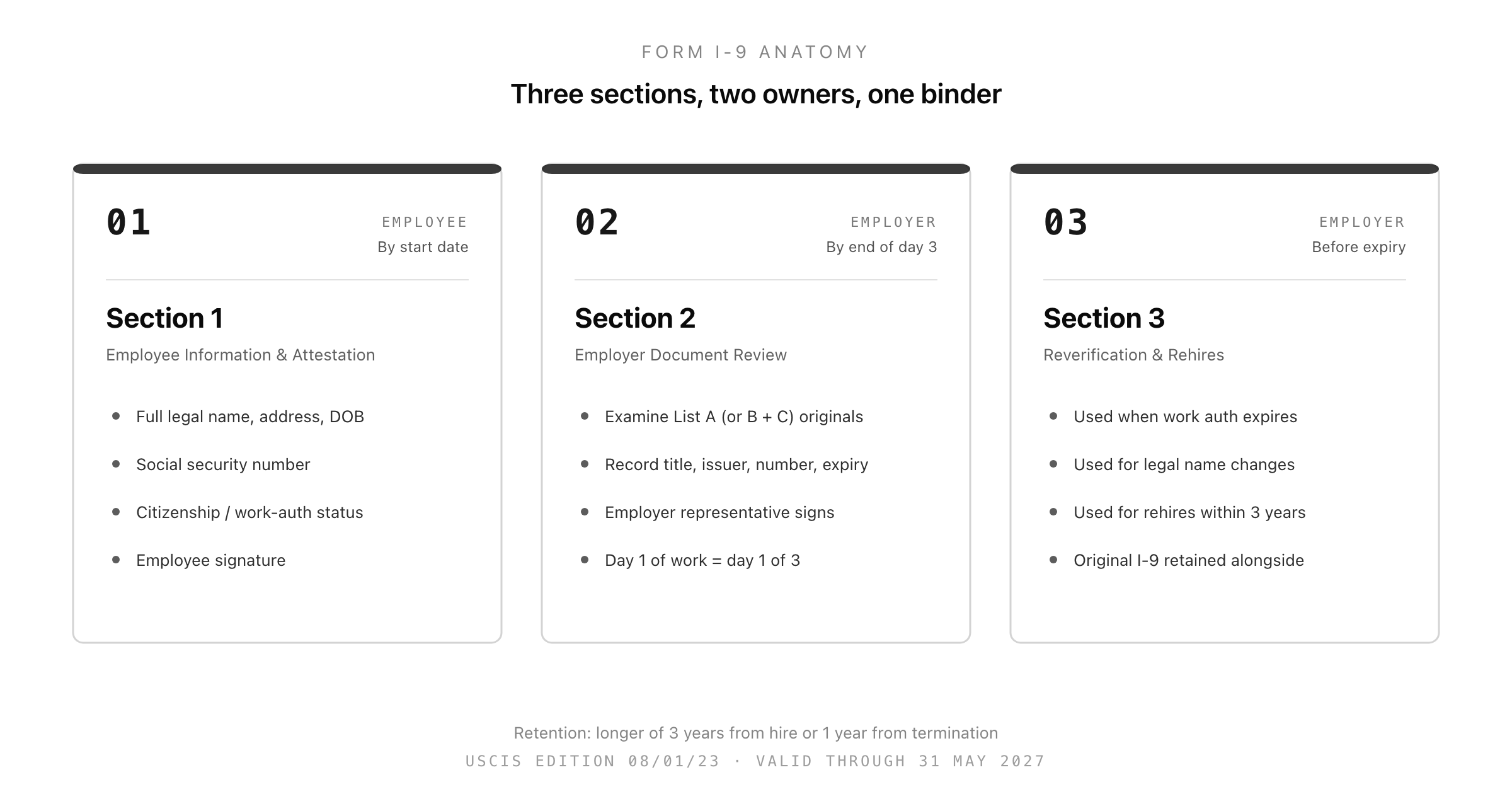
- Form I-9 has three sections. Section 1 (employee information and attestation) is the employee's, completed on or before the first day of work. Section 2 (employer document review) is the employer's, completed by the end of the third business day after the start date. Section 3 (reverification and rehires) is the employer's, completed before work authorization expires or when a rehire occurs within three years of the original I-9.
- The day-three deadline is calendar-aware: the start date counts as day one. A Monday start means Section 2 must be done by end of business Wednesday. Miss it and the I-9 is substantively defective; the employee cannot keep working until it is fixed.
- The employee picks documents from one of three lists. List A documents prove both identity and work authorization in one (US passport, permanent resident card, employment authorization document I-766). List B documents prove identity only (driver's license, state ID, military ID). List C documents prove work authorization only (unrestricted social security card, certified US birth certificate). The employee presents one from List A, OR one from List B plus one from List C. The employer cannot demand a specific document.
- Use the current USCIS edition. The 08/01/23 edition is valid through 31 May 2027. Self-built versions or expired editions are treated as no I-9. Download from uscis.gov/i-9.
- E-Verify participants in good standing can use the Alternative Procedure for remote document examination, a live-video review of the same originals plus a same-day E-Verify case creation. Non-E-Verify employers must examine originals in person.
- Retain the I-9 for the longer of three years from the date of hire or one year from the date of termination. Store I-9s separately from the personnel file so they can be produced for an ICE inspection without exposing unrelated employee records.
- The fines that hurt are the patterns: a substantive error rate above ten percent across an audit sample triggers the higher per-form penalty band, and a substantive error rate above fifty percent triggers the top band. Routine review beats remediation. Pre-flight the data with the Good Form I-9 intake so day one is verification, not data entry.
What the I-9 Form Is and Why It Exists
The I-9 is the form created by the Immigration Reform and Control Act of 1986 to require every US employer to verify that every new hire is authorized to work in the United States. Before 1986, employment-eligibility verification was not a federal requirement. After 1986, it became a strict-liability obligation: the employer is responsible for completing the I-9 for every new hire, every time, with the current form, within the statutory windows. There is no de minimis exception for small employers and no waiver for short-term hires (employees expected to work three days or less are still I-9'd; the rule used to be looser, but no longer).
The form serves three audiences. The employee uses Section 1 to attest, under penalty of perjury, that they are authorized to work in the United States. The employer uses Section 2 to record that they personally examined acceptable documents establishing identity and work authorization. ICE (and, under some circumstances, the Department of Labor or the Department of Justice Civil Rights Division) uses the completed I-9 as the evidentiary record in an audit or investigation. The I-9 is not filed anywhere when completed. It lives in the employer's binder until either three years have passed since hire or one year has passed since termination, whichever is later.
The current edition is dated 08/01/23 in the lower-left corner and is the only edition employers should be using through 31 May 2027. Prior editions, including the 10/21/19 and 07/17/17 versions, are not acceptable for new hires after their sunset dates. If you find an older edition in your records for a current employee, you do not redo the I-9; you preserve the older form as it was when completed.
Who Must Complete an I-9
Every employer in the United States must complete a Form I-9 for every individual hired for employment, including US citizens, US nationals, lawful permanent residents, and authorized non-citizens. There is no employer-size threshold. The obligation runs to anyone the employer treats as an employee for wage and tax purposes (W-2 employee).
The I-9 does not apply to independent contractors (1099 workers), volunteers, or casual domestic workers in a private home performing sporadic work. It also does not apply to employees hired before 6 November 1986 who have been continuously employed by the same employer ever since. Everyone else, every time. If you bring a remote worker on as a W-2 employee from a US state, they get an I-9 regardless of whether they will ever step into a physical office.
A useful clarification: the I-9 obligation is the employer's, not the employee's. The employee provides information and documents, but the form is the employer's to complete, retain, and produce. If a small employer outsources payroll to a PEO or co-employer, the contractual division of I-9 responsibility should be in writing; the default is still that the legal employer of record holds the I-9 burden.
Section 1: Employee Information and Attestation
Section 1 is completed by the employee, by hand or on the fillable PDF, on or before the first day of employment. "On or before the first day" means the employee can complete Section 1 the day they accept the offer, the day before they start, or the morning of day one before they begin work. They cannot complete it after they have begun working; the rule is that Section 1 attestation precedes the first hour of paid work.
The data fields are: full legal name (last, first, middle initial), other last names used (maiden, prior married name), address, date of birth, social security number (required only if the employer uses E-Verify; optional otherwise), email address (optional), telephone number (optional), and the citizenship or work-authorization attestation. The attestation has four mutually exclusive checkboxes:
- A citizen of the United States.
- A non-citizen national of the United States. (Narrow category: persons born in American Samoa or Swains Island, plus a few naturalisation tracks.)
- A lawful permanent resident, with alien registration number / USCIS number.
- A non-citizen authorized to work, with work-authorization expiration date and one of three identifying numbers (alien registration number, Form I-94 admission number, or foreign passport number plus country of issuance).
The employee signs and dates Section 1 themselves. If the employee uses a preparer or translator to fill in Section 1 (because of language or accessibility), there is a separate Preparer / Translator Certification block on the form, signed by the preparer. The preparer's name is recorded on the form; the preparer is not the employer's representative.
The Section 1 attestation is the part of the I-9 that carries criminal penalties for the employee. A knowing false attestation is a federal felony. Employers do not investigate the attestation; they record what the employee signed, examine documents, and move to Section 2.
Section 2: Employer Document Review
Section 2 is the employer's section and is where most I-9 errors originate. Section 2 must be completed by the end of the third business day after the date employment begins. The Department of Homeland Security treats the start date as day one. A Monday start means Section 2 must be done by close of business Wednesday. A Friday start gives the employer through close of business Tuesday (Saturday and Sunday are not business days). If the employee will work fewer than three business days, Section 2 must be completed on day one.
The employer examines documentation from the employee establishing identity and work authorization. The documents are organised into three lists:
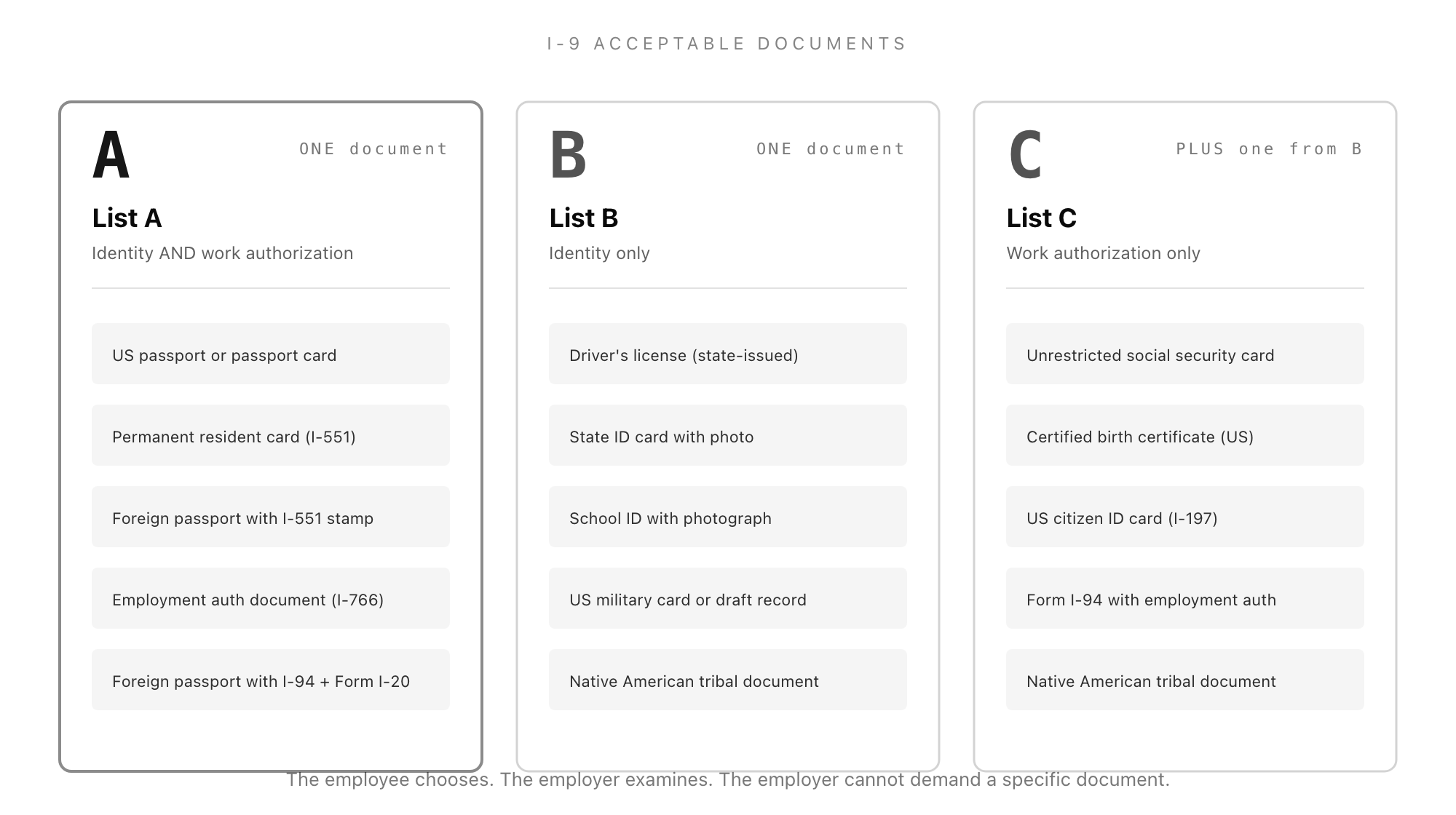
List A documents establish both identity and work authorization in one document. The common examples are the US passport or passport card, the permanent resident card (Form I-551, the "green card"), the foreign passport with a temporary I-551 stamp or printed notation, the Employment Authorization Document (Form I-766, the EAD), and (for J-1, F-1, M-1 students and exchange visitors) the foreign passport with an I-94 record bearing an admission stamp and the relevant supporting document (Form I-20 for F-1 students, Form DS-2019 for J-1 exchange visitors).
List B documents establish identity only. The common examples are the state-issued driver's license, the state ID card, the school ID with photograph, the US military card or draft record, and a Native American tribal document.
List C documents establish work authorization only. The common examples are the unrestricted social security card (a social security card without a "NOT VALID FOR EMPLOYMENT" or "VALID FOR WORK ONLY WITH DHS AUTHORIZATION" notation), a certified US birth certificate, the US citizen identification card (Form I-197), Form I-94 with an employment-authorization notation, and a Native American tribal document.
The rule the employer applies: the employee presents one document from List A, OR one document from List B plus one document from List C. The employee chooses; the employer examines what is presented. The employer cannot tell the employee which document to bring, cannot refuse a valid document the employee chose, and cannot require additional documents beyond the minimum needed. All three behaviours (specifying, refusing, over-documenting) are forms of document abuse and are independently actionable under the anti-discrimination provisions of the Immigration and Nationality Act.
For each document examined, the employer records the document title, the issuing authority, the document number, and the expiration date (or "N/A" if there is none). The employer's representative then signs and dates the Section 2 attestation: "I attest, under penalty of perjury, that to the best of my knowledge the employee is authorized to work in the United States." The "best of my knowledge" language matters: the employer is not a forensic document examiner. The employer is required to examine the documents and accept them if they reasonably appear, on their face, to be genuine and to relate to the employee. If a document is patently fraudulent, the employer should not accept it; if it appears genuine and the employer has no specific reason to doubt it, the employer accepts and moves on.
Section 3: Reverification and Rehires
Section 3 is the employer's section, used in two scenarios.
Scenario 1: reverification of work authorization. If the employee's work-authorization document recorded in Section 2 has an expiration date (the Employment Authorization Document I-766 is the most common example), the employer must reverify the employee's work authorization before the recorded expiration date. The employee presents either an unexpired List A document or a List C document; the employer cannot insist on the same kind of document the employee originally presented. The reverification is recorded in Section 3 of the original I-9, and the original I-9 is kept (the new entries are appended, not a fresh form). Note: a US passport or permanent resident card with an expiration date is not reverified. List B identity documents are never reverified. Only the work-authorization side of the document expires for I-9 purposes.
Scenario 2: rehires within three years. If a former employee returns within three years of the original I-9, the employer can either complete a brand-new I-9 or use Section 3 of the original to record the rehire (with the new start date and, if needed, an updated work-authorization document). After three years, a new I-9 is required.
A third use of Section 3 is to record a legal name change. This one is technically optional under USCIS guidance, but updating Section 3 to reflect the new legal name is good practice because it keeps the I-9 paired with the rest of the personnel record.
E-Verify and the Alternative Procedure for Remote Document Review
E-Verify is the optional, separate federal system that lets employers electronically confirm an employee's work authorization against Department of Homeland Security and Social Security Administration records. E-Verify is required for federal contractors with the E-Verify clause in their contract, for employers in a handful of states that mandate it (Alabama, Arizona, Mississippi, North Carolina, Tennessee, Utah and others, varying by employer size), and is optional for everyone else.
E-Verify participation does not replace the I-9. The I-9 is still completed, the documents are still examined, and the case is created in E-Verify within three business days of the start date (the same window as Section 2). The E-Verify case either returns Employment Authorized, Tentative Non-confirmation (which the employee has the right to contest), or Final Non-confirmation. The employer cannot take adverse action while a Tentative Non-confirmation is being contested.
The Alternative Procedure for remote document examination, introduced by USCIS in August 2023 and made permanent shortly thereafter, lets E-Verify employers in good standing examine documents over live video instead of in person. The conditions are strict: the employer must be an E-Verify participant, must be a participant in good standing (no formal compliance findings against them), must be enrolled at the hiring site at the time of hire, must create an E-Verify case for the employee, must retain copies of all documents examined for the duration of the I-9 retention window, and must conduct the live-video examination within the same Section 2 deadline. The employee transmits clear copies of the front and back of the documents in advance; the employer reviews originals on live video; the documents are saved alongside the I-9; the employer notes "Alternative Procedure" in the Additional Information field. Non-E-Verify employers cannot use the Alternative Procedure and must examine originals in person.
The Three Clocks That Govern the I-9
The I-9 has three statutory clocks that small HR teams should track explicitly:
- Section 1 clock. Employee completes Section 1 on or before the first day of employment. Practical implementation: send Section 1 in the offer-acceptance packet alongside the offer letter; the employee returns it before they walk in or before they log in.
- Section 2 clock. Employer completes Section 2 by the end of the third business day after the date employment begins. Practical implementation: schedule the in-person (or Alternative Procedure live-video) document review for the morning of day one if possible, day two at the latest, with day three as the hard backstop.
- Reverification clock. Employer must reverify before the expiration date of any List A or List C work-authorization document. Practical implementation: when recording the expiration date in Section 2, immediately add a calendar reminder for ninety days before the expiration date so HR has lead time to schedule the reverification.
The clocks are independent. Missing Section 2 does not extend the reverification clock; missing reverification does not extend retention. Each clock is its own potential audit finding.
Common Errors That Draw Fines
The fine schedule for I-9 violations changed in 2024 under the standard federal inflation adjustment. The current bands for substantive paperwork violations are roughly $281 to $2,789 per affected I-9 form for a first offence (the precise figures shift annually with inflation; check the USCIS or DOJ Civil Rights Division updates each January). The Office of the Chief Administrative Hearing Officer applies a percentage-based aggravator: a substantive-error rate below ten percent stays in the lowest band, ten to fifty percent moves to the middle band, and above fifty percent applies the top band. Patterns get punished; isolated errors are forgiven if the rest of the binder is clean.
The recurring errors that draw findings are:
Missing or late Section 2 dates. The Section 2 signature date is what proves the third-business-day deadline was met. If Section 2 is signed but undated, or dated more than three business days after the start date, that is a substantive error.
Mixing List A with List B or C. Accepting a List A document AND a List B or C document is over-documentation. The employee presented identity-plus-work-authorization in one document; nothing else should be examined. (You can still copy the List A document for your records, but you do not record a List B or List C document in addition.)
Expired documents. Accepting a driver's license that expired three months ago, or a permanent resident card past its renewal date, is a substantive error. The exception is the unrestricted social security card, which has no expiration date and never expires for I-9 purposes.
Missing reverification. Letting a List A or List C work-authorization document expire without recording a reverification in Section 3 is an in-substance failure to verify. The employee should not be working until the reverification is complete.
Wrong I-9 edition. Using an out-of-date edition of the I-9 (anything other than the 08/01/23 edition through 31 May 2027) is treated as if no I-9 was completed. Redoing the I-9 on the current edition after the deadline does not cure the original error; both the missed deadline and the wrong-edition use are findable.
Self-built I-9 forms. A self-built form, even one that reproduces every field of the federal form, is not the federal form and will be treated as no I-9. Always use the USCIS PDF.
Retention and Storage
Retain every completed I-9 for the longer of three years from the date of hire or one year from the date of termination, whichever is later. For an employee hired on 1 March 2024 and terminated on 1 May 2025: hire-plus-three is 1 March 2027; termination-plus-one is 1 May 2026. The later of the two is 1 March 2027; that is the I-9's retention date. For a long-tenure employee hired 1 March 2010 and terminated 1 May 2025: hire-plus-three was 1 March 2013, well past; termination-plus-one is 1 May 2026; the retention date is 1 May 2026.
Store I-9s separately from the personnel file. The reason is operational, not legal: if ICE serves a Notice of Inspection, the employer must produce the I-9s and only the I-9s within three business days. If the I-9s are in the personnel file, separating them under the clock is hard. A dedicated I-9 binder (paper) or a separate digital folder with access controls (digital) lets HR hand over the file as a whole when the time comes.
ICE inspections begin with a Notice of Inspection delivered by hand or by mail. The employer has three business days from receipt to produce the I-9 binder, in original or in faithful copy. ICE then reviews the binder for substantive errors and notifies the employer of findings, the employer responds, and (if a fine is proposed) negotiation or a hearing follows.
How Good Form Fits Around the I-9
The I-9 form itself must be the official USCIS PDF or a USCIS-approved electronic equivalent. Good Form is not a substitute for the I-9 and never will be. What Good Form does is take the pre-day-one data collection that surrounds the I-9 (legal name, address, date of birth, work-authorization status, document plan) and turn it into a single intake the new hire fills in before day one. The Good Form intake captures the same data the employee will eventually attest to in Section 1, lets HR see in advance which document path the employee plans to use, and surfaces any complications (recent name change, document arriving by mail, pending immigration filing) before the third-business-day deadline starts ticking.
The Good Form intake explicitly does not replace the federal I-9 and tells the employee so. It is a pre-flight checklist for the federal form. The result is a day-one session that is verification of originals against pre-filled data, not data entry from scratch. For the broader new-hire packet (W-4, state W-4, direct deposit, emergency contact, benefits enrollment), see the new hire paperwork guide, which lays out the four layers (federal, state, operational, acknowledgment) and the day-one checklist that holds them together. For the post-employment side of the same compliance binder, see the employment verification form guide, which covers the request HR receives from a future employer about a former one.
The Companion Template
For the pre-day-one I-9 intake, clone the Good Form I-9 pre-verification intake template. It captures the Section 1 information the employee will attest to (legal name, address, date of birth, citizenship or work-authorization status, document plan, in-person or Alternative Procedure preference) and the supporting fields HR needs before the third-business-day clock starts. It is free to use, takes about thirty seconds to clone, and the data flows straight into Good Form's response inbox. Pair it with the new hire information form for the rest of the day-one packet and the I-9 session on day one becomes a fifteen-minute document examination instead of a forty-five-minute Section 1 fill-in.