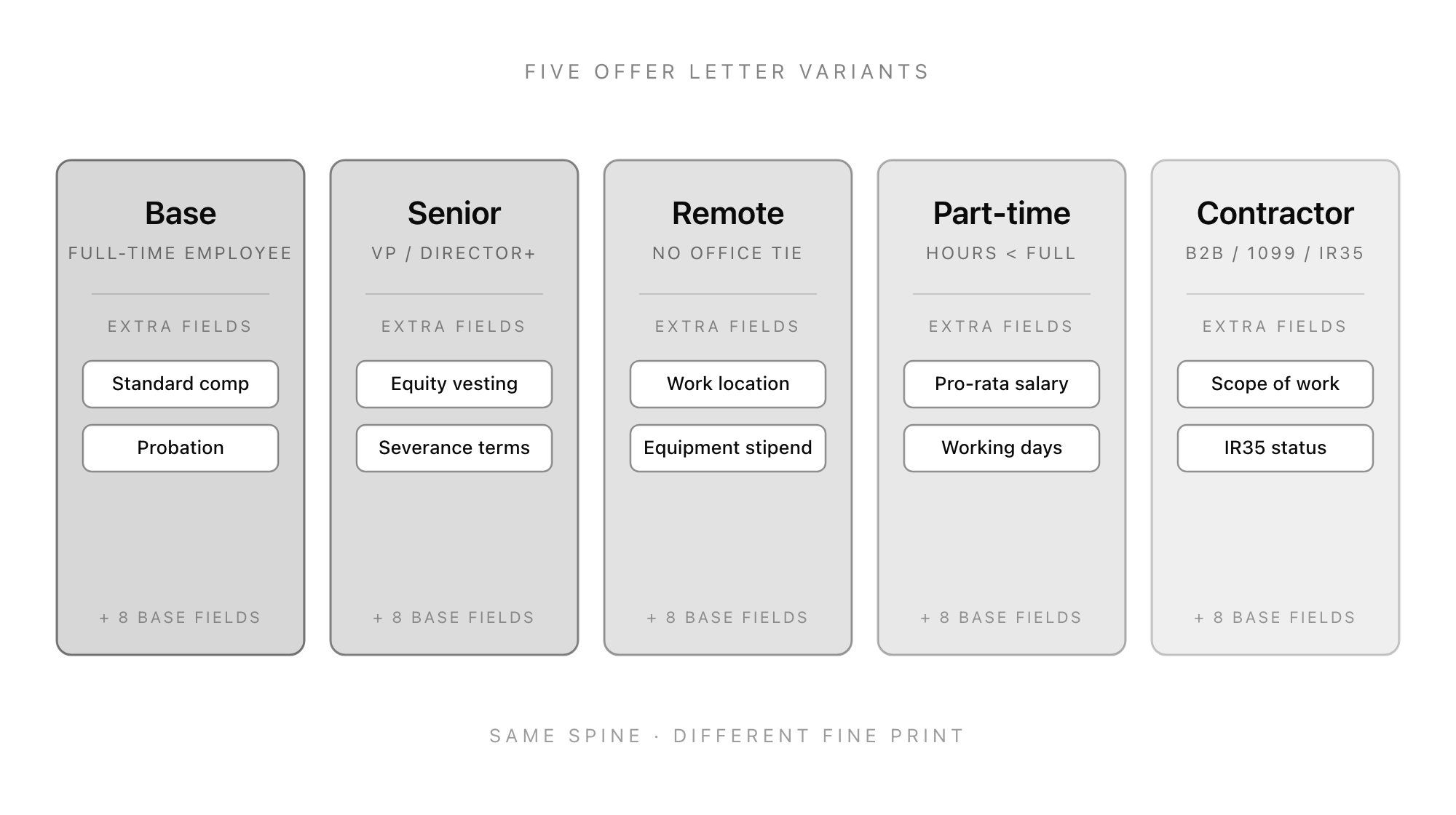
The offer letter template most companies use is the same Word document someone forked from a legal template library in 2019, edited once when the CFO asked about equity, and has been silently falling out of date ever since. It works well enough to get offers across the line, but it leaks candidates at the worst moment (after verbal yes, before signature) because it fails at three specific jobs: stating the compensation clearly, making the expiry unambiguous, and giving the candidate a single obvious way to say yes. This guide rebuilds the offer letter template from scratch, with 5 ready-to-send versions for the hiring patterns most small teams actually run: a base full-time offer, a senior/exec offer, a remote offer, a part-time offer, and a contractor offer.
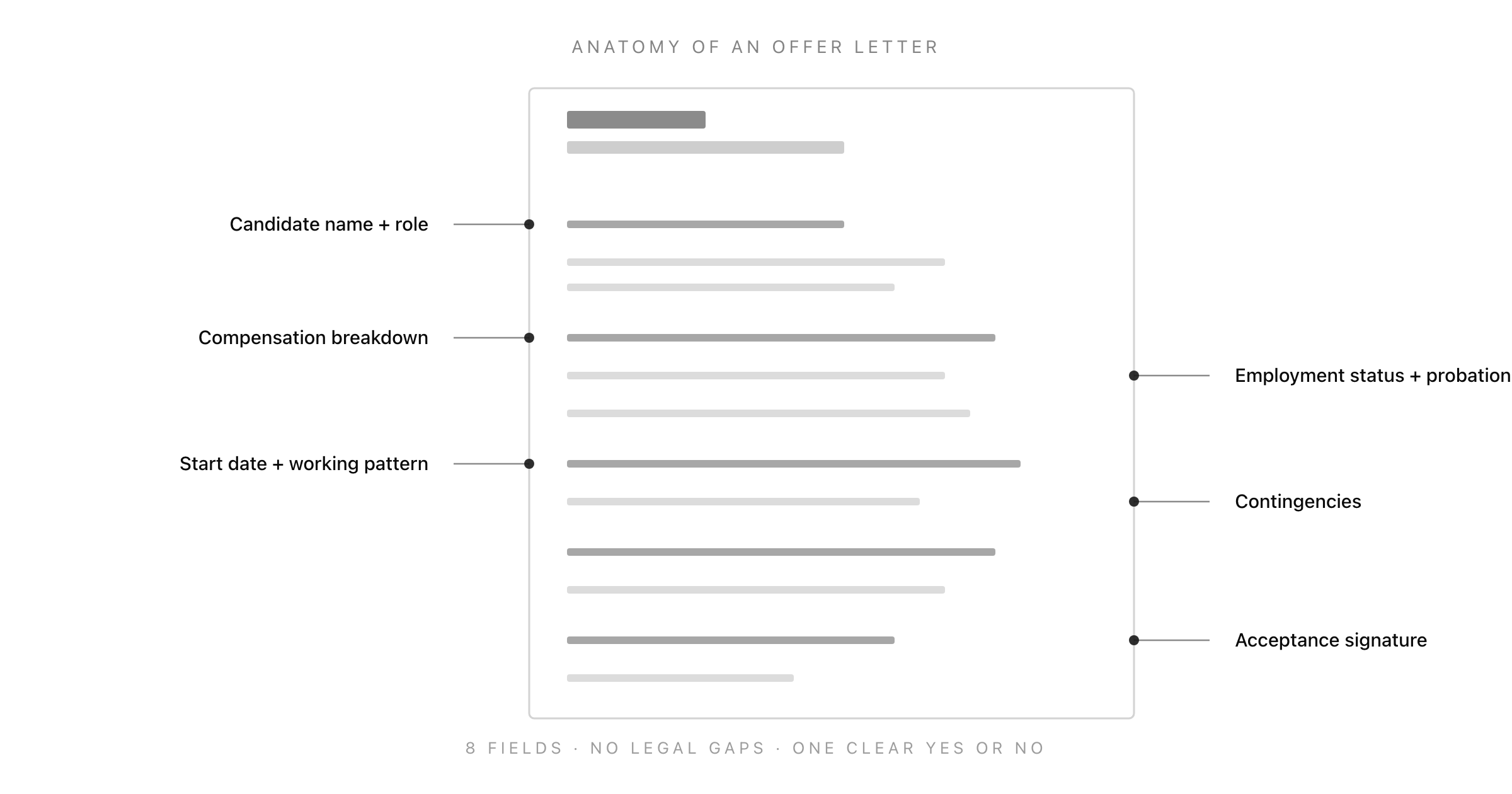
Every version uses the same 8-field spine. The variants only differ in what gets added (equity vesting, work location, pro-rata calc, scope of work) so you can clone one, adapt in five minutes, and have the whole hiring team reading from the same template. If you want to collect signed acceptance and the downstream onboarding details in one go, the Good Form offer acceptance template is the fastest way to do it.
The short version:
- Every offer letter needs 8 non-negotiable fields. Anything more is optional, anything less is a legal gap.
- State compensation as an annualised gross figure, then break down base, variable, and equity separately. Never only as "OTE".
- Put an explicit expiry on the letter. A 5-to-7 business day window is standard. An open-ended offer is a leverage problem waiting to happen.
- Separate "contingent on" clauses (background check, references, right to work) from the offer itself. The candidate should know exactly what can still block start day.
- Collect the acceptance with a form, not an email reply. A Good Form acceptance capture timestamps the yes, collects the onboarding details, and triggers the IT and payroll handoff in one step.
Why the Offer Letter Is the First Thing You Actually Sell
By the time you send an offer letter, the candidate has been through screening, technical rounds, a culture interview, and a reference call. They have said yes verbally. The job of the letter is not to re-sell the role. It is to remove every remaining reason to hesitate.
That is a specific task. A good offer letter template does four things:
- Confirms exactly what was agreed in the verbal offer, so the candidate does not spend the weekend wondering if the equity number shifted.
- States the expiry clearly, so the candidate has an actual deadline to give notice at their current role.
- Isolates the contingencies, so the candidate can plan around them rather than worrying they are unstated landmines.
- Gives a single obvious acceptance path. Not "reply with your signed letter". One button, one form, one yes.
Most templates fail at one or more of these. Usually the compensation is buried in a paragraph, the expiry is vague ("please reply at your earliest convenience"), and the contingencies are mixed in with the offer terms so the candidate cannot tell what is firm and what is conditional.
The 8-field structure below fixes each of those, one field at a time.
The 8 Fields Every Offer Letter Template Must Include
These are the fields that appear in every version. The variants in the next section add to this spine but never subtract.
1. Candidate Name and Role Title
Legal name as it appears on the right-to-work documents, plus the exact role title that will appear on the contract, in HR systems, and on the internal org chart. If the candidate is joining as "Senior Product Designer" but the contract says "Product Designer" with a "Senior" seniority band, reconcile that before the offer letter, not after.
2. Compensation Breakdown
Split compensation into three explicit lines:
- Base salary. Annual gross figure, in the currency of payment, with pay frequency (monthly, bi-weekly, weekly) noted.
- Variable compensation. Any bonus, commission, or performance-linked comp, with the target figure and the mechanism (e.g. "annual discretionary bonus target of 10% of base, paid in March").
- Equity. Number of shares or options, strike price where applicable, vesting schedule (4-year with 1-year cliff is standard at startups), and accelerated vesting terms for senior roles.
Never state compensation only as an OTE figure. OTE buries the base, and candidates renegotiate base, not OTE. State the figures the candidate actually needs to plan their life around.
3. Start Date and Working Pattern
A specific calendar date. Not "mutually agreed" or "to be confirmed". If the candidate needs to give notice, agree a target date in the verbal offer call and put that date in the letter. "Subject to release from current notice period" is fine as a qualifier, but the target has to be explicit.
Working pattern covers full-time or part-time, hours per week, typical working days, and any expected overlap hours for distributed teams.
4. Employment Status and Probation
State the employment status in plain language: permanent full-time employee, fixed-term contract, or contractor. Include the probation period length and what applies during probation (typically shorter notice periods and a reduced benefits package for the first 3 to 6 months).
5. Benefits Summary (or Reference)
Summarise the benefits package in one paragraph, then reference the full benefits document. The summary should cover: pension or retirement contribution, holiday allowance, health or dental, any location-specific perks, and learning or wellness budgets. The full document goes in the contract of employment.
6. Contingencies
List every condition that could still block the start date as a separate bullet:
- Right-to-work verification
- Background check clearance
- Reference checks (specify how many and from whom)
- Non-compete release from current employer (senior roles only)
- Medical clearance (regulated roles only)
The rule: if it could block the start date, it goes in the contingencies list. The candidate should never learn about a contingency after accepting.
7. Offer Expiry
A specific date and time. Five business days is the conventional window. Senior roles sometimes extend to 7 days to allow for compensation discussion at home. Anything longer than 10 days is unusual outside of candidates with competing offers who need more runway.
State the expiry in one sentence: "This offer is open for acceptance until 5pm local time on Tuesday 30 April 2026."
8. Acceptance Signature and Return Path
One path. Not "reply to this email or sign the PDF or call your recruiter". One path. The cleanest is a form: the candidate fills in their signature, the start date they are confirming, the right-to-work document upload, and any final questions in one place. That becomes the trigger for IT provisioning, payroll setup, and contract signing.
For the legal signature itself, typed full name plus a timestamp is sufficient in most jurisdictions for an offer letter. The contract of employment can use a dedicated e-signature tool afterwards.
The Five Offer Letter Variants
Every variant below uses the 8-field spine. Only the variant-specific fields change.
Template 1: The Base Offer Letter (Full-Time Employee)
The default. Use this when the role is a permanent, full-time employee position with a standard comp structure, no equity, and a conventional probation period.
Dear [Legal full name],

We are delighted to offer you the position of [Role title] at [Company], reporting to [Manager].

Compensation
- Base salary: [£/$XX,XXX] gross per year, paid monthly on the last working day.
- Variable: [£/$XX,XXX] annual discretionary bonus target, paid in [March].
- Equity: Not applicable for this role.

Start date: [Monday 2 June 2026], subject to release from your current notice period.

Working pattern: Full-time, 40 hours per week, Monday to Friday.

Employment status: Permanent employee, with a [3-month] probation period during which a notice period of [1 week] applies. After probation, the notice period becomes [1 month].

Benefits summary: [Pension 5% employer contribution, 25 days holiday + bank holidays, private health insurance, £1,000 annual learning budget.] The full benefits document is attached.

Contingencies
- Satisfactory right-to-work verification on day one
- Two satisfactory references
- Clear background check

Offer expiry: This offer is open for acceptance until [5pm local time on Tuesday 30 April 2026].

To accept, please complete the acceptance form linked below. If you have any questions, please reach out to me directly.

[Signature form link]

Congratulations, and welcome to the team.

[Hiring manager name]
[Title]
Template 2: Senior Role Offer Letter (Equity + Executive Terms)
Senior and exec offers need three additional provisions: equity detail, severance terms, and non-compete or garden leave clauses. The tone stays plain, but the economic terms get more specific.
Additions to the base template:

Compensation
- Equity: [XX,XXX] stock options at a strike price of [$X.XX], vesting over 4 years with a 1-year cliff. Double-trigger acceleration on change of control: [50% / 100%] of unvested shares vest on involuntary termination within 12 months of a change of control.
- Signing bonus: [£/$XX,XXX] paid in your first pay cycle, repayable on a pro-rata basis if you resign within 12 months.

Severance: On involuntary termination without cause, you will receive [3 months] of base salary as severance, conditional on signing a standard separation agreement.

Non-compete and garden leave: You agree to a [6-month] post-termination non-compete within [your direct function in the same industry]. Garden leave during notice is at the company's discretion.
Template 3: Remote Offer Letter (Location + Equipment)
Remote offers need an explicit work location clause, equipment terms, and sometimes a geographic salary adjustment policy. The ambiguity candidates worry about here is "can I work from anywhere, or are you going to tell me no when I want to move".
Additions to the base template:

Work location: You will work remotely from [country of residence]. Change of country of residence must be agreed in advance. Working from a country not on our approved list for more than [30 consecutive days] requires written approval.

Equipment: We will provide a laptop and monitor via our IT partner on your start date. A one-time home office stipend of [£/$500] is available for desk, chair, and peripherals, claimed via receipt.

Time zone: Your contracted hours include a daily overlap of [4 hours with the UK working day]. Core collaboration hours are [10am-2pm UK time].

Travel: You will be expected to attend [2 in-person team weeks] per year at company expense. All international travel is booked via [Travelperk].
Template 4: Part-Time Offer Letter (Pro-Rata Comp)
The part-time offer is where templates most commonly go wrong, because the pro-rata calculation has to be unambiguous. State the working pattern, the full-time-equivalent salary, and the pro-rata actual salary as three separate numbers.
Additions to the base template:

Working pattern: Part-time, [3 days per week], [Tuesday, Wednesday, Thursday], [21 hours per week]. Working pattern can be adjusted by mutual agreement with [2 weeks] written notice.

Compensation
- Full-time equivalent base salary: [£/$XX,XXX] per year.
- Pro-rata base salary: [£/$XX,XXX] per year, based on [0.6 FTE].
- Variable: [pro-rata bonus at the same ratio as base].

Benefits: All benefits are pro-rated. Holiday allowance is [15 days + bank holidays pro-rated to your working pattern].

Pension: Pension contributions are based on your pro-rata salary.
Template 5: Contractor Offer Letter (Scope + Tax Status)
The contractor offer is structurally different from the employee variants, because there is no employment status. Replace the employment and benefits sections with scope, day rate, and tax status.
Replaces sections 4, 5, and 7 of the base template:

Engagement type: Independent contractor engagement on a business-to-business basis. This is not an employment relationship.

Scope of work: [One-paragraph description of the deliverables, the project phases, and the reporting cadence.]

Day rate and invoicing: [£/$X,XXX] per working day. Invoices submitted monthly in arrears, paid within [14 days] of receipt.

Duration: [Initial 6-month engagement], reviewed at month 5 for extension.

Tax status: Outside IR35 based on the attached [SDS / Status Determination Statement]. You are responsible for your own income tax, National Insurance, and any applicable VAT. The engagement carries no employee benefits.

Notice: Either party may terminate the engagement with [30 days] written notice after the initial [2-month] minimum period.

IP and confidentiality: All work product created under this engagement is assigned to the company on payment of the invoice covering that work.
How to Actually Close the Candidate (The Part Most Templates Skip)
The letter itself is a commoditised document. The thing that actually closes the candidate is what happens in the 48 hours after they read it.
The pattern that works:
- Send the verbal offer first. Compensation, role, start date, equity. All on a call, not in an email. The letter confirms what was already agreed.
- Send the letter within 24 hours of the verbal. Delay kills offers. Every extra day the candidate has to wait is a day their current employer has to counter, or a day a competing offer has to land.
- Include a one-line note in the email. Not a long pitch. "Here is the letter we talked about on Tuesday. I am here over the weekend if you want to walk through anything." Human, short, available.
- Set up one call for the day after send. Not to chase acceptance. To answer any final questions about the equity mechanics, the pension, the working pattern. Most candidates have a question they were not quite ready to ask on the offer call.
- Use the expiry as a deadline, not a threat. If the candidate asks for an extension, grant a short one (48 hours, not a week) once. Beyond that, the candidate is signalling something is off, and it is worth a real conversation about what.
The last step matters. An offer letter template is not an enforcement mechanism. It is a commitment device that lets the candidate give notice at their current role with confidence. If they cannot commit by the expiry, something else is going on.
Collect the Acceptance With a Good Form
The point where offer acceptance leaks is always the return path. The candidate says yes on a call, agrees to sign, and then the letter sits in their inbox for three days because signing it means finding a printer, a scanner, or figuring out which PDF signing tool they have.
One form replaces all of that. The Good Form offer acceptance template is a single page that captures:
- Typed signature and acceptance date
- Confirmed start date
- Right-to-work document upload
- Bank account details for payroll
- Preferred equipment and access list for IT
- Any remaining questions for HR
The candidate finishes in six minutes, and the response triggers the IT ticket, the payroll setup, and the start-date email chain automatically. Our employee onboarding form guide walks through the downstream flow in detail.
If you want to see how Good Form compares to the alternatives for hiring workflows, we wrote that up in our best free form builders comparison. And if you want to start with the offer acceptance form cloned into your own account, that is a two-minute setup.
Good offer letters close candidates. Great offer letters close candidates and pre-populate the rest of the onboarding flow in the same step.