SMART goals are the difference between "get better at communication" and "deliver two team presentations this quarter and gather written feedback after each." The first is a wish; the second is a goal you can actually act on and measure. SMART is a simple framework for writing goals that get done, and it works because it forces vague intentions to become specific, measurable commitments with a deadline. For managers, it is one of the most useful tools there is, because the goals you set in a review or a development plan are only worth setting if they are clear enough to be acted on and checked. This is a guide to what SMART goals are, how to write them, with real workplace examples, and how to use them so they actually drive performance instead of gathering dust.
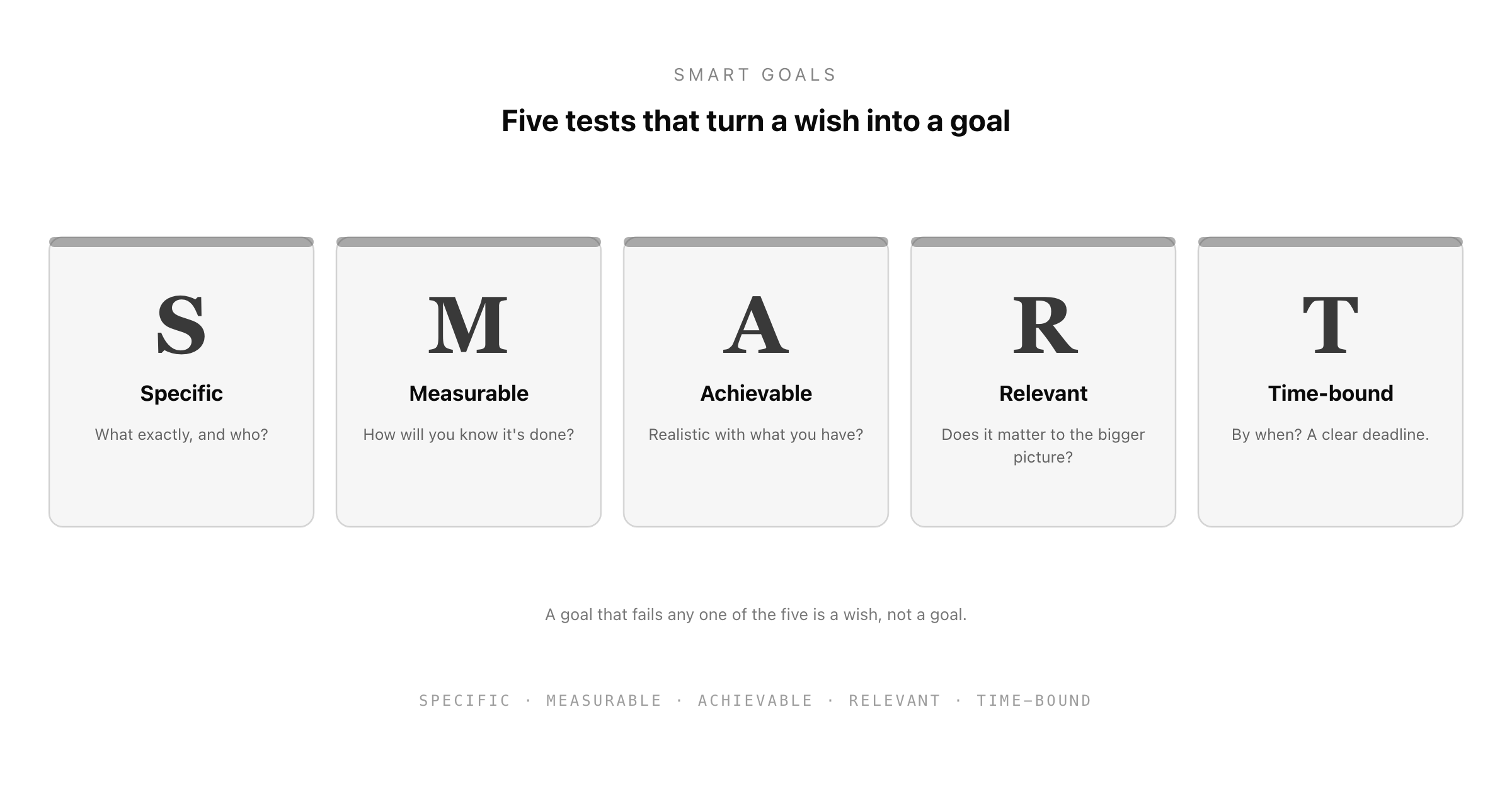
The whole idea fits in one line: a goal should be Specific, Measurable, Achievable, Relevant, and Time-bound. Miss any one of those and you have a good intention rather than a goal. Everything below unpacks the five and shows how to put them to work. When you set goals in a review, capturing them on a structured form keeps them visible and trackable; you can clone the Good Form performance review template, which has a goals section built in.
The short version:
- SMART stands for Specific, Measurable, Achievable, Relevant, and Time-bound. A goal that fails any one of the five is a wish, not a goal.
- Specific: say exactly what will be done, and by whom. Vague goals cannot be acted on.
- Measurable: define how you will know it is done. If you cannot measure it, you cannot manage it.
- Achievable and Relevant: make it realistic with the resources you have, and make sure it matters to the bigger picture.
- Time-bound: give it a deadline. A goal without a date is a goal without urgency.
- Use them in reviews and development plans, review progress regularly, and write them down. Capture them on a form.
What Are SMART Goals?
A SMART goal is a goal written to meet five criteria, captured in the acronym SMART: Specific, Measurable, Achievable, Relevant, and Time-bound. The framework has been a staple of management since the 1980s because it turns the fuzzy ambitions people tend to set ("improve quality," "be more productive") into concrete commitments you can plan around and judge. The power is not in the acronym itself but in what it forces you to do: every letter is a question that exposes a weakness in a poorly written goal.
It matters most exactly where goals are usually set and then forgotten: in performance reviews, development plans, and one-to-ones. A goal that is not SMART cannot really be reviewed, because there is no agreed definition of success, which is how "we'll work on your leadership" ends up meaning something different to the manager and the employee a year later. SMART removes the ambiguity up front.
The Five Criteria, One by One
S, Specific
A specific goal states exactly what will be accomplished, and ideally who is responsible. The test is whether someone else could read it and know precisely what is meant. "Improve customer service" is not specific; "reduce average first-response time on support tickets" is. Specificity is the foundation, because you cannot measure, plan, or judge a goal you cannot pin down.
M, Measurable
A measurable goal defines how you will know it has been achieved, usually with a number. If you cannot measure it, you cannot tell whether you are making progress or when you are done. "Reduce average first-response time on support tickets to under two hours" is measurable; the earlier version was not. The measure does not have to be a metric in a dashboard, it can be a deliverable ("publish the onboarding guide"), but it must be unambiguous.
A, Achievable
An achievable goal is realistic given the time, skills, and resources actually available. A goal that is impossible demotivates rather than motivates, and a goal that is too easy wastes the exercise. Achievable does not mean unambitious, it means honestly stretching: hard enough to matter, possible enough to believe in. If a goal depends on resources or decisions outside the person's control, it usually fails this test.
R, Relevant
A relevant goal matters to the bigger picture: the team's priorities, the business's objectives, or the person's own development. A goal can be perfectly specific and measurable and still be a waste of time if it is not aligned with what actually needs to happen. The relevance test is "why does this matter, and to what?" If you cannot answer, the goal probably should not be on the list.
T, Time-bound
A time-bound goal has a deadline. A goal without a date has no urgency and tends to slip indefinitely, because there is always something more pressing. The deadline creates the accountability that turns intention into action, and it sets the natural point to review whether the goal was met. "By the end of Q3" turns a someday into a commitment.
How to Write a SMART Goal
The easiest way to write a SMART goal is to start with the vague version everyone reaches for first, then fix it one letter at a time.
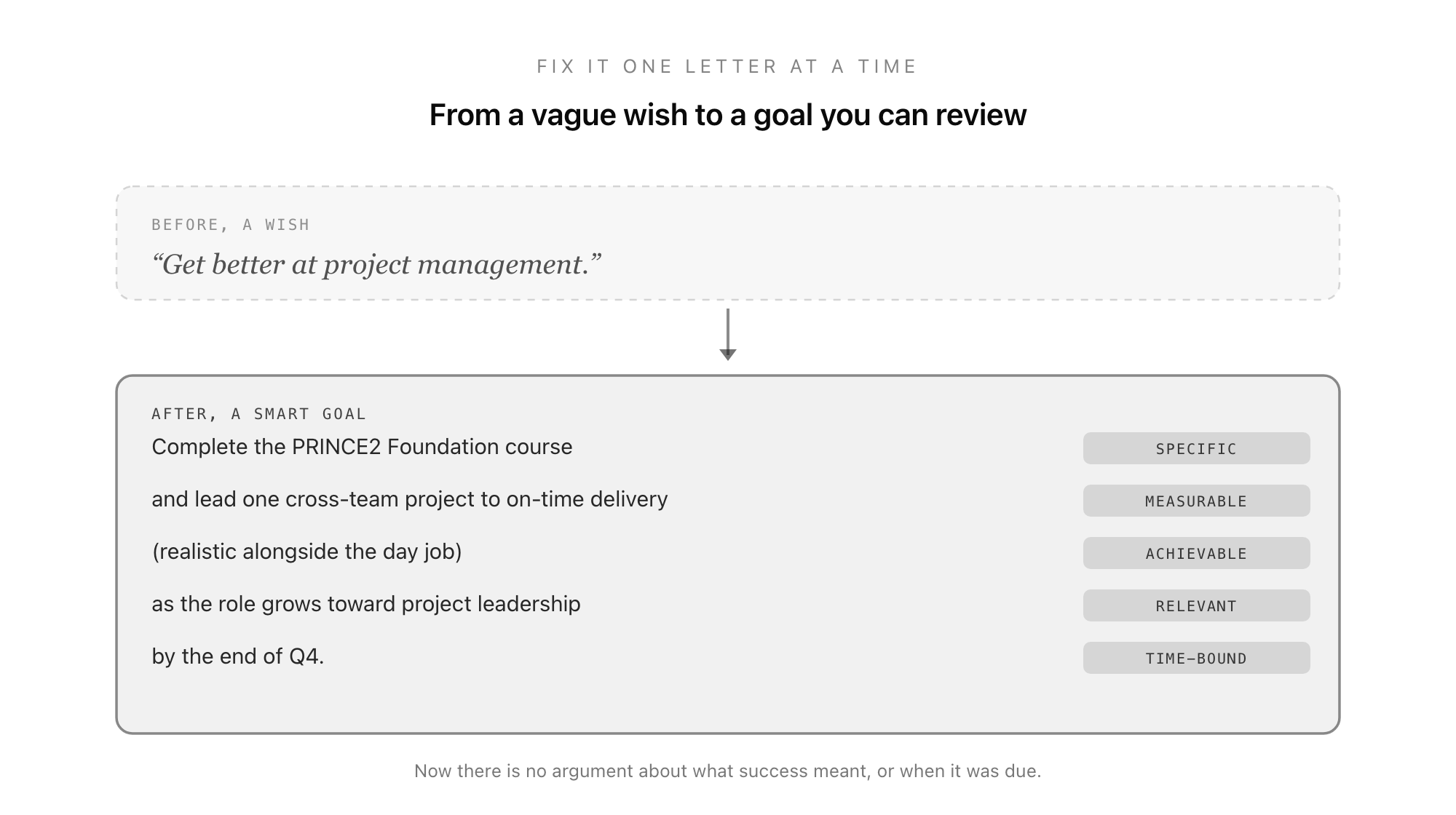
Take a typical vague goal: "Get better at project management." Now run it through SMART:
- Specific: better how? Say what "better" looks like: leading a project end to end, or earning a qualification.
- Measurable: add a clear marker of done: complete a named course, or deliver a project on time.
- Achievable: is it realistic this quarter alongside the day job? Scope it to fit.
- Relevant: does it matter? Yes, if the role is growing toward project leadership.
- Time-bound: by when? Set a date.
The result: "Complete the PRINCE2 Foundation course and lead one cross-team project to on-time delivery by the end of Q4." That is a goal you can plan for, support, and review without any argument about what success meant.
SMART Goals Examples
The fastest way to internalise the framework is to see good examples across different roles. Each of these is specific, measurable, achievable, relevant, and dated.
- Sales: "Increase qualified outbound meetings booked from 8 to 12 per week by the end of the quarter."
- Customer support: "Raise the team's customer satisfaction score from 86% to 90% over the next two quarters."
- Marketing: "Publish four case studies and grow organic blog traffic by 20% by year-end."
- Engineering: "Cut the average pull-request review time from 30 hours to under 12 hours within three months."
- Development and learning: "Complete the data analytics certificate and apply it by building one reporting dashboard for the team by the end of Q2."
- Management: "Hold monthly one-to-ones with every direct report and run a structured performance review for each by year-end."
Notice that each one names a number or a clear deliverable and a deadline. That is what makes them reviewable, and it is the single most common thing missing from real-world goals.
SMART Goals in Performance Reviews and Development Plans
SMART goals earn their keep in the recurring rituals of managing people. In a performance review, they turn the conversation from a vague sense of how things went into a clear set of commitments for the next period, agreed and written down, so the next review has something concrete to assess against. Our guide to the performance review template covers how to structure that whole conversation, with goal-setting as a core part of it.
In a development plan, SMART goals turn "we'd like you to grow" into a specific, supported path: the course to take, the project to lead, the skill to demonstrate, each with a date. And when performance is falling short, a performance improvement plan lives or dies on whether its goals are SMART, because a PIP with vague goals is neither fair to the employee nor defensible for the organisation.
The thread through all of these is the same: a goal is only useful if everyone agrees what success looks like and when it is due. SMART is how you get that agreement on paper before the work starts.
Common Mistakes and Limits
SMART is a tool, not a religion, and using it well means knowing where it bends.
- Vague measures. The most common failure is a goal that claims to be measurable but is not ("improve communication" with no marker of done). If you cannot say how you would prove it, it is not measurable.
- Sandbagging. Goals set deliberately low to guarantee a good review defeat the purpose. Achievable means realistic, not trivial.
- Set and forget. A SMART goal written in January and never looked at until December is not managed. Review progress in your one-to-ones.
- Everything must be SMART. Not every worthwhile aim fits neatly. Big, open-ended "stretch" goals and exploratory work sometimes resist tidy measurement, and forcing them into SMART can shrink the ambition. Use SMART for the goals that should be concrete, and do not let it strangle the ones that should be bold.
Used with judgment, though, SMART is the most reliable way to turn intentions into outcomes, especially for the goals you set with and for other people.
Set and Track Goals on One Form
A SMART goal that lives in someone's memory, or in a document nobody opens, is a goal that quietly slips. The fix is to write goals down where they are visible and reviewable, the same place every time.
This is what Good Form is built for. When you run a review, you can clone the performance review template and capture each person's SMART goals alongside their ratings and notes, so the goals are recorded, shared, and waiting to be assessed at the next review rather than forgotten. Pair it with a clear performance review process and, where needed, a fair performance improvement plan, and the goals you set actually drive the outcomes you wanted. Write them SMART, write them down, and review them on a schedule.