The performance review template most companies hand out is the same 12-tab Excel document that lives on a shared drive, gets emailed around every March, and produces 30 pages of manager free-text that nobody ever references again. It exists because the board asked for a performance process, not because anyone believes it improves performance. This guide rebuilds the performance review template around one question: what would a template look like if managers actually wanted to fill it in and employees actually wanted to read the result.
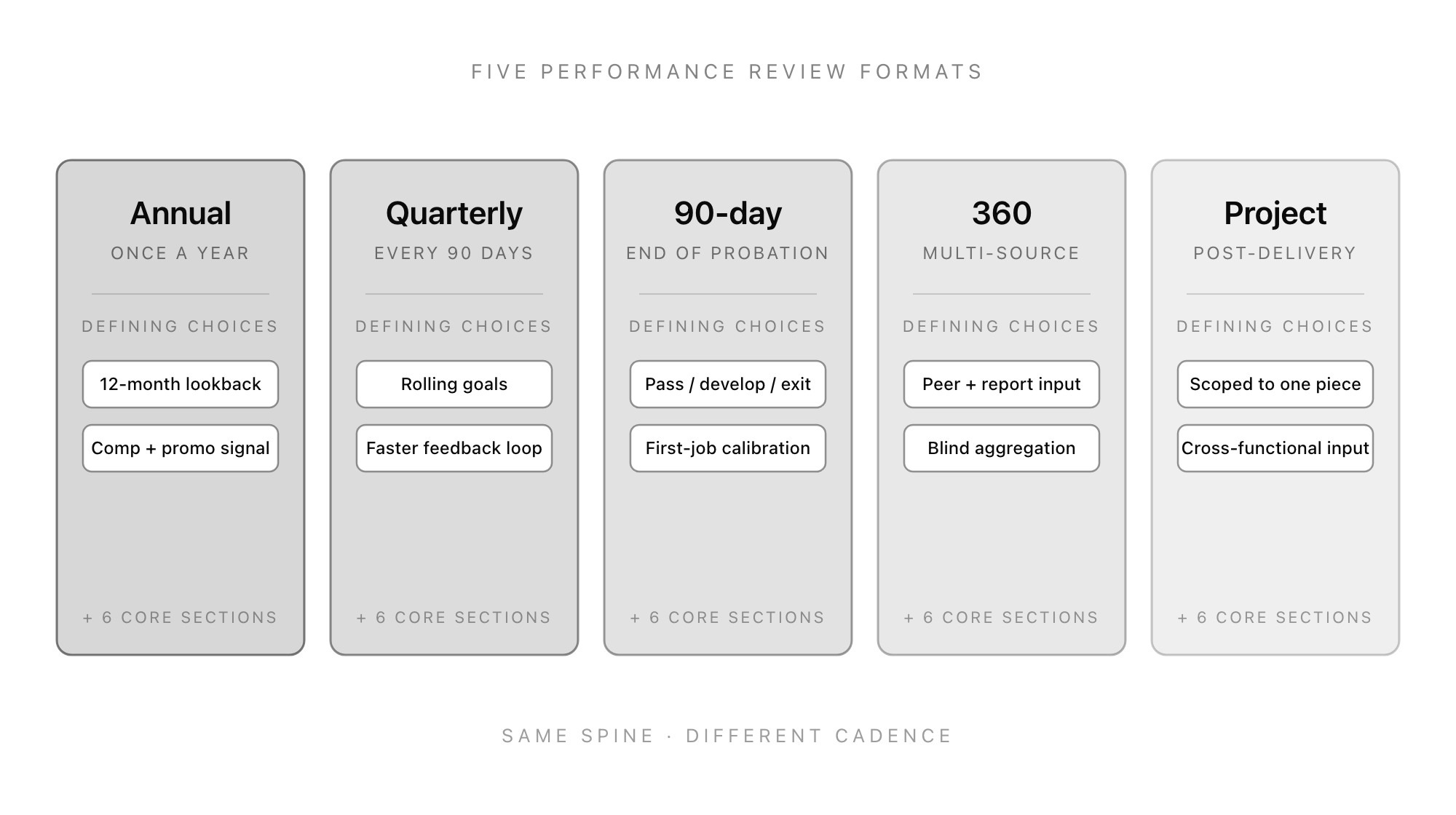
The answer is six core sections, a single rating scale, and five format variants for the hiring and review cadences small teams actually run: annual, quarterly, 90-day probation, 360 multi-source, and project-based. Every variant shares the same spine. The differences are cadence, reviewer count, and what you do with the output. If you want to run the whole review off a form that the manager fills in on their phone between meetings and that threads the scores into your HR record automatically, the Good Form review capture template is the fastest way to do it.
The short version:
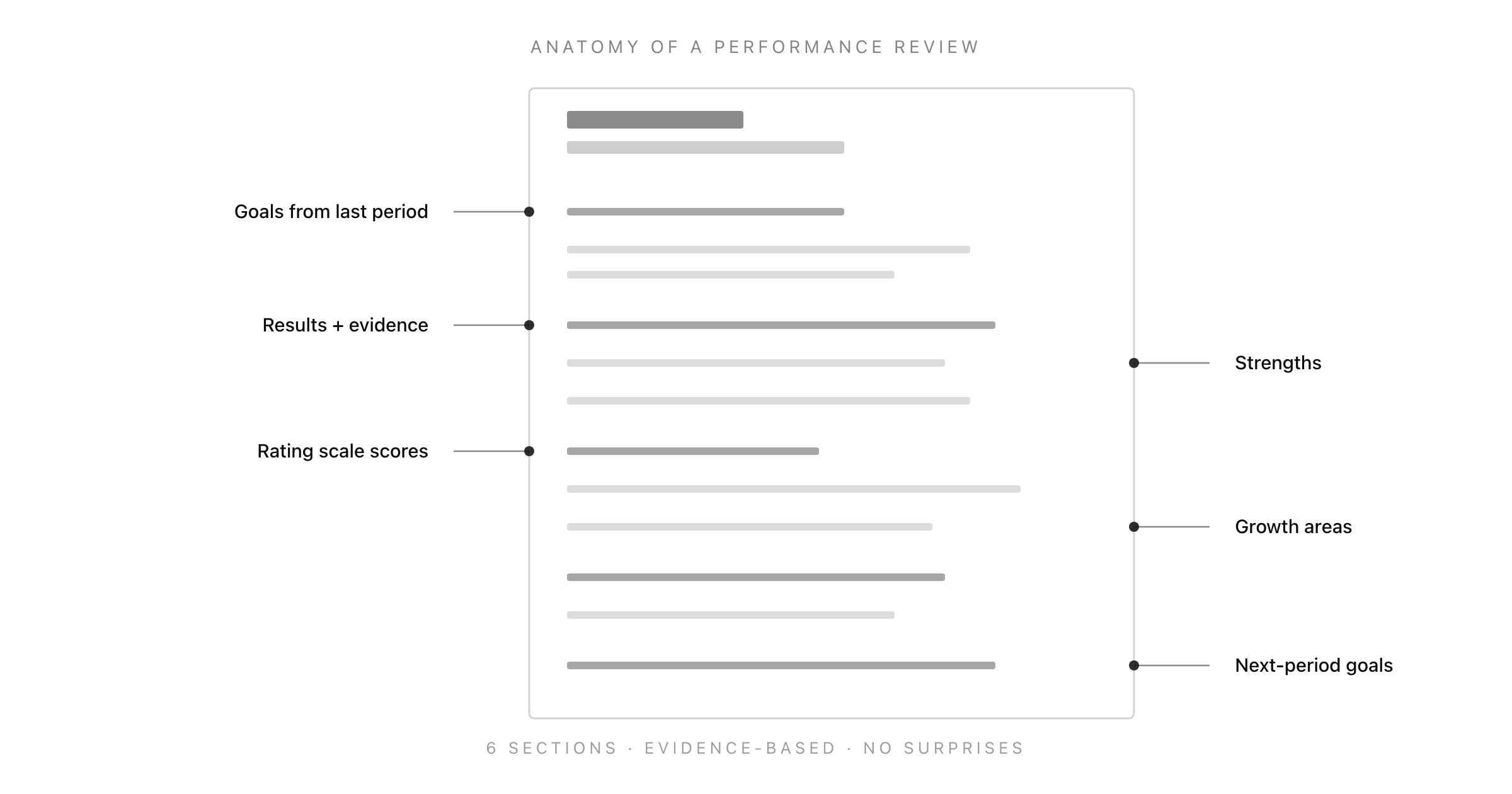
- Every performance review template needs six sections: goals from last period, results with evidence, rating-scale scores, strengths, growth areas, and next-period goals. Anything more is optional.
- Use one rating scale across the whole company. Five points (Below Expectations, Developing, Meets, Exceeds, Outstanding) with one-line anchors per point kills calibration drift.
- The annual review is a terrible feedback tool and a good compensation signal. Separate the two jobs. Give feedback quarterly or monthly. Use the annual review to set pay bands.
- Evidence is the whole game. "Consistently high-quality work" is not evidence. "Shipped 4 of 4 roadmap items on time, with a user-reported bug rate of 0.8% vs the team median of 1.4%" is evidence.
- Collect the review with a Good Form review template so the manager and the employee both see the same structured record, scores roll up into the calibration meeting, and growth areas route into the individual development plan automatically.
Why Performance Reviews Fail Before You Even Write the Template
Managers hate writing reviews. Employees hate reading them. The HR team hates chasing them. Everyone agrees the annual review is broken, and every year they run it again anyway, because the performance review template is the only structured conversation about performance that actually happens.
Most of the failure comes from four design mistakes, not from the idea of a review:
- The template asks for prose when it should ask for evidence. A box labelled "Please summarise the employee's contributions over the last 12 months" invites half a page of adjectives. A box labelled "List three shipped projects with the measurable outcome of each" invites a list.
- The rating scale is vague or invisible. If managers across a company are rating on different scales (three points versus five, numeric versus descriptive, with anchors or without), calibration becomes impossible and the comp linkage is random.
- Feedback and compensation ride on the same document. The manager who wants to give honest growth feedback has to weigh it against the fact that the same document will set next year's pay. So they soften the feedback. So the feedback is useless.
- The output has no route. The review gets written, filed, and never surfaces again until the next cycle. Growth areas identified in Q1 do not route into a development plan, so they are not worked on, so they appear again in Q2, Q3, Q4, and Q1 of next year.
The six-section spine below fixes mistakes one and two. The five variants in the next section separate feedback from comp (mistake three). And the section on routing the output (mistake four) is the difference between a review template that improves performance and one that just generates paperwork.
The Six Sections Every Performance Review Template Needs
These sections appear in every variant. Only the cadence and the reviewer list change.
1. Goals From the Last Period
The starting anchor of every review is the set of goals that were agreed at the end of the previous cycle. Not invented at review time. Not reverse-engineered from what the employee actually did. The goals should have been written down, shared with the manager, and visible throughout the period.
Each goal needs a one-line status: met, partially met, not met, or superseded (meaning the business priority shifted and the goal was consciously dropped). "Superseded" is the most-abused status and the most important one to use honestly. If 60% of the goals were superseded, the template has uncovered a business-prioritisation problem, not a performance problem.
2. Results With Evidence
For each goal and each significant piece of work in the period, the employee or the manager writes one line of evidence. Evidence is measurable and specific: numbers, dates, named deliverables, named stakeholders.
The rule: if the evidence sentence could apply to ten other people in the team, it is not evidence. "Worked well with stakeholders" applies to everyone. "Led the API migration project from 12 May to 30 July, moving 47 endpoints off v1, zero production incidents reported during cutover" applies to one person doing one thing.
The template should require three to six evidence lines. Fewer than three and the review has no support. More than six and the reviewer is stacking filler.
3. Rating-Scale Scores
One scale across the whole company. Five points is the sweet spot for most teams:
- 1 · Below Expectations. Consistently below the standard for the role and grade.
- 2 · Developing. Meeting expectations in some areas, improvement needed in others.
- 3 · Meets Expectations. Reliably delivering what the role and grade require.
- 4 · Exceeds Expectations. Consistently exceeding the role standard, with visible wider impact.
- 5 · Outstanding. Role-model performance. Rare. Expected in the top 5% of the team or below.
Score against the same five dimensions every cycle: delivery, quality, collaboration, ownership, and growth. Every dimension gets a number and a one-sentence anchor. The five dimensions are a deliberate choice: skill-specific criteria (e.g. "SQL proficiency") drift as roles evolve and do not compare across the team. The five above are stable across every role in a small company.
4. Strengths
Three specific strengths, each linked to one piece of evidence from section two. Strengths are not personality compliments. They are patterns in the work that the employee should lean into and the company should build roles around.
Good: "Consistently translates ambiguous briefs into shippable scopes within 48 hours, evidenced by the Q1 pricing project and the Q2 onboarding refactor."
Bad: "Hard-working team player with a positive attitude."
5. Growth Areas
Two to three specific growth areas, each paired with what the employee will do differently next period. Not "needs to communicate better", but "will lead the standup once per week in Q2 to build muscle on verbal status updates".
The pairing matters. A growth area without a concrete action is a complaint. A growth area with a concrete action is a development plan.
6. Next-Period Goals
Three to five goals for the next period, agreed between manager and employee before the review is finalised. Each goal states the outcome (not the activity), the measure, and the deadline.
Outcome: "Customer support response time under 4 hours for 95% of tickets." Activity version (weaker): "Improve customer support response times."
Goals should be ambitious enough that meeting all of them lands you in the top of the rating scale and missing one or two is the expected norm. A template that produces all-met goals every cycle is rewarding sandbagging.
The Five Performance Review Template Variants
Every variant uses the six-section spine. The variants differ only in cadence, reviewer list, and what happens with the output.
Template 1: The Annual Performance Review
The default in most companies. Run once a year, aligned to the fiscal year or the calendar year. The output feeds the comp review and the promotion slate.
Performance Review, Annual, [Employee Name], [Period: Jan 2026 - Dec 2026]

1. Goals from the last period
- Goal 1: [text] - Status: [Met / Partially / Not / Superseded] - Evidence: [one line]
- Goal 2: [text] - Status: [...] - Evidence: [...]
- Goal 3: [text] - Status: [...] - Evidence: [...]

2. Results with evidence (3-6 lines)
- [Measurable outcome with date, number, or named deliverable]
- [...]

3. Rating scale (1-5, with anchor)
- Delivery: [score] - [anchor sentence]
- Quality: [score] - [anchor sentence]
- Collaboration: [score] - [anchor sentence]
- Ownership: [score] - [anchor sentence]
- Growth: [score] - [anchor sentence]
- Overall: [score] - [anchor sentence]

4. Strengths (3)
- [strength] - evidence: [...]

5. Growth areas with actions (2-3)
- [area] - action next period: [...]

6. Next-period goals (3-5)
- [outcome + measure + deadline]

Employee comments: [optional]
Manager signature / date / Employee signature / date
The key design choice for the annual: do not use it as the primary feedback mechanism. By the time you write an annual review, the feedback is already 11 months old. Give feedback quarterly or monthly. Use the annual to calibrate comp.
Template 2: The Quarterly Performance Review
The feedback review. Runs every 90 days. Shorter than the annual, focused on the most recent quarter, and decoupled from compensation.
The changes from the annual template:
- Goals are for one quarter, so typically three to four instead of three to five.
- Evidence is limited to three lines (less has happened).
- Rating scale is optional. Many teams run quarterly reviews as rating-free conversations with only the six-section structure.
- The "strengths" and "growth areas" sections are the real payload. These are what the quarterly exists for.
- Output routes into the development plan, not into comp.
Quarterly Review, [Q1 2026]

1. Quarterly goals (3-4)
- Goal: [text] - Status: [...]
- ...

2. Highlights with evidence (2-3 lines)
- [one shipped thing or one significant outcome]

3. [Optional: rating scale]

4. Strengths observed this quarter
- [strength] - when: [...]

5. Growth areas with actions for next quarter
- [area] - action: [...]

6. Next quarter goals (3-4)
- [outcome + measure]
The thing that makes the quarterly work is the 90-day loop. A growth area raised in Q1 should have evidence of improvement (or not) by Q2. That cadence forces development to actually happen, rather than getting parked until next year's annual.
Template 3: The 90-Day Probation Review
Different purpose, different output. The 90-day review decides three things: is the person on track to pass probation, do they need a development period, or is it a wrong fit.
The output is one of three decisions: Pass, Extend probation by 30-60 days with specific milestones, Exit the probation.
90-Day Probation Review, [Employee Name], [Start: 1 Feb 2026, Review: 1 May 2026]

1. Onboarding goals from day one
- [goal] - Status: [met / partial / not]

2. Observations with evidence
- Delivery: [specific examples from the 90 days]
- Quality: [...]
- Fit: [culture and collaboration observations]

3. Rating scale (against role expectations, not tenure)
- [same five dimensions]

4. Strengths observed
- [strength]

5. Growth areas identified
- [area] - plan: [what will happen next]

6. Decision
- [Pass / Extend 30 days with milestones / Exit]

If Extend: specific milestones for the extension period.
The most common template failure for 90-day reviews is using the same scale as a tenured employee. A probationer should not be scored against senior-career benchmarks. The anchor is "role expectations for someone three months in", not "role expectations in general". Otherwise the template will exit competent new hires and keep underperformers.
Template 4: The 360 Review
Multi-source feedback. The employee is reviewed by their manager, two to four peers, one to two people they manage (if applicable), and optionally one or two cross-functional stakeholders. The output is aggregated.
The design choices that make 360s work or fail:
- Anonymised aggregation. Individual peer responses are not revealed verbatim to the employee. Patterns are surfaced; specific identities are not. Without anonymity, peers soften, and the feedback becomes useless.
- Minimum response threshold. Do not surface a score or theme unless three or more respondents surfaced it. Single-source criticism in a 360 is toxic and unrepresentative.
- Manager owns the synthesis. The 360 is not a direct channel from peers to employee. The manager reads the raw input, identifies the patterns, and writes the synthesis. The employee sees the synthesis, not the raw input.
360 Review, [Employee Name], [Period]

Participants
- Manager: [name]
- Peers (3-5): [list]
- Reports (if applicable): [list]
- Cross-functional (1-2): [list]

Aggregated themes (managerial synthesis)
- Strengths (at least 3 respondents): [theme + how it shows up]
- Growth areas (at least 3 respondents): [theme + how it shows up]

Rating scale (aggregated)
- [five dimensions, average score, range]

Development plan coming out of the 360
- [action per growth area]
The 360 template is the most expensive review to run. Budget 60-90 minutes of respondent time per employee. Run it annually or semi-annually for senior roles only; quarterly 360s burn out the reviewers.
Template 5: The Project Performance Review
Post-delivery, scoped to a single project. Run when a significant piece of work ships, not on a calendar cadence. Good for cross-functional teams where the person's calendar-year output is hard to summarise but individual project contributions are clear.
Project Performance Review, [Project Name], [Delivery Date]

Project summary
- Goal: [what shipping was]
- Outcome: [what actually happened]
- Employee's role: [one line]

Performance on this project (3-6 lines of evidence)
- [specific contribution with measurable outcome]

Rating scale (scoped to this project)
- [five dimensions]

Strengths shown on this project
- [with evidence from the project]

Growth areas surfaced
- [with action for the next project]

Carry-forwards for the next project or annual review
- [things to track]
Project reviews are most valuable in engineering and design teams where someone might work on two or three major projects a year and annual reviews lose the project-level texture.
How to Actually Run the Review (The Part the Template Cannot Fix)
A template is necessary but not sufficient. The review conversation and the review routing matter more than the document.
The 48-Hour Rule
Share the draft review with the employee 48 hours before the review meeting. Not the same day. Not at 9pm the night before. Forty-eight hours gives the employee time to read, process, and prepare a thoughtful response rather than reacting in real time.
The Conversation Structure
Run the review in this order:
- Employee speaks first, on the six sections, for 10-15 minutes uninterrupted.
- Manager speaks second, on the same six sections, for 10-15 minutes.
- Both walk through disagreements, one section at a time, until the written record reflects an agreed account.
- Agree the next-period goals together, with both parties editing the document in real time.
If the manager speaks first, the employee anchors on the manager's framing. The self-assessment becomes performative. Employee-first surfaces the employee's honest read before anchoring contamination.
Routing the Output
Every review needs three downstream routes or the document is paperwork:
- Development plan. Growth areas route into a specific development plan with check-ins before the next review.
- Compensation calibration. Rating scale scores route into the team calibration meeting. Individual manager scores are not reliable until they are compared across the team.
- Career conversation. The rating plus the growth areas plus the strengths are the input for the annual career conversation (promotion, lateral move, senior track, management track).
Without these routes, the review is theatre.
Collect the Review With a Good Form
The place performance reviews leak is the format. Managers draft in Word, employees respond in Google Docs, someone pastes scores into an HR Excel sheet, and three months later nobody can find the growth areas when the development plan is being set.
A form is the fix. One structured document per review, captured once, with the scores automatically rolling into the calibration view and the growth areas automatically routing into the development plan.
The Good Form performance review template captures:
- All six spine sections with evidence prompts that stop free-text wandering
- The five-dimension rating scale with the one-line anchors pre-populated
- Strengths and growth areas as structured lists, not paragraphs
- Next-period goals as outcome plus measure plus deadline
- Employee self-assessment and manager assessment as two views of the same record
If you are running the full HR cycle, our employee onboarding form guide covers what happens in the first 90 days before the first review, and the exit interview questions guide covers the review you want to run last. For the hiring side, the interview feedback form uses the same evidence-based structure.
A good performance review template is not the thing that improves performance. A good performance review template is the thing that makes the conversations about performance honest, and the actions that follow them routine. The document is a scaffolding, not a substitute.