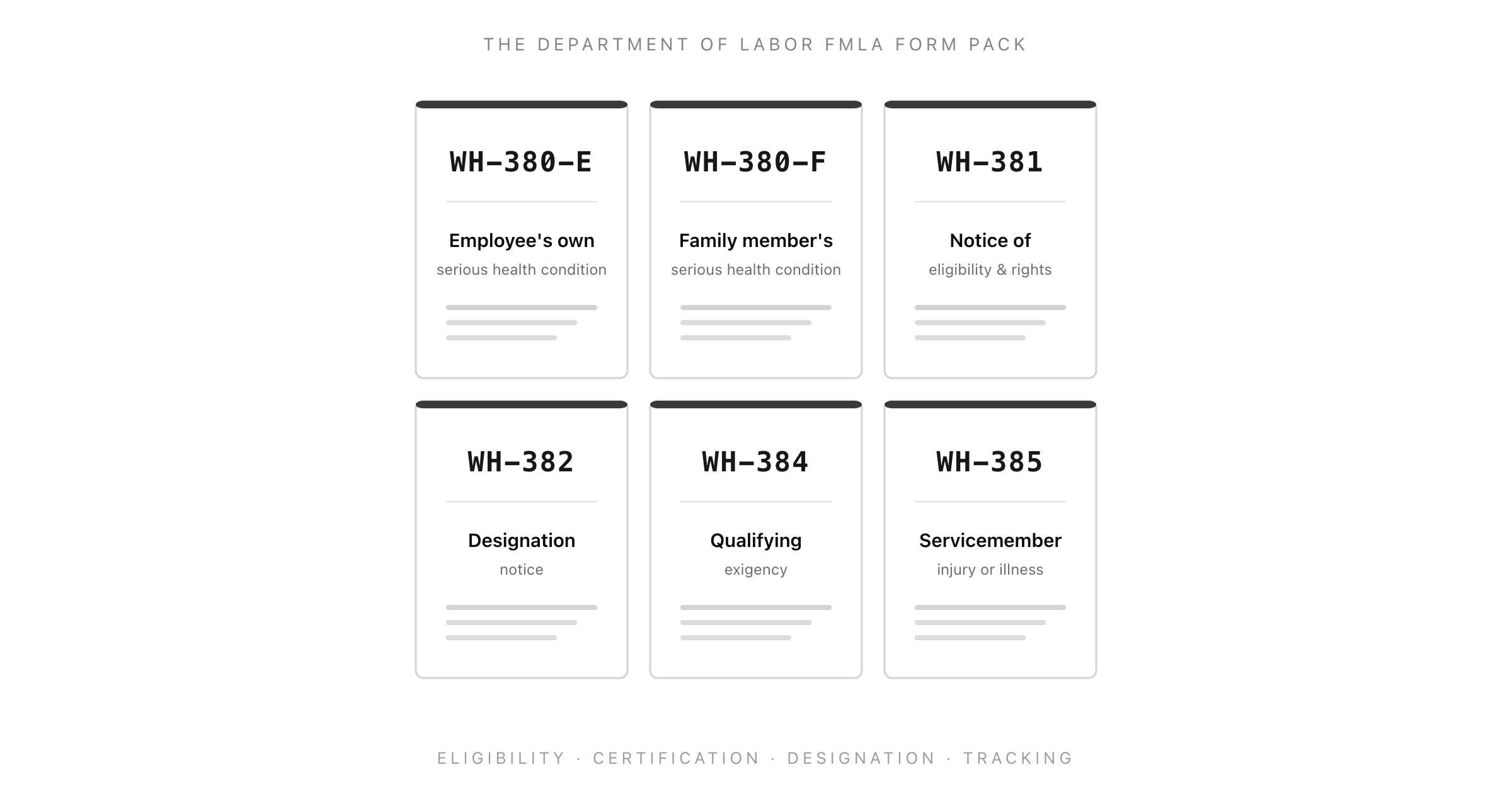
The FMLA form is not one document. It is a pack of six prescribed Department of Labor forms (WH-380-E, WH-380-F, WH-381, WH-382, WH-384, WH-385) plus an intake form HR builds itself, and the difference between a clean leave file and a Department of Labor complaint usually comes down to which one was sent when. The forms themselves are short. The clocks they start, the rights they trigger, and the evidence they record are not. A small HR team handling the first FMLA leave of the year often discovers, three months in, that they sent the wrong certification form, missed the five-business-day eligibility notice, or never issued a designation notice at all, which means the leave was technically not even FMLA-protected.
This guide walks through the entire FMLA form pack, what each WH-prefixed form does, when to use which, the 12-week eligibility math and the three edge cases that trip most HR teams, and the intake workflow that keeps the file defensible. The guidance is for the small HR team, the office manager wearing the HR hat, the operations lead who just inherited a leave request and has 5 business days to issue an eligibility notice. If you want to skip ahead and put the intake step on a form your employees can submit in three minutes, clone the Good Form FMLA leave request template.
The short version:
- There are six prescribed FMLA forms, not one. WH-380-E and WH-380-F are certifications (employee's own and family member's serious health condition); WH-381 is the eligibility notice; WH-382 is the designation notice; WH-384 covers qualifying military exigency; WH-385 covers servicemember caregiver leave. They are optional in form but mandatory in content; if you write your own you have to capture exactly what the WH version captures.
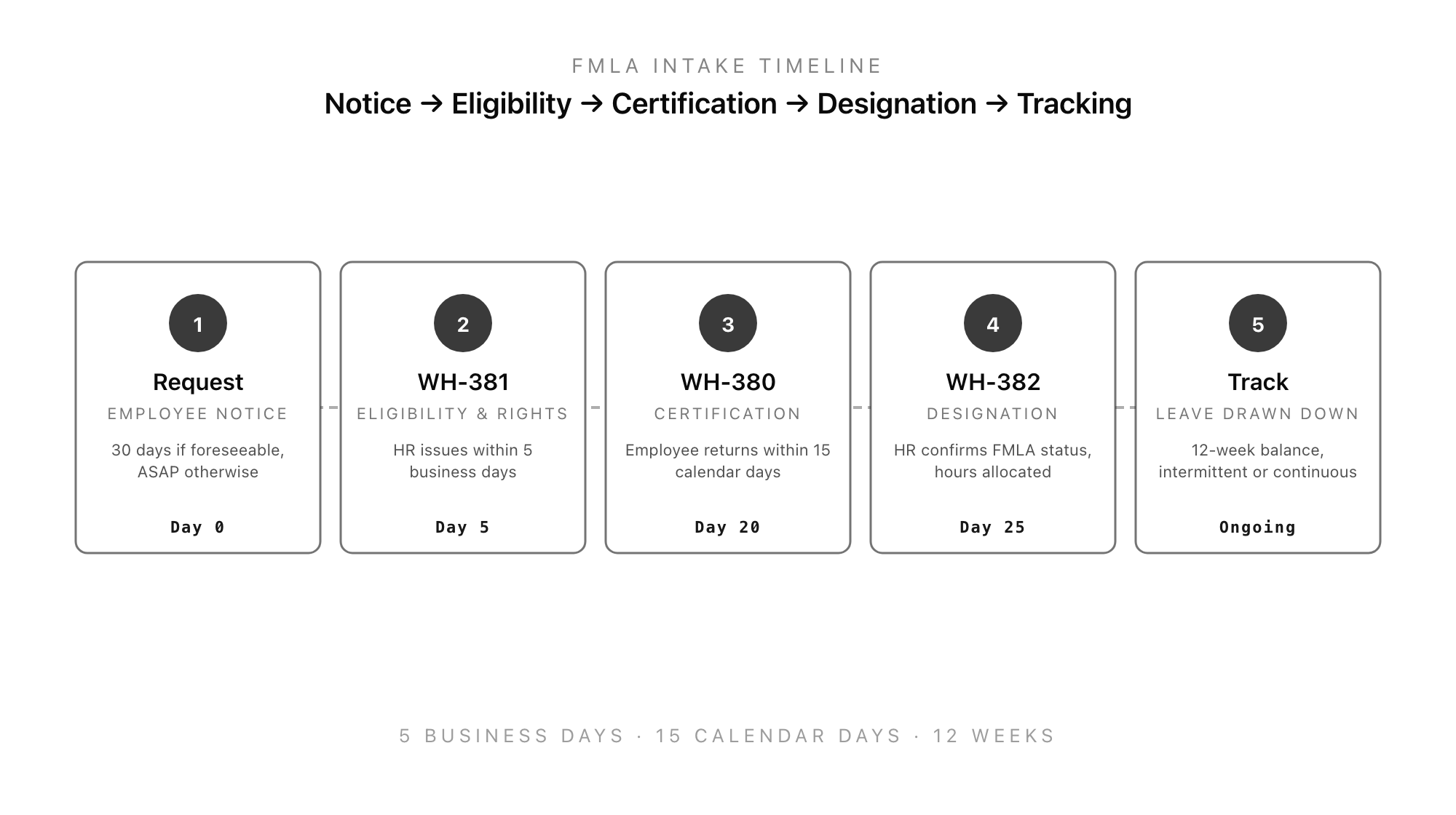
- The FMLA clocks: 30 days advance notice from the employee if foreseeable (ASAP otherwise); 5 business days for HR to issue the WH-381 eligibility and rights notice; 15 calendar days for the employee to return the certification; 5 business days for HR to issue the WH-382 designation notice once certification is received. Missing any of these creates exposure.
- Eligibility has three independent tests, all of which must pass: 12 months of service (need not be consecutive), 1,250 hours worked in the prior 12 months, and a worksite with 50 employees within a 75-mile radius. Two of those tests are routinely miscounted.
- The 12-week entitlement is per leave year, not calendar year, and the employer must commit to one of four leave-year definitions in writing. Pick the one most favourable to operations once and document it.
- Certifications must be returned within 15 calendar days, and incomplete certifications get one round of cure (7 calendar days) before the leave can be denied. Authentication and clarification are allowed; second and third opinions are allowed at employer expense for serious-health-condition cases.
- Clone the Good Form FMLA leave request template to capture the request cleanly, then attach it to the WH-381 issuance step so the entire intake is timestamped, structured, and retrievable when the leave is reviewed.
What FMLA Actually Covers (and Who Each Form Is For)
The Family and Medical Leave Act of 1993, administered by the Wage and Hour Division of the US Department of Labor, gives eligible employees of covered employers up to 12 weeks of unpaid, job-protected leave per leave year for a defined set of qualifying reasons, and up to 26 weeks of military caregiver leave in a single 12-month period. The leave is unpaid in itself, although the employer can require (and the employee can elect) to substitute accrued paid time off, and most state and employer policies layer paid leave on top.
The qualifying reasons are narrow. They are:
- Birth of a child and bonding within 12 months of the birth. Available to either parent, including same-sex parents and adoptive parents. The 12-week entitlement runs out at the end of the 12-month bonding window if not used.
- Placement of a child for adoption or foster care, and bonding within 12 months of placement. Same structure as birth.
- Care for a spouse, child, or parent with a serious health condition. "Spouse" covers same-sex spouses since Obergefell (2015); "parent" includes someone who stood in loco parentis; "child" includes biological, adopted, foster, step, legal-ward, and in-loco-parentis children under 18, or 18 and over if incapable of self-care due to a mental or physical disability.
- Employee's own serious health condition that prevents performance of essential job functions. This is where the bulk of FMLA volume sits and where the WH-380-E certification gets used.
- Qualifying exigency arising from a family member's covered active military duty. Triggers the WH-384.
- Care for a covered servicemember with a serious injury or illness (military caregiver leave). Up to 26 weeks in a single 12-month period; triggers the WH-385.
The form a leave triggers depends on which qualifying reason it falls under. Birth, adoption, and foster placement do not require a medical certification (you cannot ask for a doctor's note for a healthy birth or an adoption). Care for a spouse, child, or parent triggers WH-380-F. Employee's own serious health condition triggers WH-380-E. Qualifying exigency triggers WH-384. Servicemember caregiver leave triggers WH-385. Every leave, regardless of reason, triggers the eligibility notice (WH-381) and the designation notice (WH-382).
The Six Department of Labor FMLA Forms Decoded
The forms are downloadable from the Department of Labor at dol.gov/agencies/whd/fmla/forms. They were last updated in mid-2020 and the expiration dates on the OMB-approved versions are extended periodically; using an older version is not fatal so long as it captures the same information. The forms are optional, in the sense that an employer can create its own version, but the content is mandatory: an employer-built form has to ask for everything the WH version asks for and cannot ask for more than the WH version asks for. The DOL publishes the forms in fillable PDF and Spanish translations.
WH-380-E: Certification of Health Care Provider for Employee's Serious Health Condition
The form HR sends when an employee requests leave for their own serious health condition. The employee gives it to their healthcare provider, who completes the medical sections (nature of the condition, expected duration, treatment regimen, whether the employee can perform essential functions, intermittent or reduced-schedule needs). The completed form is returned to HR within 15 calendar days. This is the certification with the highest volume in most workplaces because employee-illness leaves outnumber every other category combined.
The single most common mistake at this stage is HR asking for a diagnosis. Diagnosis is not on the form and the employer is not entitled to it. The form asks whether the condition meets the regulatory definition of "serious health condition" and what the functional limitations are. That is what HR is allowed to know.
WH-380-F: Certification of Health Care Provider for Family Member's Serious Health Condition
The mirror image of WH-380-E for when the employee is requesting leave to care for a spouse, child, or parent with a serious health condition. The form is given by the employee to the family member's healthcare provider, who completes the medical sections about the patient (not the employee). The same 15-calendar-day return clock applies.
The complication here is the GINA (Genetic Information Nondiscrimination Act) safe harbour. If the family member's condition is genetic in nature, HR cannot use the information for any purpose other than administering FMLA, and the form contains the standard GINA safe-harbour notice telling the provider not to volunteer genetic information. Keep WH-380-F filings in the medical file, separate from the personnel file, and limit access to those administering the leave.
WH-381: Notice of Eligibility and Rights & Responsibilities
The form HR sends to the employee within 5 business days of receiving notice (or learning) that a request might qualify for FMLA. WH-381 has two functions: it tells the employee whether they are eligible for FMLA, and it lays out the rights and responsibilities of both parties during the leave (the requirement to provide certification, the right to substitute paid leave, the maintenance of group health benefits, the obligation to give periodic status updates, and the consequences of failing to return).
The 5-business-day clock is the one that quietly fails most often in small HR teams, because the request arrives via Slack on a Friday afternoon, gets buried over the weekend, and the team realises on Wednesday that they are now late. Build the workflow so the WH-381 is issued the same business day the request is logged. The clock starts when HR has enough information to know FMLA might apply, which can be earlier than when the employee uses the words "FMLA leave"; if an employee says "I need a few weeks off because of surgery," that is enough notice to start the clock.
WH-382: Designation Notice
The form HR sends to the employee within 5 business days of receiving the completed certification, telling them whether the leave is approved as FMLA-protected, how the 12-week balance is being counted (continuous, intermittent, or reduced-schedule), what happens with paid-leave substitution, and what the requirement to use a fitness-for-duty certification on return looks like. Without a designation notice, the leave is not officially FMLA-counted, which sounds like a gift to the employee until the employer realises they have just given the employee 12 weeks of leave that does not eat into the FMLA balance, meaning the employee may still have 12 more weeks available.
The 5-business-day clock here starts when HR has enough information to designate, which means a complete certification (or a refusal-to-certify position the employee maintains after a 7-day cure period). If the certification is incomplete or unclear, HR can request authentication or clarification from the provider (with employee consent), and the clock resets when the corrected version comes back.
WH-384: Certification of Qualifying Exigency for Military Family Leave
The form HR sends when an employee requests leave because a family member is on covered active duty, has been notified of an impending call to covered active duty, or is on rest-and-recuperation leave from a deployed status. WH-384 asks for the family relationship, the active-duty orders or notification, and the specific exigency category (short-notice deployment, military events, childcare or school activities arising from the deployment, financial and legal arrangements, counselling, R&R, post-deployment activities, parental care arising from the deployment).
Volume here is low compared to WH-380-E, but the categories are surprisingly broad and the form is one of the more under-used in the pack because employees often do not know it exists. If the workplace employs reservists or guard members, build the eligibility memo into the standard onboarding pack so the option is visible.
WH-385 (and WH-385-V): Certification for Serious Injury or Illness of a Servicemember
The form HR sends for the 26-week military caregiver leave entitlement, which is the only place in FMLA where the entitlement exceeds 12 weeks. WH-385 covers current servicemembers and certain veterans with serious injuries or illnesses incurred or aggravated in the line of duty; WH-385-V is the specific veteran variant.
Two things to note. First, the 26-week entitlement is per servicemember, per injury, in a single 12-month period, and that 12-month period starts on the first day the caregiver leave is taken (not the leave year). Second, it interacts with the regular 12-week FMLA balance: a single eligible employee cannot exceed 26 weeks of leave in any single 12-month period combining military caregiver leave with other FMLA reasons. The interaction trips most small teams the first time it happens.
The 12-Week Eligibility Math (and the Three Edge Cases That Trip Most HR Teams)
Eligibility has three independent tests. All three must pass at the time the leave begins.
Test 1: 12 months of service. The employee must have been employed by the employer for at least 12 months. The 12 months do not have to be consecutive, but service more than 7 years before the start of leave is generally not counted (with two exceptions: military service covered by USERRA, and a written agreement to count earlier service). A common error is excluding seasonal or part-time periods that should count.
Test 2: 1,250 hours worked in the prior 12 months. Time actually worked counts. Paid time off, holidays, sick leave, and other non-work hours do not. The 1,250 figure is roughly 24 hours per week averaged over the year. For salaried employees who do not track hours, the FLSA presumption is 40 hours per week unless the employer can prove otherwise; that presumption tilts toward eligibility, not against it. The hours test is the most miscounted of the three because companies use payroll hours (which include PTO) instead of actual worked hours.
Test 3: 50 employees within a 75-mile radius. The employee's worksite must have at least 50 employees of the employer, including joint-employer headcount, within a 75-mile radius (driving distance, not as the crow flies, although DOL guidance allows reasonable approximations). For employees who work from home, the worksite is the office to which they report or from which assignments are made, not the home address.
The three edge cases that trip most HR teams:
Edge case 1: the leave year definition. The 12-week entitlement is per leave year, but the employer chooses which of four definitions to use: calendar year, any fixed 12-month period (like a fiscal year), the 12-month period measured forward from the first day of leave, or a 12-month rolling backward from the first day of leave. The rolling-backward method is generally most favourable to the employer because it prevents the employee from stacking 12 weeks at the end of one period and 12 weeks at the start of the next. Pick one and document it before the first FMLA leave; if you do not pick, the rule defaults to whichever method is most favourable to the employee on a leave-by-leave basis, which is the worst outcome for the employer.
Edge case 2: spouses working for the same employer. A married couple who both work for the same covered employer share a combined 12 weeks for bonding leave (birth, adoption, foster placement) and for parent-care leave. They do not share for their own serious health conditions or for spouse or child care. The combined-leave rule is buried in the regulation and routinely missed in small companies that did not realise the policy applied.
Edge case 3: intermittent leave for chronic conditions. Leave for a chronic serious health condition (asthma, migraine, diabetes flare-up) can be taken in increments as small as the employer's payroll system tracks (commonly 6 minutes or 15 minutes). The certification establishes the medical need; the day-to-day usage is up to the employee. The compliance problem is not approving intermittent leave; it is tracking it accurately so the 12-week balance draws down correctly. Build a tracking method that converts every flare-up into a fraction of the 480-hour annual entitlement, or the balance will drift.
The FMLA Intake Workflow That Doesn't Lose Forms
The workflow that keeps a small team out of trouble has six steps and one rule: every step is timestamped and stored in one place.
Step 1: Capture the request. The employee submits a request form (this is the only step where a custom form is appropriate, because none of the WH forms are designed for the initial request). Capture the employee's name, role, start date, qualifying reason, type of leave (continuous, intermittent, reduced-schedule), anticipated dates, and the three eligibility checkboxes (12 months of service, 1,250 hours, 75-mile worksite). The Good Form FMLA leave request template covers exactly these fields.
Step 2: Issue WH-381 within 5 business days. Same business day if at all possible. Mark it with the date issued and store the timestamped copy in the employee's medical file (not the personnel file).
Step 3: Send the appropriate certification form. WH-380-E for own serious health condition, WH-380-F for family member, WH-384 for qualifying exigency, WH-385 for servicemember caregiver leave. Birth, adoption, and foster placement do not require certification. The 15-calendar-day return clock starts when HR sends the form.
Step 4: Review the returned certification. Check it is complete (all sections answered), authentic (the provider is real and signed it), and sufficient (the answers actually establish the qualifying reason). Incomplete or unclear certifications get one round of cure: a written notice to the employee explaining the deficiency and giving them 7 calendar days to provide a corrected version. Authentication and clarification can be sought directly from the provider with the employee's consent. Second and third opinions are allowed at employer expense for serious-health-condition cases where there is reason to doubt the certification.
Step 5: Issue WH-382 within 5 business days of complete certification. This is where the leave becomes officially FMLA-protected and the 12-week balance starts drawing down. Specify the leave-year basis, the substitution-of-paid-leave arrangement, and the fitness-for-duty requirement on return.
Step 6: Track the balance. Continuous leave is straightforward (480 hours of entitlement, drawn down by hours of leave taken). Intermittent and reduced-schedule leave needs a tracking method that records each instance of FMLA-counted absence and subtracts it from the balance. Most HR systems have an FMLA module; if yours does not, a spreadsheet with a simple running balance works for low volume.
The single failure mode that this workflow prevents is the "lost form" outcome where the certification arrives, gets attached to an email, and never makes it into a designation. If every step is logged in the same record (the request form is the seed, and every subsequent action attaches to it), the leave file is defensible by construction. We cover the broader principle of one timestamped record per HR event in the employee write up form guide, which uses the same intake-and-store pattern.
Common FMLA Form Mistakes That Cost Companies in Court
The Department of Labor settles or prosecutes a handful of FMLA cases every month, and the failure modes repeat. The five most expensive ones:
- Failing to issue the WH-381 within 5 business days. Often because the request arrived informally and was not logged. Fix: any mention of medical leave triggers the workflow, even if the employee did not say "FMLA".
- Counting paid time off against the 1,250-hour eligibility test. PTO does not count toward the 1,250. Fix: pull actual-worked hours from time-tracking, not payroll.
- Not issuing a designation notice. The leave runs, the employee returns, and only later does the employer realise they never sent WH-382, which means the leave was not FMLA-counted. Fix: WH-382 is the step that closes the loop; build the workflow so it cannot be skipped.
- Asking for a diagnosis. The certifications ask for the nature of the condition, the functional limitations, and the duration. Diagnosis is not required and not allowed. Fix: when reviewing a returned certification, do not call the provider for "more detail" on the diagnosis; that is the violation.
- Treating the 12-week balance as a calendar-year balance without picking a leave-year definition. When the employee's leave straddles year-end, the math fails and the company may end up giving extra weeks. Fix: write down the leave-year method (rolling backward is the standard recommendation) and apply it consistently.
For the broader question of what a defensible HR records system looks like across the leave-discipline-termination chain, the performance improvement plan template guide covers the same evidentiary standard applied to performance work, and the termination form guide covers what FMLA-related terminations specifically require if the leave does not return the employee to work.
Storage, Confidentiality, and the GINA Rule
FMLA records are confidential medical records under the Americans with Disabilities Act, even though FMLA itself is not the ADA. They have to be stored separately from the personnel file, with access limited to those administering the leave (HR, the leave coordinator, the employee's direct supervisor only on a need-to-know basis for the duration of the leave). The retention requirement is at least 3 years, and the records that have to be kept include payroll and identifying data, dates of leave, hours of leave (for intermittent), copies of all notices given to or received from the employee, copies of designations, premiums paid for benefits maintained, and any disputes.
The GINA safe harbour is a specific note. The medical certifications can incidentally surface family-history information that GINA prohibits using. The standard fix is the GINA safe-harbour language printed on the WH-380-E and WH-380-F forms, which tells the provider not to volunteer genetic information. If you build your own version of the certification, copy the safe-harbour language verbatim. If you receive a return that contains genetic information anyway, segregate it from any decision-making and keep it in the medical file.
The Closing Move
FMLA is the federal statute that has the most prescribed paperwork in HR, and the paperwork is the substance: the Department of Labor evaluates compliance by looking at the timestamps on the WH-381 and WH-382, not by interviewing managers about what they meant to do. Build the workflow so each form is issued the same business day it is needed, store every form in one timestamped record, and pick a leave-year method now so the math is consistent the first time someone asks.
If you are running FMLA without a structured intake form today, your file probably has gaps that only show up when a leave goes wrong. Clone the Good Form FMLA leave request template to fix the first step, then build the WH-381, WH-380, and WH-382 issuances around it as standard follow-ups. The FMLA file becomes a single thread, retrievable in one place, with every notice timestamped and every clock visible.
The form is not the protection. The workflow is.