Inventory is the record of what you have and where it is. Every business that holds physical things needs one, and almost every business that holds physical things has one that is wrong. The gap between the number in the system and the number on the shelf is the single most common data quality problem in operations, and it is expensive in both directions: too little stock and you cannot fulfil an order, too much and you have money sitting on a shelf depreciating. The uncomfortable part is that you cannot tell which situation you are in without counting, which is why stock takes exist and why people dislike them.
This guide covers what inventory actually is, how stock differs from assets, why counts drift even when nobody is doing anything wrong, the three counting methods and when each suits, how to run a full count properly, the numbers worth tracking, and what an inventory record must capture to be useful.
Stock and Assets Are Two Different Registers
The word inventory covers two things that behave completely differently, and conflating them causes real confusion.
Stock (or inventory in the narrow sense) is what you hold to sell or consume: goods for resale, raw materials, components, consumables. It moves constantly, it is counted in quantities, and it is valued as a current asset. The question you are asking is "how many do we have".
Fixed assets are the things you own and use: laptops, tools, vehicles, equipment, furniture. They are individually identifiable, they are tracked by serial number rather than counted in bulk, they are assigned to a person or location, and they depreciate. The question is "where is it and who has it".
You need both registers and they should be separate. A single spreadsheet trying to track 4,000 units of a component and one company van will do neither job. Some organisations also keep a third, lighter register for consumables that are not worth tracking individually but do need reordering, such as stationery or cleaning supplies, usually managed by a simple minimum-level rule rather than counted.
Why Counts Drift
It is worth knowing why the number is wrong before deciding what to do about it, because most drift is not theft.
Receiving errors. A delivery of 48 booked in as 50, or booked to the wrong code. This is the single largest source of discrepancy in most operations, and it happens at the point where the least attention is usually paid.
Unrecorded movement. Someone takes an item for a job, a sample, a repair, or an urgent customer, entirely legitimately, and the system is never told.
Damage and write-off. Broken, expired, or spoiled goods removed physically but not from the record.
Unit confusion. Counting boxes where the system counts individual items, or vice versa. Very common, and it produces spectacular variances that look like theft.
Returns and reworks. Items coming back in without a clean process for putting them back into stock.
Shrinkage. The general term for unexplained loss, which includes theft by staff, customers, and suppliers, but in most businesses is a minority of total drift.
The practical implication is that a variance is a diagnostic signal rather than an accusation. If the same item drifts every month, you have a process problem at a specific step, and finding it is worth more than counting harder.
The Three Counting Methods
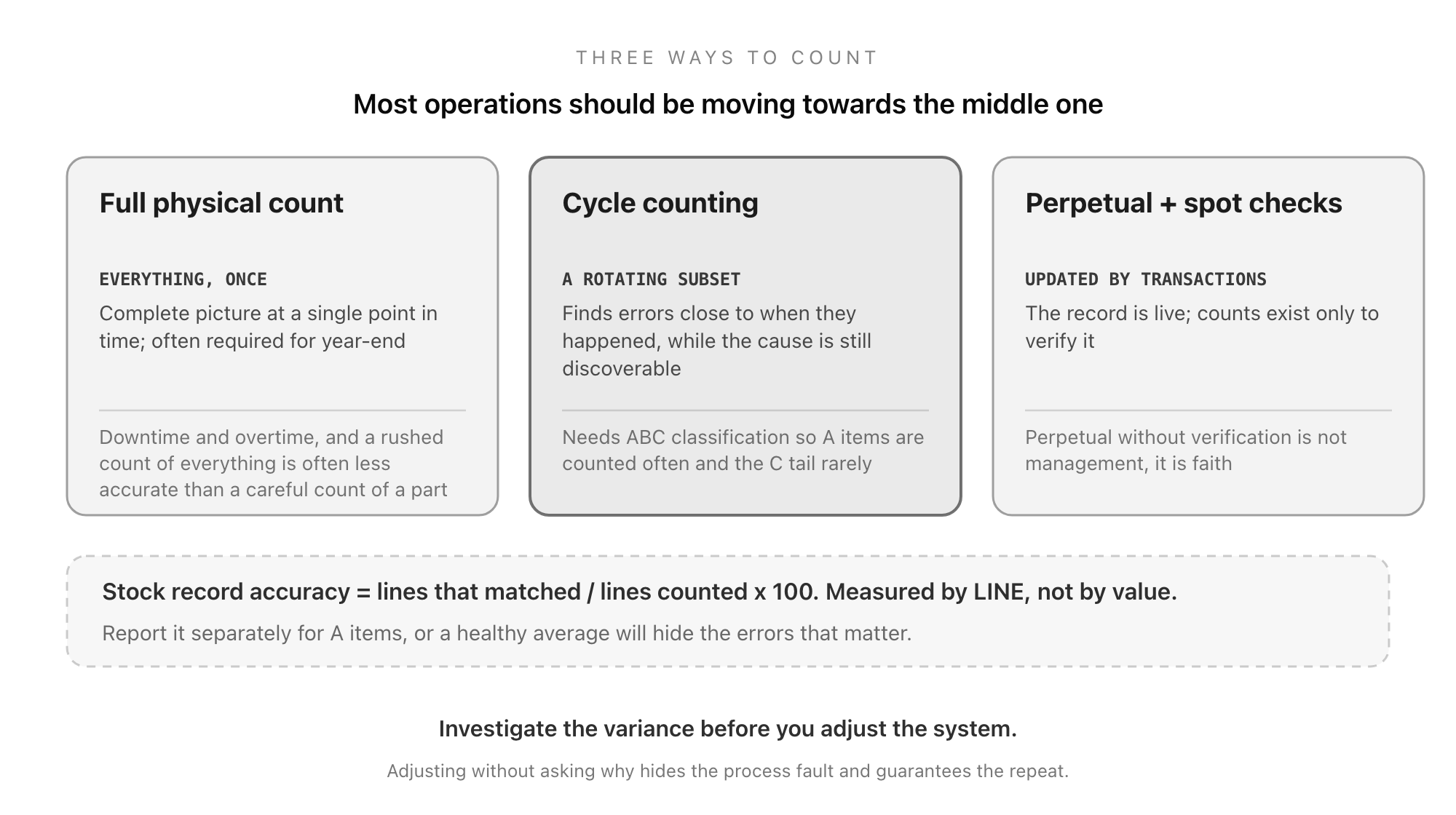
Full physical count. Everything counted at once, usually with operations paused. Gives a complete picture at a single point in time and is often required for year-end accounts. The costs are real: downtime, overtime, and the fact that a rushed count of everything is frequently less accurate than a careful count of a part.
Cycle counting. A rotating subset counted continuously, so that everything gets counted over a defined period and high-value or fast-moving items get counted more often. Usually classified by an ABC approach: A items are the small share of lines that account for most of the value and get counted frequently, C items are the long tail of low-value lines counted rarely. This is the method most operations should move towards, because it finds errors close to when they happened, when the cause is still discoverable.
Perpetual inventory with spot checks. The system is updated by every transaction in real time, and counts exist only to verify it. This is what good software plus disciplined process gives you, and the spot checks are what stop the theoretical number quietly diverging from reality. Perpetual without verification is not inventory management, it is faith.
Most mature operations run perpetual records, cycle count continuously, and do a full count only when accounts or regulation require it.
Running a Full Count Properly
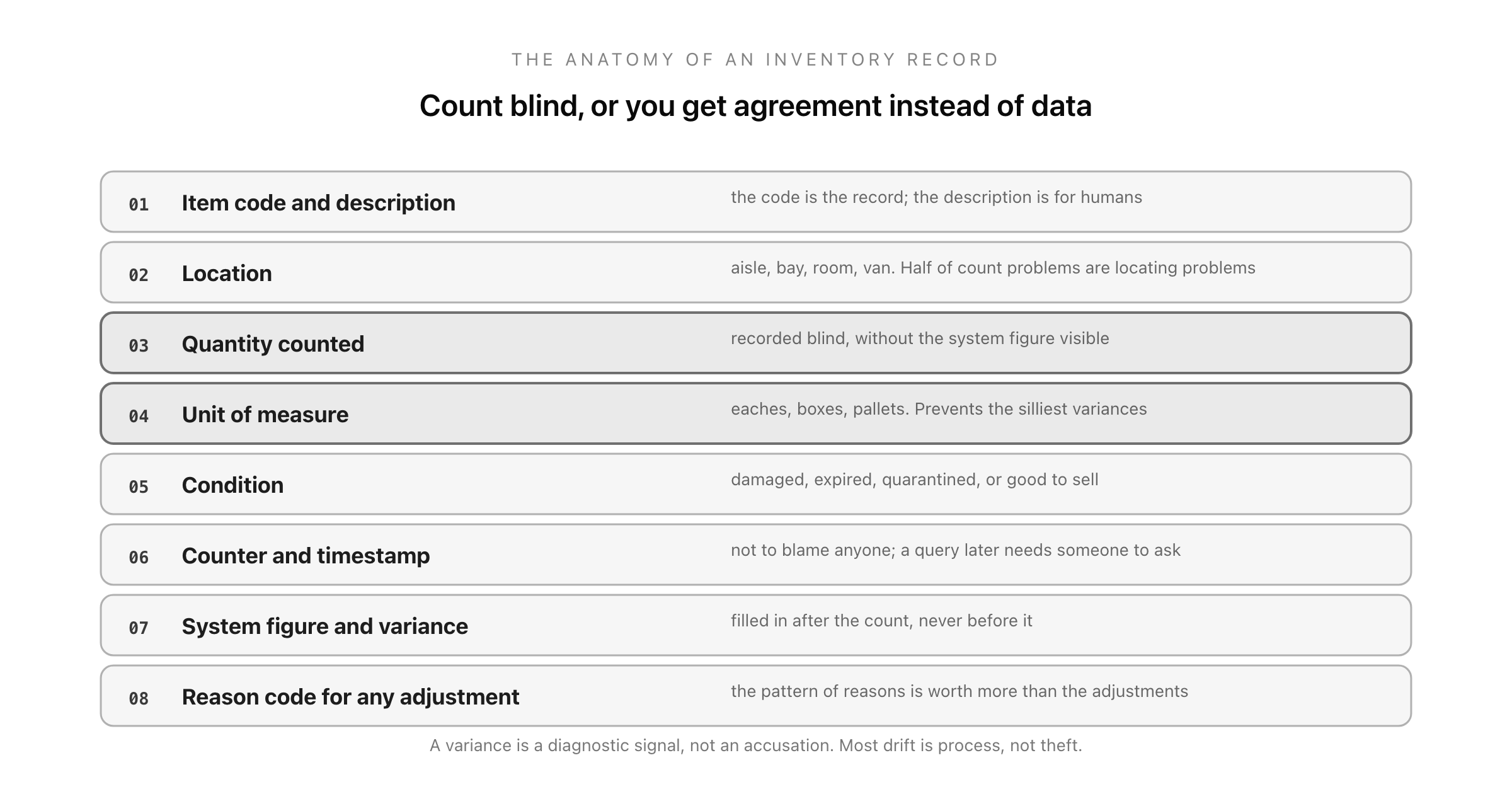
Freeze movement, or record it separately. Anything moving during the count must be quarantined or logged, or you will be reconciling ghosts.
Tidy and organise first. Half of counting problems are locating problems. An hour spent putting like with like saves several during the count.
Count blind. Do not show counters the expected figure. If people can see the system number, a proportion will unconsciously count towards it, and you will get confirmation rather than data.
Two people per area, or a second count on variances. Recount anything that differs materially, before investigating it.
Record the unit explicitly. Every line should say what was counted: eaches, boxes, pallets. This one field prevents the most embarrassing variances.
Timestamp and name the counter. Not to blame anyone, but because a query three weeks later needs to know who to ask.
Investigate variances before adjusting. Adjusting the system to match the count without asking why hides the process fault that caused it, and guarantees a repeat.
Then adjust, and record the reason. Every adjustment should carry a reason code, because the pattern of reasons is more valuable than the adjustments themselves.
The Numbers Worth Tracking
Stock record accuracy = (lines counted that matched / total lines counted) × 100. Note that this is measured by line, not by value: 200 of 220 lines matching is 91 percent accuracy, regardless of what those lines were worth. Many operations that believe their inventory is fine have never measured this.
Shrinkage rate = (value of unexplained loss / value of stock or sales) × 100, typically over a year.
Stock turnover = cost of goods sold / average stock value, which tells you how many times you sell through your holding in a period. Low turnover means money tied up; very high turnover can mean you are running out.
Days of stock = 365 / turnover, which is often the more intuitive way to say the same thing.
Take one caution with accuracy figures: a high percentage across thousands of low-value lines can coexist with serious errors on the handful of items that matter. Report accuracy for A items separately.
Asset Registers
For fixed assets the record is different in kind. Each item is individually identified with an asset tag or serial number, and the register carries its description, purchase date and cost, location, assigned person, condition, service or calibration dates, warranty expiry, and disposal date.
Three things make asset registers work. Tag things physically, so the record and the object can be matched without guesswork. Record custody, because "IT department" is not a location and an unassigned laptop is a lost laptop. And check periodically, on the same cycle-count logic, verifying a portion of the register each quarter rather than attempting everything once a year and abandoning it halfway.
Common Mistakes
One register for stock and assets. Two different jobs, two different records.
Counting with the expected number visible. Produces agreement rather than accuracy.
No unit of measure on the line. The cause of the largest and silliest variances.
Adjusting without investigating. Hides the process fault, guarantees the repeat.
Annual-only counting. Finds the error eleven months after the cause is traceable.
No reason codes on adjustments. Throws away the most useful data the whole exercise produces.
Never measuring accuracy. If you cannot state your stock record accuracy as a number, you do not know whether your inventory is good.
Build Your Inventory Form in Good Form
Counting is the easy part. The part that goes wrong is capture: the same fields every time, the unit stated, the location recorded, the counter and timestamp attached, and the whole thing landing somewhere you can compare against the system rather than on a clipboard that gets typed up on Monday.
You can build a stock take or asset register form in minutes with the free form builder, with item code, location, quantity, unit of measure, condition, photo, and counter, collecting every count in one searchable place ready to reconcile. The same structure supports the operational records around it, like the inspection checklist for condition checks and the procedures that generate them, documented as a standard operating procedure. If you are choosing a tool to run these on, the guide to the best free form builders covers what to look for.
Build your stock take form in Good Form →
Inventory is one of those areas where the difficulty is never the arithmetic. Keep stock and assets in separate registers, accept that most drift is process rather than theft and use variances as a diagnostic, count blind so you get data rather than agreement, always state the unit, move from annual counts towards cycle counting so errors are found while their causes are still findable, investigate before you adjust, and put a reason code on every adjustment. Then measure your stock record accuracy and actually look at the number. That last step is the one that turns counting from a chore you survive into information you can run the operation on.