An inspection is a structured check that something is in the condition it is supposed to be in. A landlord checks a property between tenancies, a fleet manager checks a van before it goes out, a site manager walks the scaffolding, a restaurant checks its fridge temperatures, a school checks its fire doors. In every case the same thing is happening: a defined list of things is examined against a defined standard, at a defined moment, by a named person, and the result is written down. That written result is the whole point. An inspection nobody recorded did not happen, and an inspection recorded so vaguely that nobody can act on it may as well not have.
This guide covers what an inspection is, how it differs from an audit and a risk assessment, the common types, what an inspection form must capture, how to write checklist items that cannot be fudged, the scoring approaches and when each suits, and the defect loop that turns findings into repairs rather than into a filing cabinet.
What Is an Inspection?
An inspection is a point-in-time examination of a specific thing against a specific standard. Three words in that sentence do the work.
Specific thing. A named asset, area, or item: van RX21 KJP, the second-floor kitchen, scaffold bay 4. Inspecting "the site" produces findings nobody can attach to anything.
Specific standard. What good looks like, stated in advance. Without it, an inspection collapses into one person's opinion on the day, which means two inspectors produce different results and neither can be challenged or defended.
Point in time. The record says what was true at that moment, which is why the date and time matter as much as the findings. In a dispute months later, the timestamp is often the most valuable field on the form.
The output of an inspection is not a verdict, it is a list of things that are and are not as they should be, plus what is going to be done about the ones that are not.
Inspection, Audit, and Risk Assessment
These three get used interchangeably and mean quite different things, which causes real confusion when someone asks for one and gets another.
An inspection checks the condition of a thing right now. Is the extinguisher in place, charged, and in date?
An audit checks whether the system is working. Does the organisation have a fire equipment regime, is it being followed, are inspections happening on schedule, and is the paperwork consistent? An audit will often examine your inspection records as its evidence.
A risk assessment looks forward. What could cause harm here, who might be harmed, how likely and how severe, and what controls reduce it? Inspections then check that those controls are actually in place.
The three form a loop: the risk assessment decides what matters, the inspection checks it, and the audit checks that the checking is happening. Getting the vocabulary right matters because a regulator or insurer asking for one of them will not be satisfied by another.
The Common Types
Safety and workplace inspections. Walk-rounds checking hazards, housekeeping, guarding, signage, PPE, and fire equipment.
Property and premises inspections. Move-in and move-out condition reports, periodic landlord inspections, and building fabric checks.
Vehicle and fleet inspections. Daily walk-round checks of tyres, lights, brakes, fluids, and load security, which in commercial transport are usually a legal requirement with retention rules attached.
Equipment and plant inspections. Pre-use checks and scheduled examinations of machinery, lifting gear, ladders, and electrical equipment.
Food safety and hygiene checks. Temperature logs, cleaning schedules, and stock rotation.
Quality inspections. Checking output against a specification, in manufacturing or on finished work.
The subject changes; the structure of a good inspection form does not.
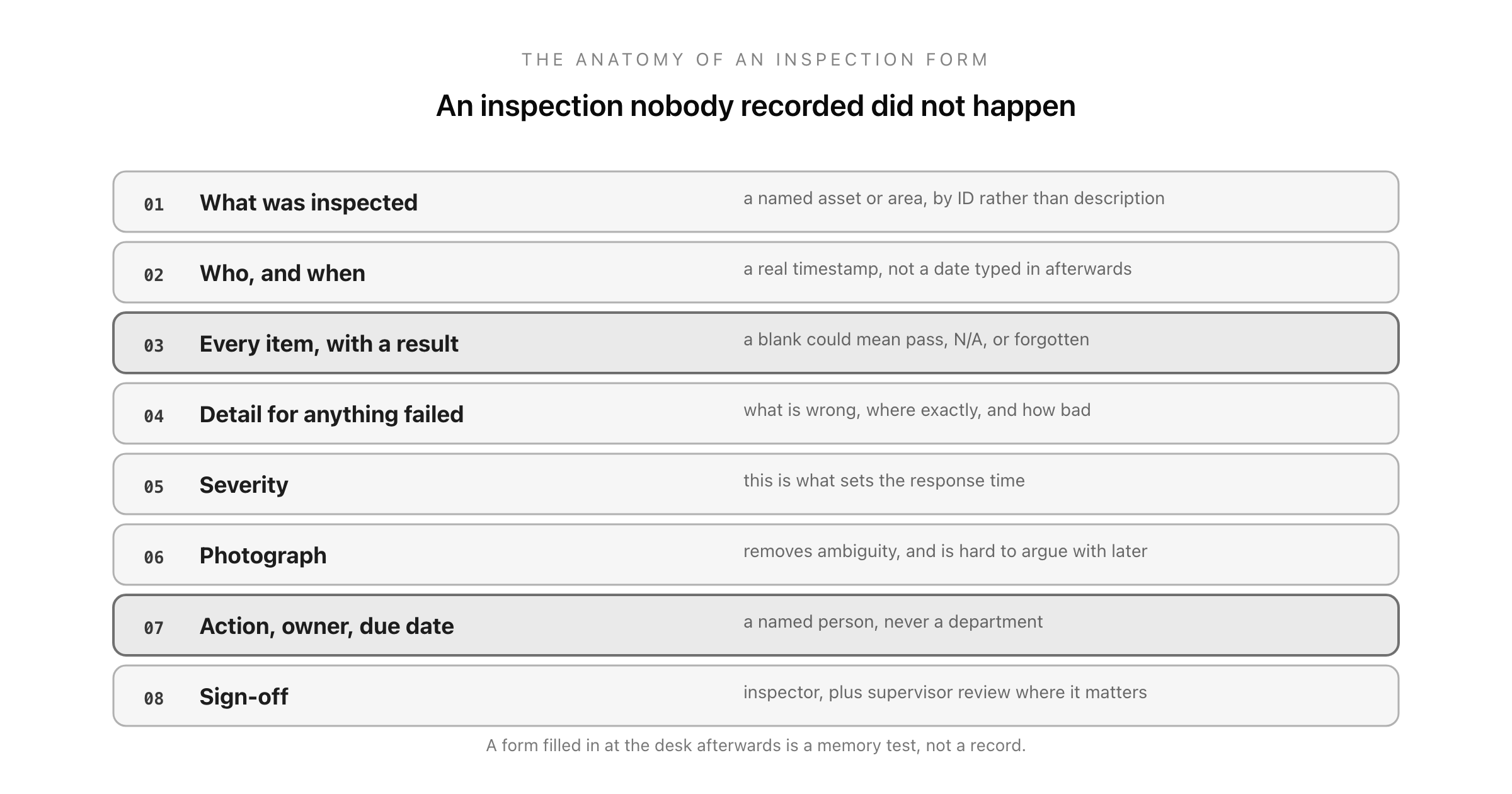
What an Inspection Form Must Capture
What was inspected. The asset, area, or item, identified precisely, ideally by an ID rather than a description.
Where, and under what conditions, if relevant. Weather matters for external work; occupancy matters for premises.
Who inspected it, and when. Name and a real timestamp, not a date typed in later.
The checklist items, each with a result. Every item answered, including the ones that are fine. A blank is ambiguous: it could mean pass, not applicable, or forgotten.
Detail for anything that failed. A failed item with no description is a dead end. What is wrong, where exactly, and how bad.
Severity. Some rating of how serious each defect is, because that is what drives the response time.
Photographs. For most physical inspections a photo is the single most valuable field, because it removes the ambiguity of a written description and is very hard to argue with later.
The action, owner, and due date. Who is fixing it and by when. Without this the inspection generates awareness and nothing else.
Sign-off. The inspector's confirmation, and where appropriate a supervisor review.
Writing Checklist Items That Cannot Be Fudged
This is where most inspection forms fail, and it is entirely fixable.
One thing per item. "Lights and indicators working" cannot be answered when one is out. Split it.
State an objective criterion. "Fire door in good condition" invites judgement; "fire door closes fully and latches without being pushed" does not. Where a number exists, use it: "fridge between 1 and 5 degrees" beats "fridge cold enough".
Write items as questions with an unambiguous expected answer. The inspector should never be deciding what the question means.
Avoid double negatives, which reliably produce reversed answers under time pressure.
Order items by physical route, not by category. An inspector walking the building in the order the form lists will actually look at each thing; one jumping around will start filling from memory.
Include a "not applicable" option with a reason, so people are not forced into a false pass.
Keep it as short as the standard allows. A 120-item list gets pencil-whipped. Which brings us to the central problem.
Scoring: Pass/Fail, Graded, or Risk-Rated
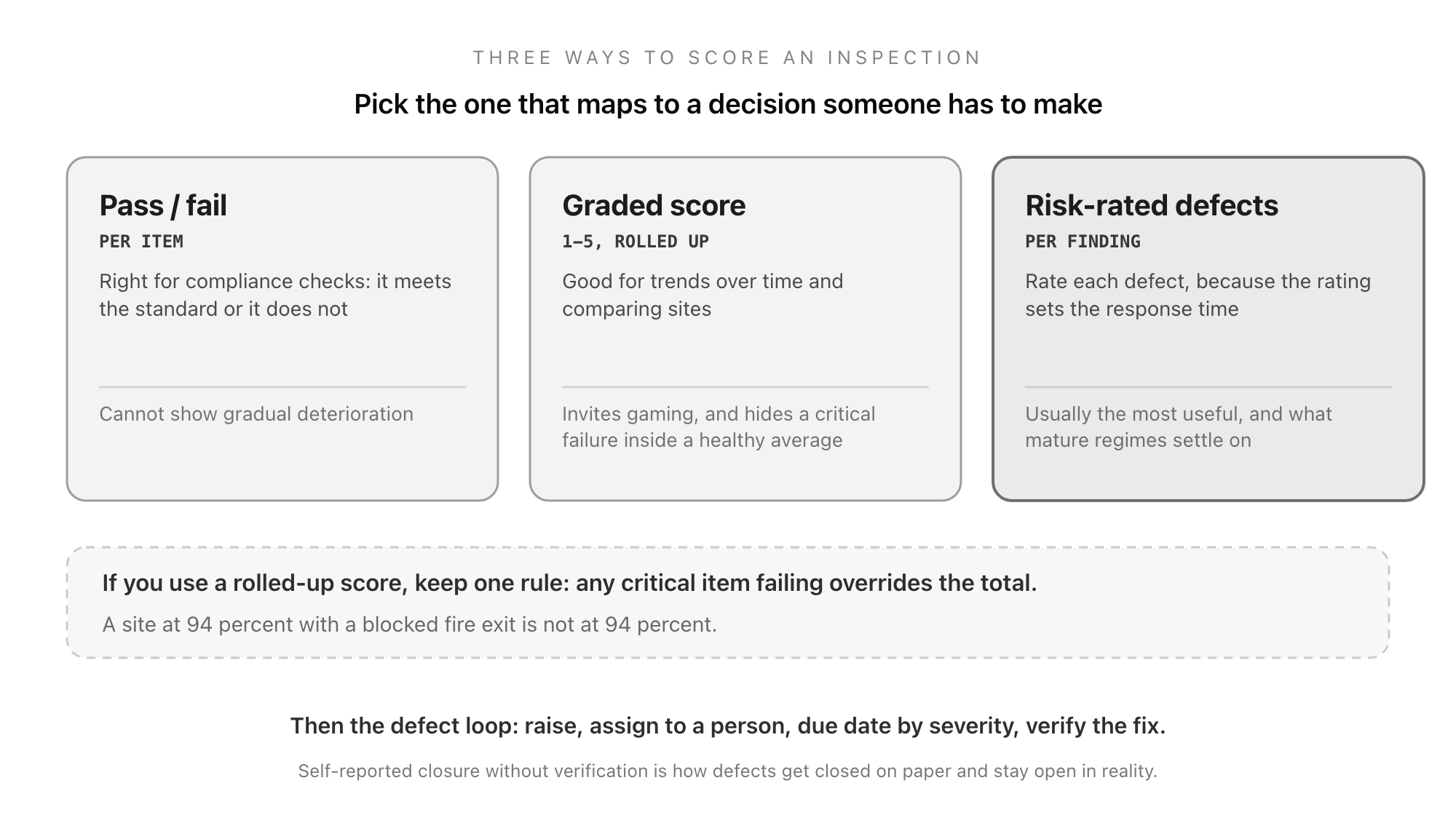
Pass/fail per item. Simple, fast, and correct for compliance-style checks where a thing either meets the standard or does not. The limitation is that it cannot show gradual deterioration.
Graded scoring, such as 1 to 5 per item with an overall percentage. Useful for tracking condition over time and comparing sites, but scores invite gaming and can obscure a single critical failure inside a healthy-looking average. If you use scores, keep a rule that any critical item failing overrides the total.
Risk-rated defects. Rather than scoring the inspection, rate each defect found: typically something like immediate danger, high, medium, low. This is usually the most useful approach, because the rating maps directly to a response time, which is the decision anyone actually needs to make.
Most mature inspection regimes end up combining the second and third: a graded picture for trend reporting, and a severity rating per defect for action.
The Defect Loop
An inspection that ends when the form is submitted is half a process. The value is in what follows.
Raise. Each failed item becomes a defect record with its description, photo, and severity.
Assign. A named owner, not a department. Defects assigned to "maintenance" are assigned to nobody.
Set a due date driven by severity. Immediate dangers get made safe now, not scheduled. This is the point of severity rating.
Track to closure. Open defects should be visible, and ageing ones should be uncomfortable to look at.
Verify. Someone confirms the fix, ideally with a photo. Self-reported closure without verification is how defects get closed on paper and stay open in reality.
Feed it back. The same defect recurring across sites or months is telling you about a systemic problem, not a maintenance one.
Common Mistakes
Pencil-whipping. The industry term for completing an inspection form without doing the inspection. It is common, it is usually a symptom of a form that is too long or a schedule that is unrealistic, and it is far more dangerous than not inspecting at all, because it produces a record saying everything was checked. The fixes are practical: shorten the list, require photographs, timestamp entries as they happen, and make the schedule achievable.
Vague criteria. Turns the inspection into an opinion poll.
Findings with no owner. Produces a growing list nobody is fixing.
No severity rating. Everything looks equally urgent, so nothing is.
Retrospective completion. A form filled in at the desk afterwards is a memory test, not a record.
Never revising the checklist. Standards, equipment, and layouts change. An unchanged checklist slowly stops describing the thing being inspected.
Collecting and never analysing. The pattern across many inspections is more valuable than any single one, and it is invisible if the records are on paper in a folder.
Build Your Inspection Form in Good Form
Everything that makes an inspection trustworthy is a data-capture problem: the same items every time, answered at the point of inspection, with a photo attached, a timestamp you did not type, and a defect that lands somewhere it can be tracked. Paper checklists fail on every one of those, and they cannot be analysed without someone re-typing them.
You can build an inspection form in minutes with the free form builder, with your checklist items, per-item results, photo upload, severity rating, and action owner, collecting every completed inspection in one searchable place. The same structure supports the records around it, like the incident report form for when something does go wrong and the waiver for participants at the sites you are inspecting. If you are choosing a tool to run these on, the guide to the best free form builders covers what to look for.
Build your inspection form in Good Form →
An inspection is a simple idea that quietly depends on unglamorous discipline: identify the thing precisely, define the standard in advance, write items nobody has to interpret, answer every one at the point of looking, photograph what fails, rate it by severity, give it an owner and a date, and verify the fix. Do that and inspections stop being a compliance ritual and become what they are for, which is finding the problem while it is still small enough to be cheap.