A waiver is a document in which someone voluntarily gives up a right, most commonly the right to bring a claim against an organiser if they are injured while taking part in an activity. If you run a gym, a climbing wall, a dance class, a youth sports club, an obstacle race, a workshop with sharp tools, or anything else where a participant might get hurt, a waiver is the form that sits between you and a great deal of avoidable trouble. It is also the form most likely to be copied off the internet, signed without being read, filed somewhere nobody can find it, and then discovered, at the worst possible moment, to be worthless.
This guide covers what a waiver actually is, how it differs from the related documents it gets confused with, when you need one, what to put in it, what makes a waiver enforceable, the important limits on what it can do, and how to collect and store them so they hold up. One thing to say plainly at the start: waiver law varies significantly between countries and between states, and this is general guidance, not legal advice. If the risk is serious, have a lawyer in your jurisdiction review your wording.
What Is a Waiver?
A waiver is the voluntary surrender of a known right. In everyday business use, "waiver" almost always means a liability waiver: an agreement in which a participant acknowledges the risks of an activity and agrees not to hold the provider responsible if those risks materialise.
Two things do the real work. The first is informing: the document explains, in specific terms, what the activity involves and what could go wrong. The second is agreeing: the participant confirms they understand those risks, choose to take part anyway, and give up the right to claim in respect of them. A waiver that skips the first part and jumps straight to "the participant waives all claims" is the weakest kind, because a court asked to enforce it will want to know what exactly the person understood themselves to be accepting.
It helps to see a waiver as a risk-management document rather than a magic shield. Its practical value is partly legal and partly behavioural: a well-written waiver genuinely reduces your exposure, and it also makes participants read a clear description of the risks before they start, which is a safety measure in itself.
Waiver, Release, Indemnity, and Consent
Four words get used interchangeably and mean different things.
A waiver is giving up a right you would otherwise have, typically before the activity happens.
A release discharges someone from liability, and is often used after something has already occurred, for example as part of settling a dispute. In practice many documents are titled "waiver and release" and do both jobs at once, which is fine as long as the wording is clear.
An indemnity goes further than either. It is a promise to cover the other party's losses, including claims brought by third parties. A participant who indemnifies you is agreeing not just to refrain from suing but to reimburse you if someone else does. Indemnities are stronger, and correspondingly more likely to be challenged or read narrowly.
A consent form is not about liability at all. It is a record that someone agreed to something being done, whether that is medical treatment, photography, or the processing of their personal data. The two often travel together, and the distinction matters: consent is about permission, a waiver is about claims. If you need both, say so explicitly rather than burying permission inside a liability clause, and see the guide to consent forms for how that document should be structured.
When You Need a Waiver
The general test is whether participation carries a genuine risk of physical injury, property damage, or another loss the participant might later attribute to you. Common situations:
Physical activity and sport. Gyms, fitness classes, martial arts, climbing, watersports, cycling events, races, and youth sports.
Adventure and experience businesses. Trampoline parks, escape rooms, paintball, karting, horse riding, diving.
Workshops with real hazards. Woodwork, ceramics, cooking with knives and heat, welding, anything with power tools.
Events and volunteering. Organised group activities, festivals, charity events, and volunteer days where people work on site.
Trips and travel. School trips, club tours, expeditions.
There is a common misconception worth clearing up: a waiver is not only for high-risk activities. Any organised activity where a person could reasonably be hurt benefits from a written record that the risks were explained and accepted. What changes with the level of risk is how carefully the document should be drafted and reviewed.
What to Include in a Waiver Form
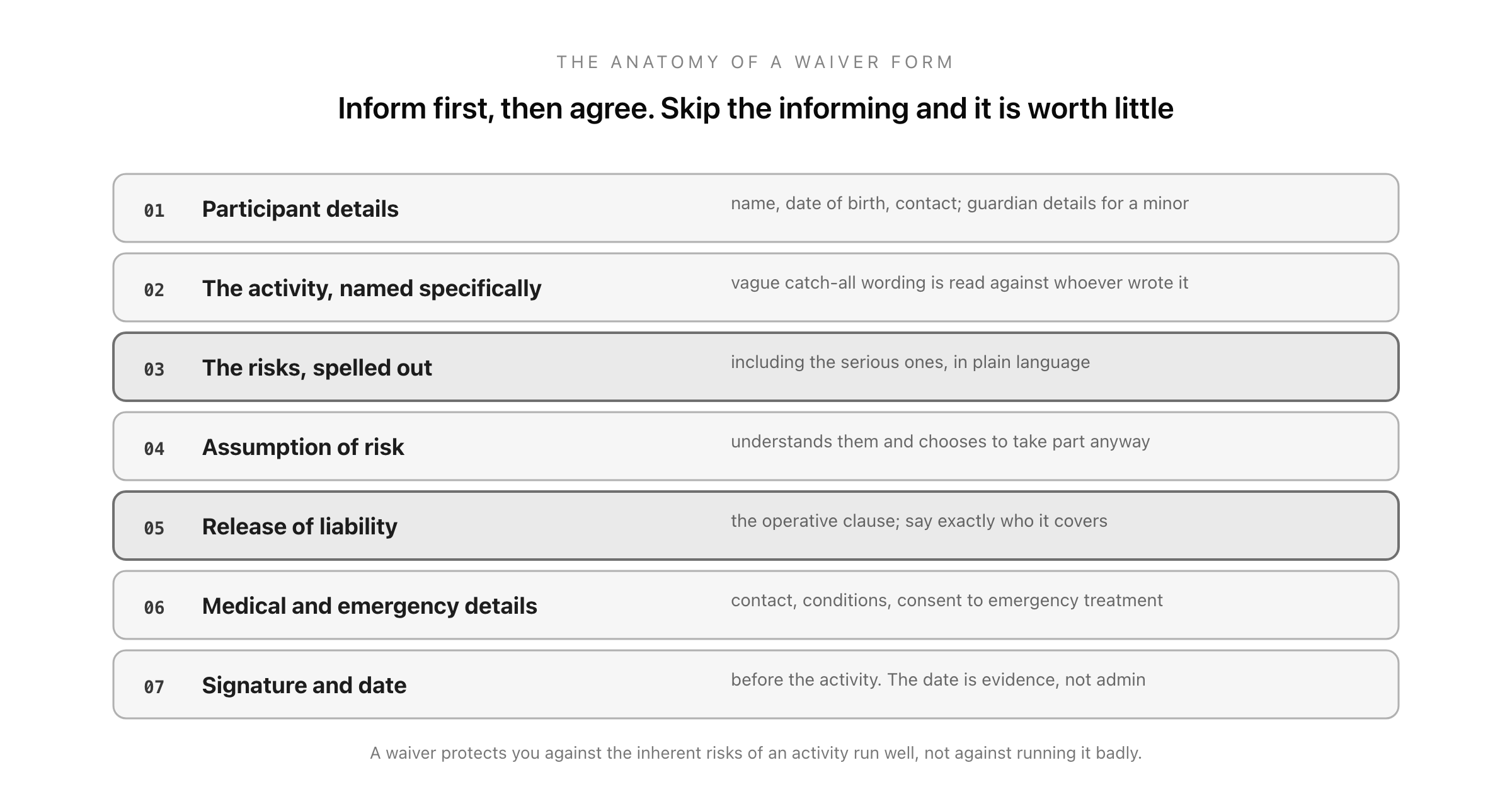
A workable waiver form has a predictable structure.
Participant details. Full name, date of birth, contact details, and, for minors, the details of the parent or guardian signing.
A specific description of the activity. Name the activity concretely. Vague, all-purpose wording is a common weakness, because a waiver is generally read against the person who wrote it, and generic wording invites a narrow reading.
The risks, spelled out. This is the part people water down and should not. List the material risks in plain language, including the serious ones. A waiver that lists "minor scrapes" will not carry much weight when the injury was a fracture.
Assumption of risk. A statement that the participant understands those risks and voluntarily chooses to take part.
The release of liability. The operative clause: the participant agrees not to bring claims arising from the described activity. Set out clearly who is covered, whether that is the company, its staff, its instructors, and any venue.
Confirmation of fitness to participate. A statement that the participant is in suitable health and has disclosed any relevant condition.
Medical and emergency information. Emergency contact, relevant medical conditions, allergies, and consent to emergency treatment if needed. Treat this as sensitive personal data and handle it accordingly.
Rules and instructions. An agreement to follow safety rules and staff instructions, which matters because a participant who ignored clear instructions is in a very different position afterwards.
Acknowledgement, signature, and date. A statement that the person has read and understood the document, then their signature and the date. The date is not a formality: you may later need to prove the waiver was signed before the activity, not afterwards.
What Makes a Waiver Enforceable
Enforceability depends on your jurisdiction, but a consistent set of factors comes up almost everywhere.
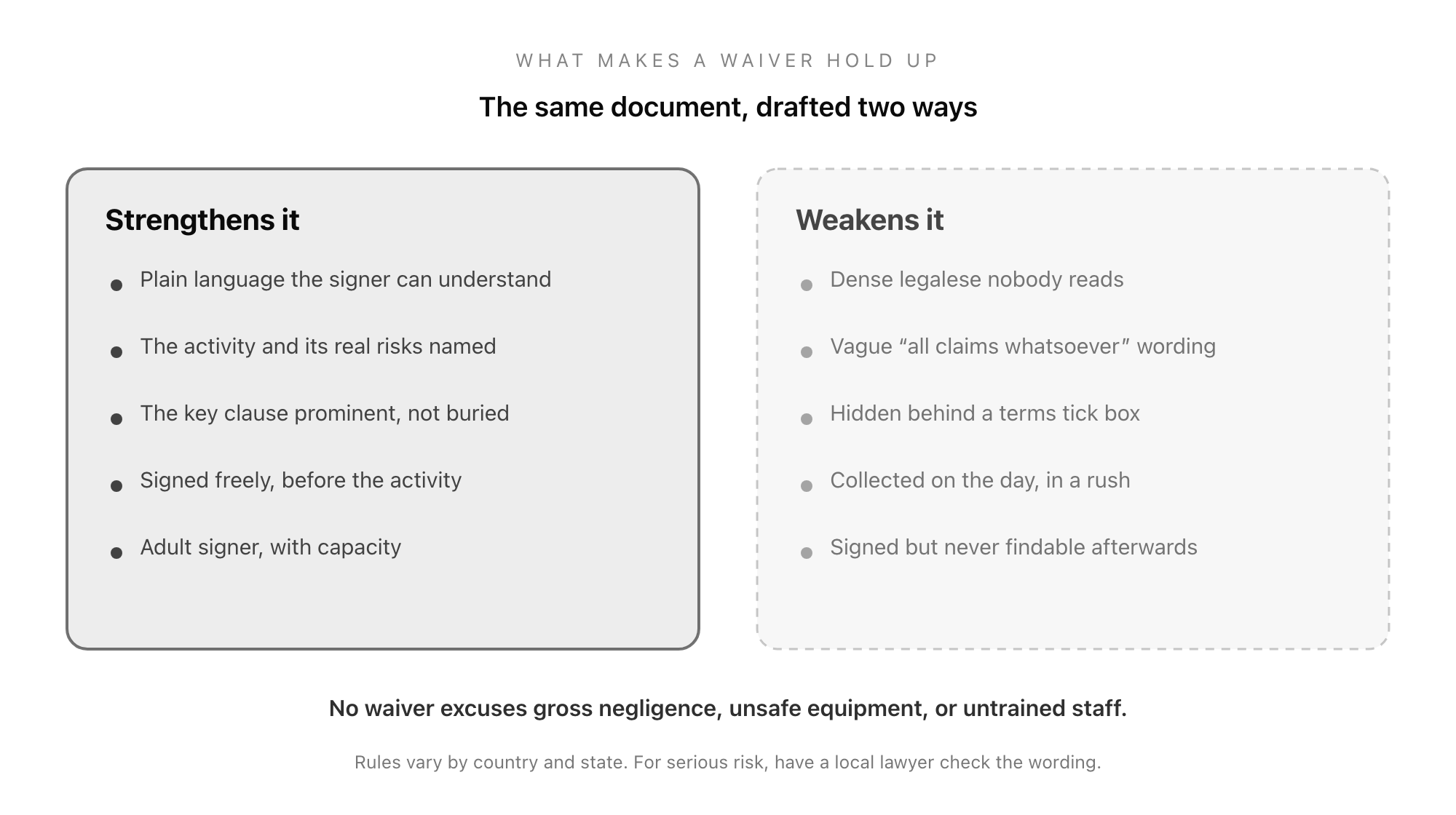
Clarity. The document must be understandable by the person signing it. Dense legalese works against you, because the question a court asks is whether this participant genuinely understood what they were agreeing to.
Specificity. Naming the activity and its actual risks is stronger than a catch-all. Broad "all claims of any kind whatsoever" wording is frequently read down.
Prominence. The clause giving up rights should be visible, not buried in small print at the bottom of a registration page. Some jurisdictions expect key terms to be conspicuous.
Voluntariness. The participant must have a genuine choice, and must not be pressured or rushed into signing.
Timing. Signed before participation, always. A waiver signed after an incident is close to worthless, which is why the date field matters.
Capacity. The signer must be an adult with the capacity to agree. Minors cannot generally waive their own rights.
Reasonableness. Terms that are wildly one-sided, or that attempt to excuse serious wrongdoing, tend to be struck down in whole or in part.
The Limits of a Waiver
A waiver is not a licence to be careless, and being clear-eyed about the limits is what keeps it useful.
In most jurisdictions a waiver cannot excuse gross negligence or reckless conduct, and typically cannot exclude liability for death or personal injury caused by negligence at all in some legal systems. Consumer protection rules may override terms that unfairly disadvantage the signer. Statutory duties, including health and safety obligations to staff and the public, cannot be signed away by a participant. And a waiver cannot cure an unsafe operation: faulty equipment, untrained staff, or ignored safety procedures remain your problem no matter what anyone signed.
The right mental model is that a waiver protects you against the ordinary, inherent risks of an activity properly run. It does not protect you against running the activity badly. Which means the waiver should sit alongside real risk management, proper maintenance, trained staff, and a working process for recording what happened when something goes wrong, which is what an incident report form is for.
Minors and Parental Consent
Children cannot enter binding agreements, so a minor's waiver is signed by a parent or guardian. The important caveat is that in many jurisdictions a parent cannot fully waive a child's own right to bring a claim, and some courts will not enforce such waivers at all.
That does not make them pointless. A parental waiver still documents that the risks were explained, that the parent consented to participation, and that emergency contact and medical details were provided, all of which matter. But the sensible posture is to treat a minor's waiver as evidence of informed consent rather than as a reliable bar to a claim, and to raise your standard of care accordingly.
Common Mistakes
Copying a waiver from another business. Wording drafted for a different activity, in a different jurisdiction, describes risks you may not have and misses the ones you do.
Hiding it in the booking flow. A tick box next to "I agree to the terms", with the waiver behind a link nobody opens, is exactly the arrangement most likely to be challenged.
Vague risk descriptions. Softening the language to avoid alarming customers directly weakens the document, and undermines the informing function that gives it value.
Collecting signatures late. On the day, in a rush, sometimes after the activity has started. The date on the form is evidence, and it should support you rather than embarrass you.
Losing the records. A waiver you cannot produce is a waiver you do not have. Paper forms in a box under the desk are the classic failure.
Never reviewing it. Activities change, venues change, and the law changes. A waiver written five years ago may describe a business you no longer run.
Collecting Waivers Properly
The administrative half of this is where most small operators fall down, and it is the easiest half to fix.
Collect waivers digitally and in advance. A form sent at booking gives people time to actually read it, removes the queue at the door, and produces a clean record automatically. Capture the timestamp and store the completed record so you can retrieve any individual waiver quickly, by name and date, without going through a filing box. Keep them for as long as a claim could realistically be brought, which is longer than most people assume, and treat any medical information in them as sensitive data with access limited accordingly.
Build Your Waiver Form in Good Form
A waiver only does its job if the right person signed the right version, before the activity, and you can find it afterwards. That is a forms and records problem as much as a legal one, and it is the part you can fix today.
You can build a waiver form in minutes with the free form builder, capturing participant details, medical and emergency information, and a dated acknowledgement, with every submission collected in one searchable place instead of a folder of scanned paper. The same structure supports the forms around it, like the client intake form you use to onboard new participants and the consent form covering photography or data. If you are choosing a tool to run these on, the guide to the best free form builders covers what to look for.
Build your waiver form in Good Form →
A waiver is a small document doing a serious job. Written well, in plain language, naming the activity and its real risks, signed freely and in advance by someone who had the chance to read it, and stored where you can produce it years later, it meaningfully reduces your exposure and makes your participants better informed at the same time. Written badly, copied from a competitor, buried in a booking flow, and lost in a drawer, it provides the comfortable feeling of protection without any of the substance. The difference costs about an afternoon, and it is worth taking that afternoon before you need it rather than after.