A consent form is how you turn a person's agreement into a clear, documented record, and how you make sure that agreement is actually informed. Whether you are running a medical procedure, a research study, a photo shoot, a school trip, or collecting personal data, a good consent form protects everyone: it gives the person the information they need to make a real decision, and it gives you a record that they made it freely. Done badly, with vague language, buried risks, or no genuine choice, a consent form protects no one and can be worthless when it matters. The difference is in understanding what consent actually requires and building the form around it.
This guide covers what a consent form is, the main types you are likely to need, the essential elements every consent form should include, what makes consent legally valid, the common mistakes that undermine it, and how to build one. It is a practical overview, not legal advice, the specifics vary by country and context, so always check the requirements for your situation, but the principles below apply broadly.
What Is a Consent Form?
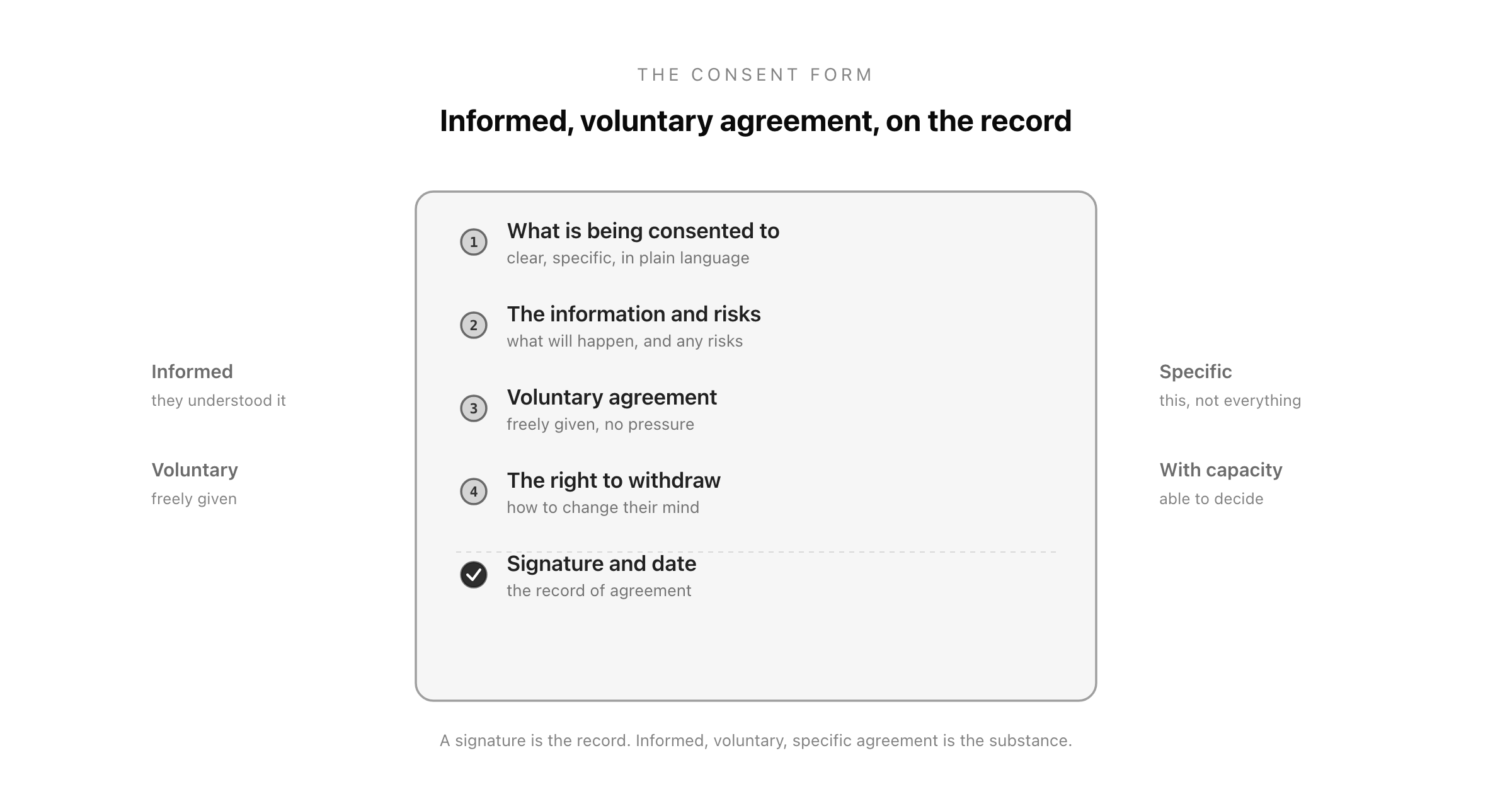
A consent form is a document by which a person formally agrees to something, having been given the information they need to understand what they are agreeing to. It does two jobs at once: it communicates the relevant facts, what will happen, why, and any risks, and it records the person's voluntary agreement, usually with a signature and date.
The key word is informed. Consent is not just a signature on a page; it is a signature given by someone who genuinely understood what they were consenting to. A form that gets a signature without ensuring understanding may collect a mark on paper, but it does not collect real consent, and in many contexts that distinction matters legally as much as ethically. The form is the record; the informed, voluntary agreement is the substance.
Consent forms show up wherever one party needs another's clear, documented permission before proceeding, in healthcare, research, education, media, events, and data handling. In every case the underlying purpose is the same: to make sure the person is agreeing freely and knowingly, and to have proof that they did.
The Main Types of Consent Form
Consent forms take different shapes for different situations, though they share the same core. These are the most common.
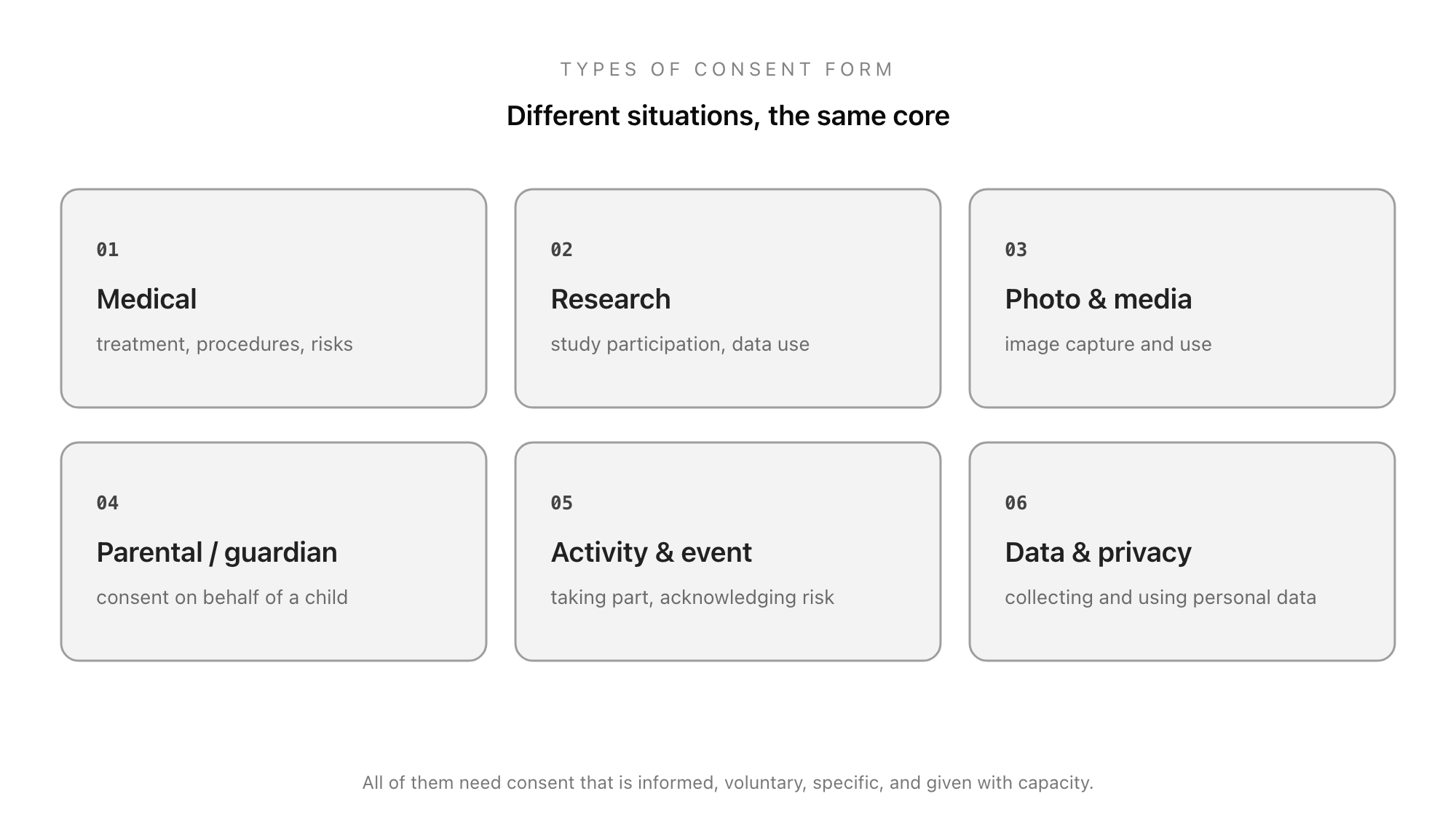
Medical consent. Agreement to a treatment, procedure, or examination, having been told what it involves, the risks, and the alternatives. Informed consent is a legal and ethical cornerstone of healthcare.
Research consent. Agreement to take part in a study, covering what participation involves, any risks, how data will be used, and the right to withdraw. Ethics boards require it for studies involving people.
Photo and media release. Permission to photograph, film, or record someone and to use their image, common for events, marketing, and publishing. It specifies where and how the image may be used.
Parental or guardian consent. Where the person cannot consent for themselves, typically a child, a parent or guardian consents on their behalf, for a school trip, an activity, or medical care.
Activity and event consent. Agreement to take part in an activity, often acknowledging risks, common for sports, trips, and physical activities, and frequently combined with emergency and health information.
Data and privacy consent. Agreement to the collection and use of personal data, increasingly required by privacy laws, specifying what data is gathered and how it will be used.
What to Include in a Consent Form
Whatever the type, a strong consent form contains the same core elements.
A clear description of what is being consented to. State plainly and specifically what the person is agreeing to, in language they can understand. Vague or overly broad wording undermines the whole point.
The relevant information and risks. Give the person what they need to make an informed decision: what will happen, why, and any risks, discomforts, or implications. Do not bury the important parts.
A statement that consent is voluntary. Make clear the person is agreeing freely and is not being pressured, and, where relevant, that declining will not disadvantage them.
The right to withdraw. In most contexts, especially research, the person should know they can withdraw their consent, and how, and what happens if they do.
Contact information. Who to ask with questions, before or after signing.
Signature and date. The record of agreement. For a minor or someone who cannot consent, the parent or guardian signs, and their relationship should be recorded.
Collecting this consistently, and keeping the signed records organised, is exactly the kind of documentation you want to be able to produce later if a question arises.
What Makes Consent Valid
A signature alone does not guarantee valid consent. Broadly, for consent to be meaningful it usually needs to be:
Informed: the person was given, and understood, the relevant information. Consent obtained by withholding or obscuring key facts is not genuine.
Voluntary: the agreement was freely given, without coercion or undue pressure.
Specific: the person consented to this particular thing, not a vague, catch-all permission. Consent to one procedure is not consent to another.
Given with capacity: the person was able to understand and decide. Where they cannot, a parent, guardian, or authorised representative consents on their behalf.
These principles are why the form's wording matters so much: clear, specific, honest language is not just good style, it is what makes the consent it records actually hold up. The exact legal requirements vary by jurisdiction and context, so verify what applies to you, but a form built on these principles starts from the right place.
Why Written Consent Matters
Consent can technically be given in several ways: implied (inferred from someone's actions), verbal (spoken agreement), or written (a signed form). All three can be genuine consent, but they are not equally useful when it counts, which is why the written consent form exists.
The problem with implied and verbal consent is not that they are invalid; it is that they are almost impossible to prove after the fact. If a question or dispute arises, weeks or years later, a memory of a conversation is weak evidence, and an inference from behaviour is weaker still. A written, signed, dated consent form turns a fleeting agreement into durable proof: proof that consent was given, proof of what was consented to, and, if the form is well written, proof that the person had the information to make it informed. This is exactly why higher-stakes contexts, medical procedures, research, anything with real risk or legal weight, insist on written consent rather than relying on a nod or a spoken yes. The form is not bureaucracy for its own sake; it is the record that protects both the person consenting and the person relying on that consent.
Common Consent Form Mistakes
- Vague or overly broad wording. A form that does not specify clearly what is being agreed to fails the "specific" and "informed" tests. Be precise.
- Burying the risks or key information. If the important parts are hidden in dense text, the consent is not genuinely informed. Make them clear and prominent.
- Getting a signature without understanding. A mark on paper from someone who did not grasp what they signed is not real consent. Ensure the information is actually communicated.
- No right to withdraw. Especially in research, omitting how someone can change their mind undermines the validity of their agreement.
- Forgetting capacity and guardianship. Collecting consent from someone who cannot legally give it, without the right guardian consent, invalidates it.
- Not keeping the records. An unorganised pile of signed forms you cannot find when needed defeats the documentary purpose. Keep them structured and retrievable.
Build Your Consent Form in Good Form
A consent form only does its job if it presents the information clearly, captures a genuine agreement, and stores the signed record where you can actually find it. That is exactly where a good form builder helps, letting you lay out the description and risks readably, capture the consent and signature, and keep every response organised and retrievable rather than scattered across paper and email.
You can build a consent form in minutes with the free form builder, tailoring it to your situation, medical, research, media, parental, or data, and collecting the signed records in one structured place. The same approach powers other permission-and-information forms like the client intake form and the emergency contact form, which often sit alongside consent in the same workflow. If you are choosing a tool to run your forms on, the guide to the best free form builders covers what to look for.
Build your consent form in Good Form →
A consent form is a small document with an outsized job: it turns a person's informed, voluntary agreement into a clear record that protects both of you. Build it around the principles that make consent valid, specific, informed, voluntary, and freely given, write it in language people actually understand, and keep the signed records organised, and your consent form stops being a formality and becomes what it should be: real permission, properly documented.