A panel interview is one candidate meeting several interviewers at the same time, in the same conversation. Done well, it is one of the most efficient and fair ways to make a hiring decision: instead of three separate one-on-ones that each see a slightly different person, the whole panel watches the same answers and can compare notes against the same evidence. Done badly, it becomes an intimidating interrogation where interviewers talk over each other, repeat questions, and walk out with three vague impressions that are impossible to reconcile. The difference is almost entirely in the preparation. This is a recruiter's guide to running a panel interview that actually helps you decide: who to put on the panel, how to structure it, what each person should ask, and how to score it so the comparison holds up.
The single rule that separates a good panel from a bad one: assign every interviewer a lane before anyone sits down, and have them all score on the same form. Everything below is in service of that.
The short version:
- A panel interview is one candidate, multiple interviewers, one shared conversation. It is not a group interview (that is several candidates at once, a different format entirely).
- Keep the panel small: three is the sweet spot, four at most. More than that and it becomes a firing squad and people stop listening.
- Give each panelist a lane. One owns role and skills, one owns behavioral and ownership, one owns team and culture-add. No overlap, no repeated questions.
- Appoint a chair. One person runs the clock, opens and closes, and stops people talking over each other.
- Ask the same core questions of every candidate for the role, so you can actually compare. See our guides to behavioral interview questions and the best interview questions to ask.
- Score independently, then debrief. Each panelist fills the same scorecard before discussing, so the loudest voice does not anchor everyone else. Clone a shared scorecard here.
What Is a Panel Interview?
A panel interview is a single interview in which a candidate is questioned by two or more interviewers together, at the same time. The panel typically includes the hiring manager plus one or two others: a future teammate, a subject-matter expert, or someone from a function the role works closely with. Everyone hears the same answers, which is the whole point. You are not collecting three independent opinions of three slightly different conversations; you are collecting three independent reads of one conversation.
That makes the panel interview meaning easy to pin down by contrast with the formats it gets confused with:
- Panel interview: one candidate, several interviewers, one session. The subject of this guide.
- Group interview: several candidates at once, often with one or two interviewers, sometimes including a group exercise. Used for high-volume or early-career hiring to see how people interact. Useful, but a different tool with different mechanics.
- Sequential or back-to-back interviews: one candidate meeting several interviewers one after another, separately. Thorough but slow, and each interviewer sees a different version of the candidate as they warm up or tire.
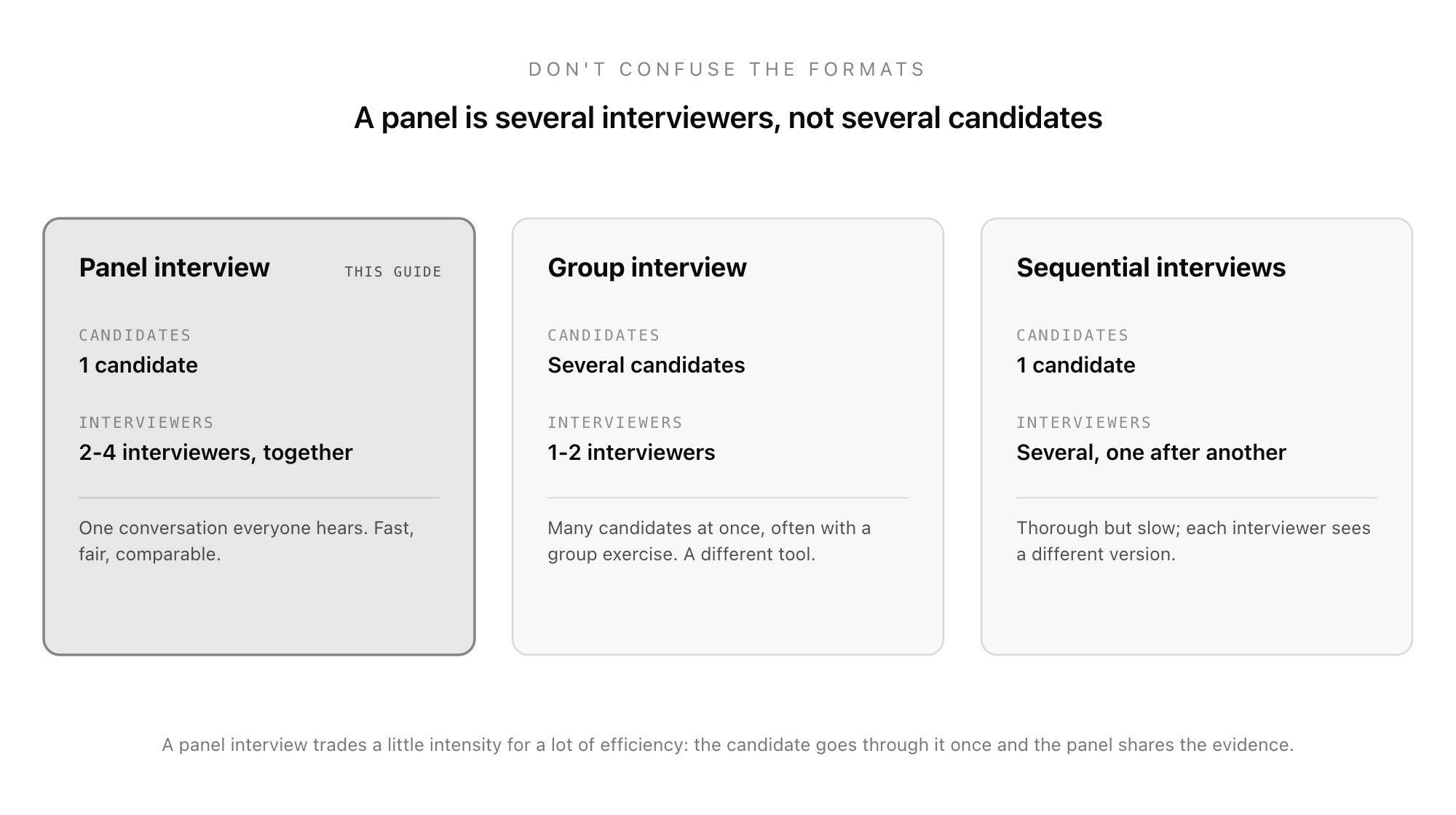
The panel format trades a little intensity for a lot of efficiency and consistency. The candidate goes through the experience once, the panel shares the evidence, and the decision can be made the same day.
Why Run a Panel Interview (and When Not To)
The case for a panel is mostly about fairness and speed.
- Shared evidence. When everyone hears the same answer, a disagreement in scoring is a real disagreement about the candidate, not an artifact of two different conversations. That is far easier to resolve in a debrief.
- Less individual bias. A single interviewer's gut feeling carries the whole decision. Three independent scores dilute any one person's blind spot, especially if they score before they talk.
- Speed. One scheduled session instead of three separate ones. For the candidate, one block of time instead of a day of repeated introductions.
- Different angles in real time. A teammate notices something the hiring manager misses, and can follow up on it immediately rather than reporting it later.
The case against, or at least for caution: panels can feel intimidating, which suppresses the very signal you are trying to read. A nervous candidate underperforms, and you learn less about them and more about how they handle pressure (which may not be the trait the job needs). The fix is not to abandon the panel; it is to keep it small, warm it up properly, and brief the candidate in advance that it will be a panel and who they will meet. Skip the panel for very early screening, where a short phone screen is faster and friendlier as a filter.
Who Should Be on the Panel
A panel works when each seat has a clear purpose and the seats do not overlap. The most common mistake is stacking the panel with people who all assess the same thing, so the candidate answers the same competency three times and nobody covers culture or the actual day-to-day of the job.
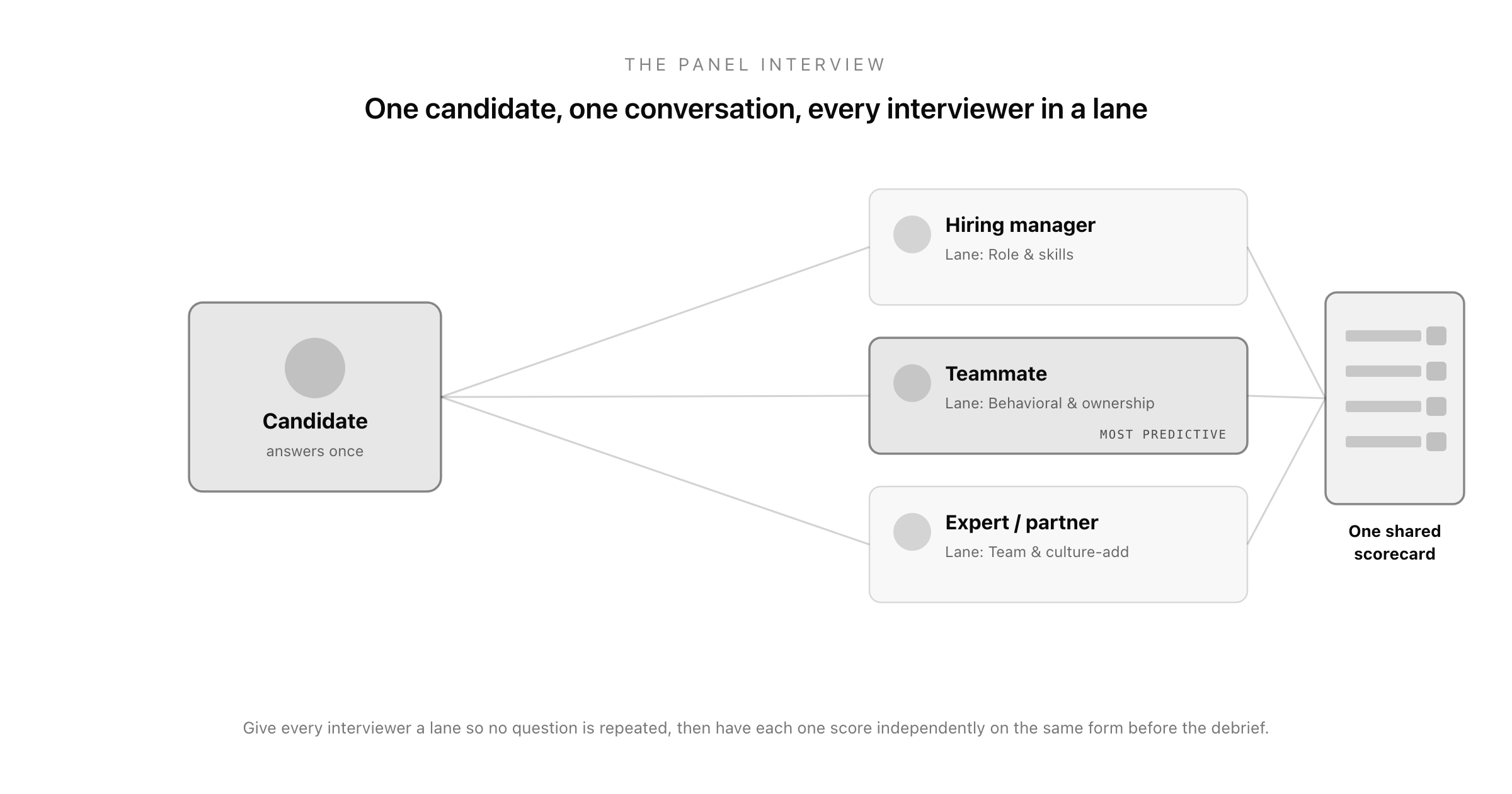
A clean three-person panel usually looks like this:
- The hiring manager (chair). Owns the role and competency questions: can this person do the actual job? They also run the session, keep time, and make the final call. This is the one seat that is never optional.
- A future teammate or peer. Owns the team and collaboration angle, and assesses culture-add: what this person brings that the team does not already have. Peers often spot practical day-to-day fit that a manager misses, and it gives the candidate a realistic preview of who they would work with.
- A subject-matter expert or cross-functional partner. Owns the deep technical or domain probing, or represents a function the role works with closely (the way a designer might sit on an engineering panel). This is the seat to drop first if you want a panel of two.
For senior roles you might add a skip-level leader or a stakeholder from another team, but resist the urge to grow the panel for the sake of inclusion. Beyond four interviewers, people stop actively listening, questions get repeated, and the candidate faces a wall rather than a conversation. If more people need a say, have them review the recording or the scorecards afterward rather than adding chairs.
How to Structure a Panel Interview
A panel interview that is not structured is just three people improvising at one person simultaneously. Here is how to conduct a panel interview that produces comparable, defensible results.
Before the interview
- Define the lanes. Decide who covers what, and write it down. Each panelist gets two or three questions in their lane and agrees not to wander into someone else's. This is what prevents the candidate from being asked "tell me about a challenge you overcame" three times.
- Agree the question set. Pull the core questions from your interview plan so that every candidate for the role gets the same ones, asked by the same seat. Consistency across candidates is what makes the scores comparable. Our guide to the best interview questions to ask is a good source for each lane.
- Pick a chair. One person, usually the hiring manager, opens the session, manages the clock, decides the order of questioners, and closes. Without a chair, panels drift and run over.
- Share the scorecard in advance. Everyone should know exactly what they are rating before they walk in, so they listen for the right things.
During the interview
A 45-to-60-minute panel has a natural shape:
- Open (3-5 min). The chair introduces the panel by name and role, explains the format, and asks a warm-up question to settle the candidate. This is not scored; it is there so the candidate can do themselves justice.
- Rounds (30-40 min). Each panelist takes their lane in turn. The chair hands off cleanly ("Thanks, I'll pass to Priya, who works on the team you'd join"). Others can ask one short follow-up but should not hijack the lane.
- Candidate's questions (5-10 min). Always leave real time for this. What a candidate chooses to ask the panel is data, and it is also simply fair: the interview is a two-way decision.
- Close (2 min). The chair explains next steps and timing, and thanks the candidate. Clear next steps are a basic courtesy and protect your employer brand.
The chair's job throughout is traffic control: keep one conversation going rather than three competing ones, watch the clock, and make sure the quiet panelist gets their turn and the talkative one does not eat the room.
Panel Interview Questions
Good panel interview questions are not different in kind from good interview questions generally; they are just divided by lane so each is asked once, by the right person. Assigning questions to seats is what stops the repetition that makes panels feel exhausting.
A worked example for a three-person panel:
Hiring manager (role and competency):
- "Walk me through how you would approach [a core task of this role]."
- "What does your process look like for [a key deliverable]?"
- "Tell me about a project most similar to what this role does day to day."
Teammate (behavioral and ownership): these are the most predictive questions, so give them to the person who will work alongside the hire.
- "Tell me about a time you disagreed with a colleague and how you handled it."
- "Describe a mistake you made and what you did next."
- "Tell me about a time priorities changed at the last minute."
For the full method and how to score these answers, see our guide to behavioral interview questions.
Subject-matter expert or cross-functional partner (depth and collaboration):
- "Walk me through a hard problem in [domain] you solved with limited information."
- "How do you usually work with [the function this role partners with]?"
- "What would you want to understand in your first month to do this well?"
The rule that ties it together is the same one that governs any structured interview: ask the same core questions of every candidate for the role. When the lanes and questions are fixed, the only thing that varies between candidates is the candidate, which is exactly what you want.
Panel Interview Tips for the Day
A few practical panel interview tips that separate a smooth session from an awkward one:
- Brief the candidate in advance. Tell them it is a panel, how many people, and their names and roles. A panel that is a surprise reads as an ambush; a panel they were prepared for reads as organized.
- Sit so it is a conversation, not a tribunal. Avoid three interviewers in a row across a table from a lone candidate where you can. A slight angle, or video tiles rather than a single intimidating block, lowers the temperature.
- One question at a time. No piling on, no two panelists following up at once. The chair enforces this.
- Take your own notes, in your own lane. Do not outsource memory to one note-taker; each panelist captures evidence for the things they are scoring.
- Do not react to each other mid-answer. A panelist nodding enthusiastically or frowning shapes how the others hear the answer. Keep your tells to yourself until the debrief.
- Watch the clock so the candidate's questions survive. The most common panel failure is running long on the panel's questions and cutting the candidate's, which leaves a bad final impression.
Score Independently, Then Debrief
This is where most of the value of a panel is won or lost. The reason to run a panel at all is to get several independent reads of the same evidence. You destroy that the moment one panelist says "I loved them" out loud before anyone has written anything down, because now everyone is scoring against that anchor.
So the sequence matters:
- Each panelist scores alone, first. Right after the interview, before any discussion, every interviewer fills in the same scorecard: a rating per competency on a consistent scale, plus a short note citing what the candidate actually said. A 1-to-4 scale works better than 1-to-5 because it removes the fence-sitting middle.
- Then debrief. The chair collects the scores, and the panel discusses, leading with where they disagree. Because everyone heard the same answers, a split score is a productive conversation ("I read that as ownership, you read it as blame-shifting, let's go back to what they said") rather than two people describing two different interviews.
- Decide against the bar, not against the other candidates in the room. The question is "does this person clear the bar for the role," answered from the combined evidence.
All of this falls apart if the scores live in three people's heads and a Slack thread. The fix is the same one that makes any hiring step defensible: capture every panelist's scores on a shared, structured form, the same one for every candidate.
This is exactly what Good Form is built for. You can clone the interview scorecard template and send it to every member of the panel: it captures the candidate and role, a rating and an evidence-anchored note per competency, and an overall recommendation, so the whole panel scores the same way and the debrief starts from real data instead of vibes. Pair it with a sharp job description at the top of the funnel and a consistent interview feedback form at every stage, and your panel produces a decision that is fast, fair, and holds up if a rejected candidate ever asks why.
Common Panel Interview Mistakes
To close, the failure modes to design against:
- Too many people. Five interviewers is a wall, not a panel. Keep it to three or four.
- Overlapping lanes. Three people all asking competency questions, nobody covering culture or the actual job. Assign lanes.
- No chair. The session drifts, runs over, and the candidate's questions get cut.
- Talking over each other. Two panelists following up at once. One question at a time.
- Scoring out loud first. The loudest or most senior voice anchors everyone. Score alone, then debrief.
- Inconsistent questions across candidates. If candidate A got softballs and candidate B got grilled, you cannot compare them. Fix the core set.
Run the panel small, give everyone a lane, ask every candidate the same questions, and have each person score independently before you talk. Do that, and a panel interview becomes the fastest fair way you have to make a hire. Set up your shared scorecard and let the form do the remembering.