A reference check is the last verification step before a hire: a structured conversation with someone who has actually worked with your candidate, to confirm what they told you and surface anything the interviews could not. Done as a box-ticking formality, it tells you nothing, because a referee the candidate hand-picked will of course say nice things. Done well, with the right questions asked the same way every time, it is one of the cheapest ways to avoid an expensive mis-hire. This is a recruiter's guide to running a reference check that earns its place in the process: what a professional reference actually is, how to request one, the questions to ask, how to read the answers, and where the legal lines are.
The single most useful thing to know up front: the most predictive question in any reference check is "would you re-hire this person?" A warm, immediate yes is reassuring. A pause, a careful "it would depend," or a redirect tells you more than a page of praise. Everything below is built around getting honest answers to questions like that one. To capture them cleanly, you can clone the Good Form reference check template and send it to each referee.
The short version:
- A reference check verifies and adds context. It confirms the facts (title, dates, responsibilities) and gathers a past colleague's honest read on how the person actually works.
- Get the candidate's consent first, and only contact the references they have agreed to, until you have explicit permission to go wider.
- A professional reference is someone who worked with them in a work context, ideally a former manager. Weight managers over peers, and peers over friends.
- Ask the same structured questions of every referee so candidates are comparable, just like a structured interview.
- "Would you re-hire them?" is the tell. So is any hesitation on a direct strengths-and-weaknesses question.
- Mind the law. Stick to job-relevant questions, get consent, and never ask about protected characteristics. Capture it all on one form.
What Is a Reference Check?
A reference check is a conversation (by phone, video, or a written form) with a person who has worked with your candidate, carried out near the end of hiring to verify their history and assess their fit. It does two jobs at once. The first is verification: confirming the things a candidate can exaggerate on a CV, like their job title, dates of employment, scope of responsibility, and reason for leaving. The second is context: getting a past colleague's candid view of how the person performs, collaborates, and handles pressure, the things you can only partly judge from an interview.
It is the final filter, not the first one. By the time you are checking references you have already decided you want to hire this person; the check is there to confirm that decision or to surface the one red flag that should stop it. That framing matters, because it tells you how to weight the result: you are looking for disconfirming evidence, not more reasons to like someone you already like.
Who to Ask: What Counts as a Professional Reference
A professional reference is someone who can speak to your candidate's work from direct experience, as opposed to a personal or character reference (a friend, neighbour, or mentor who can vouch for them as a person but not for their job performance). For a hiring decision, professional references are what you want, and not all of them carry equal weight:
- A former direct manager is the gold standard. They set the candidate's goals, saw their work up close, and can speak to performance, reliability, and growth. Always try to get at least one.
- A peer or close colleague adds a useful second angle, especially on collaboration and day-to-day behaviour, but they did not manage the person and may be a friend.
- A direct report (for a leadership hire) tells you how the candidate actually leads, which a manager's view cannot.
- A client or external partner can speak to delivery and professionalism for client-facing roles.
The candidate will offer references they expect to be flattering, which is fine, that is how it works, but it is why a former manager matters most and why the questions do the real work. If a candidate cannot produce a single former manager as a reference, that is itself worth a gentle follow-up.
How to Request a Reference
Two things make the request go smoothly: consent and clarity.
Get the candidate's consent first. You should have their agreement to contact references, and you should generally only contact the people they have nominated unless they have explicitly agreed you can approach others (such as a named former employer). Going behind a candidate's back to their current employer, who may not know they are job-hunting, is a serious breach and can cost someone their job.
Then make it easy for the referee. A reference request email should be short, explain who you are and the role, say roughly how long it will take, and offer a couple of options (a quick call or a written form). A simple reference request email looks like this:
Subject: Reference request for [Candidate Name]
Hi [Referee Name], [Candidate] has applied for the [Role] position with us and listed you as a reference. Would you have ten minutes for a quick call this week, or would you prefer to answer a few short questions by form? I have attached the questions either way. Thank you for your time.
Offering the written-form option is not just a courtesy; it gets you a response from busy referees who would never schedule a call, and it captures the answers in a consistent, comparable format automatically.
The Reference Check Questions to Ask
Good reference check questions are open, specific, and the same for every referee, so you can compare candidates rather than collect a grab-bag of impressions. Move from the factual to the revealing.
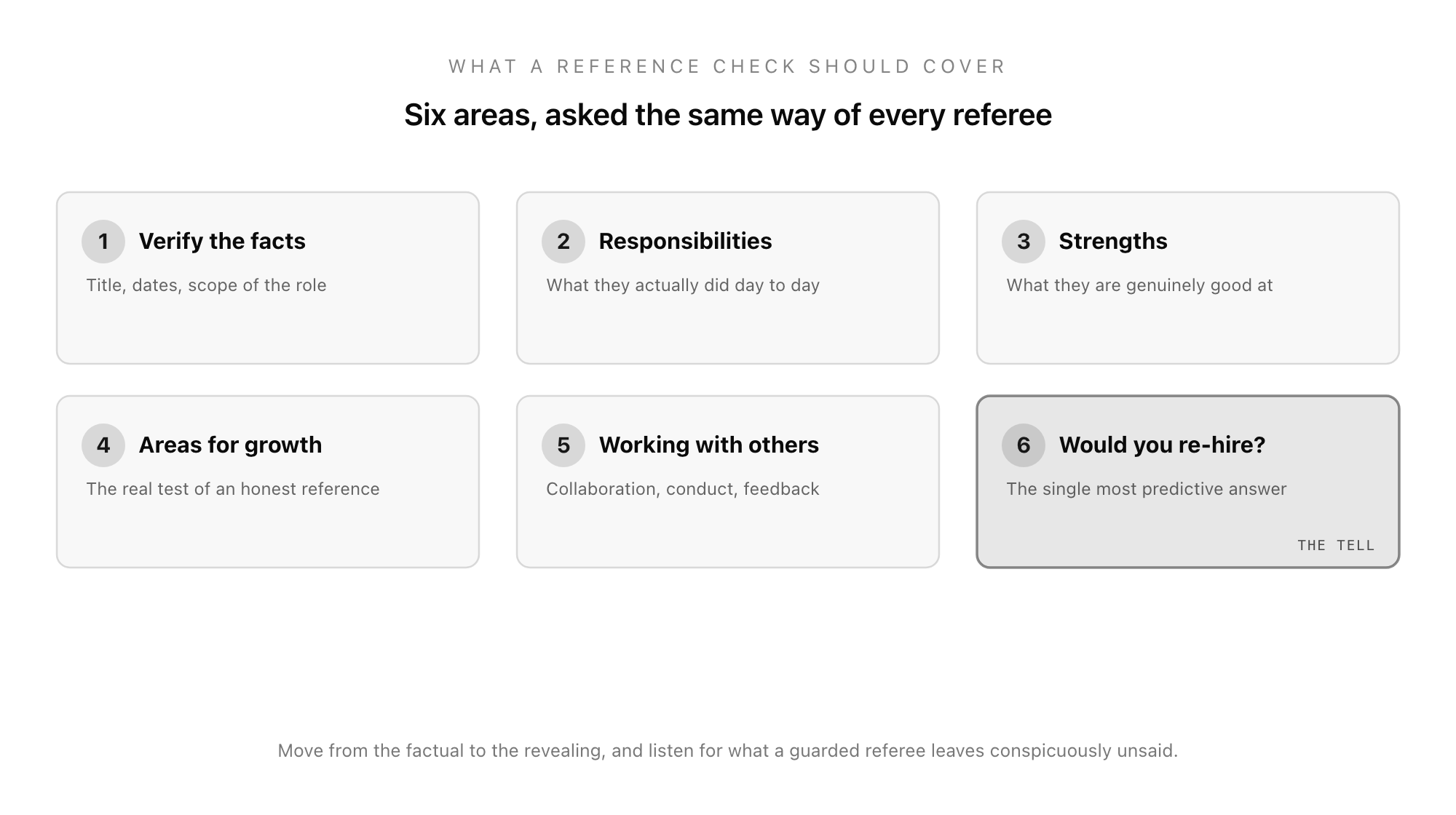
Verify the facts.
- "Can you confirm [Candidate]'s job title and dates of employment?"
- "What were their main responsibilities in that role?"
Understand the work.
- "What would you say were their greatest strengths?"
- "In what areas could they have developed, or where did they need the most support?"
- "How did they handle pressure, deadlines, or setbacks?"
Probe collaboration and conduct.
- "How did they work with the rest of the team?"
- "How did they respond to feedback?"
Ask the two that matter most.
- "Why did they leave, and would you say they left on good terms?"
- "If you had the opportunity, would you hire this person again?"
That last question is the one to listen to hardest. It forces a summary judgment, and the way it is answered, not just the answer, is the signal.
How to Read the Answers
The skill in a reference check is interpretation, because most referees will not say anything overtly negative. They will signal it instead.
- The strengths-and-weaknesses test. A genuine reference can name a real area for development without hesitation, because they actually know the person. A referee who insists the candidate has "no weaknesses" either does not know them well or is being guarded. Push gently once: "If you had to pick one thing they could improve?"
- The re-hire pause. As above: a warm, fast "absolutely" is a green flag; a hesitation, an "it would depend on the role," or a pivot to something unrelated is an amber one. Note the hesitation, do not explain it away.
- Faint praise. "He was always on time" as the headline answer, with nothing about the actual work, is a referee telling you what little they can say positively. Listen for what is conspicuously absent.
- Tone and energy. Enthusiasm is hard to fake and easy to hear. A flat, brief, get-this-over-with reference from a former manager is information.
None of these is a veto on its own. A reference check rarely produces a single disqualifying fact; more often it shifts your confidence up or down a notch. Treat it as one more input weighed against the interview scorecard and the rest of the process, not as a verdict on its own.
The Legal Guardrails
References carry real legal risk on both sides, so a few rules are non-negotiable.
- Get consent. Only check references with the candidate's permission, and only the ones agreed.
- Stay job-relevant. Ask only about things that bear on the role. Never ask a referee about a candidate's age, race, religion, health or disability, marital or family status, or other protected characteristics, exactly as you would never ask them in an interview. An answer you did not even ask for can still create liability if it influences your decision.
- Be consistent. Ask every candidate's references broadly the same questions, so your process is fair and defensible if a rejected candidate ever challenges it.
- Handle the data carefully. Reference responses are personal data about both the candidate and the referee. Store them securely, use them only for the decision at hand, and do not pass them around.
If you are the one giving a reference, the mirror-image rule applies: stick to facts you can support, because a reference that is misleading (in either direction) can expose your organisation to a claim. Many companies now limit themselves to confirming title and dates for exactly this reason, which is itself worth knowing as a recruiter, because a bare "we only confirm dates" is a policy, not a signal about the candidate.
Capture It on One Form
A reference check falls apart when the answers live in scattered notes, three different inboxes, and half-remembered phone calls. The fix is the same one that makes every hiring step defensible: ask the same questions on one structured form, for every candidate and every referee.
This is exactly what Good Form is built for. You can clone the reference check template and send it to each referee in minutes: it captures the candidate and role, the referee's relationship and dates, the factual verification, the strengths-and-growth questions, and the all-important "would you re-hire" answer, all in one consistent place. Because every reference comes back in the same format, candidates are genuinely comparable and the record is clean if anyone ever asks how a decision was made. Pair it with a structured interview scorecard and a fair panel interview, and your hiring process is consistent and defensible from first screen to final check. Send the form, ask the re-hire question, and listen to how they answer it.