Second interview questions are the ones that actually decide the hire, and most interviewers waste them by asking the same things they asked in the first round. By the time a candidate reaches the second interview, you already know they can clear the bar. The first round screened them out or let them through. The second round has a completely different job: to select the person you will actually hire from a short list of people who are all, on paper, capable. Ask "walk me through your CV" again and you learn nothing you did not already know.
This guide gives you 30+ second interview questions organized by what they actually measure, the framework for what the final round is for, the mistakes that waste it, and a free second-interview scorecard so every finalist is assessed on the same rubric. The questions are written to go deep rather than wide, because depth is the entire point of a second interview. The goal is to leave the room with evidence a hiring decision can rest on, not a warmer version of the same impression you already had.
The short version:
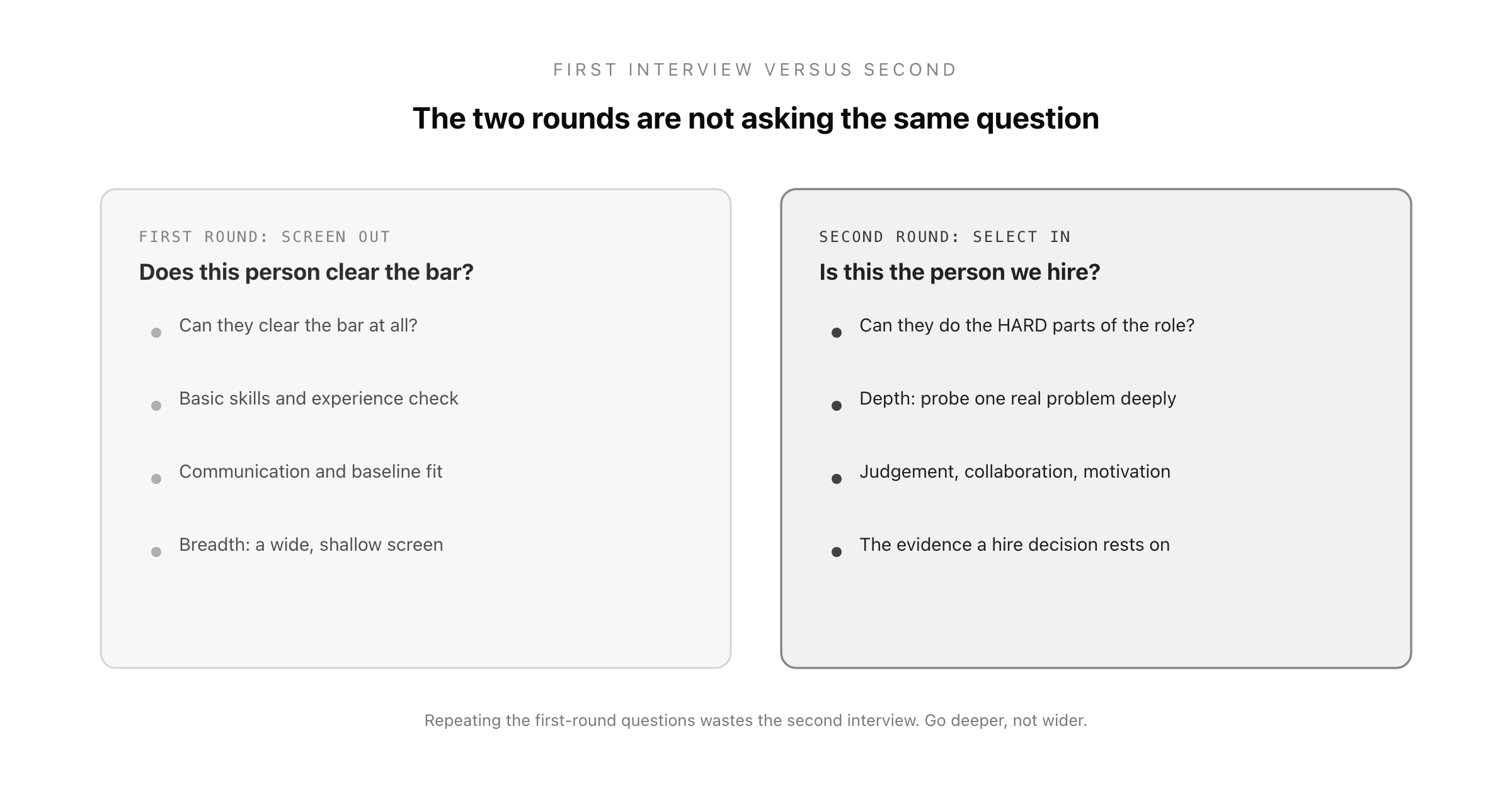
- The first interview screens out; the second interview selects in. They are not the same question, so they should not use the same questions.
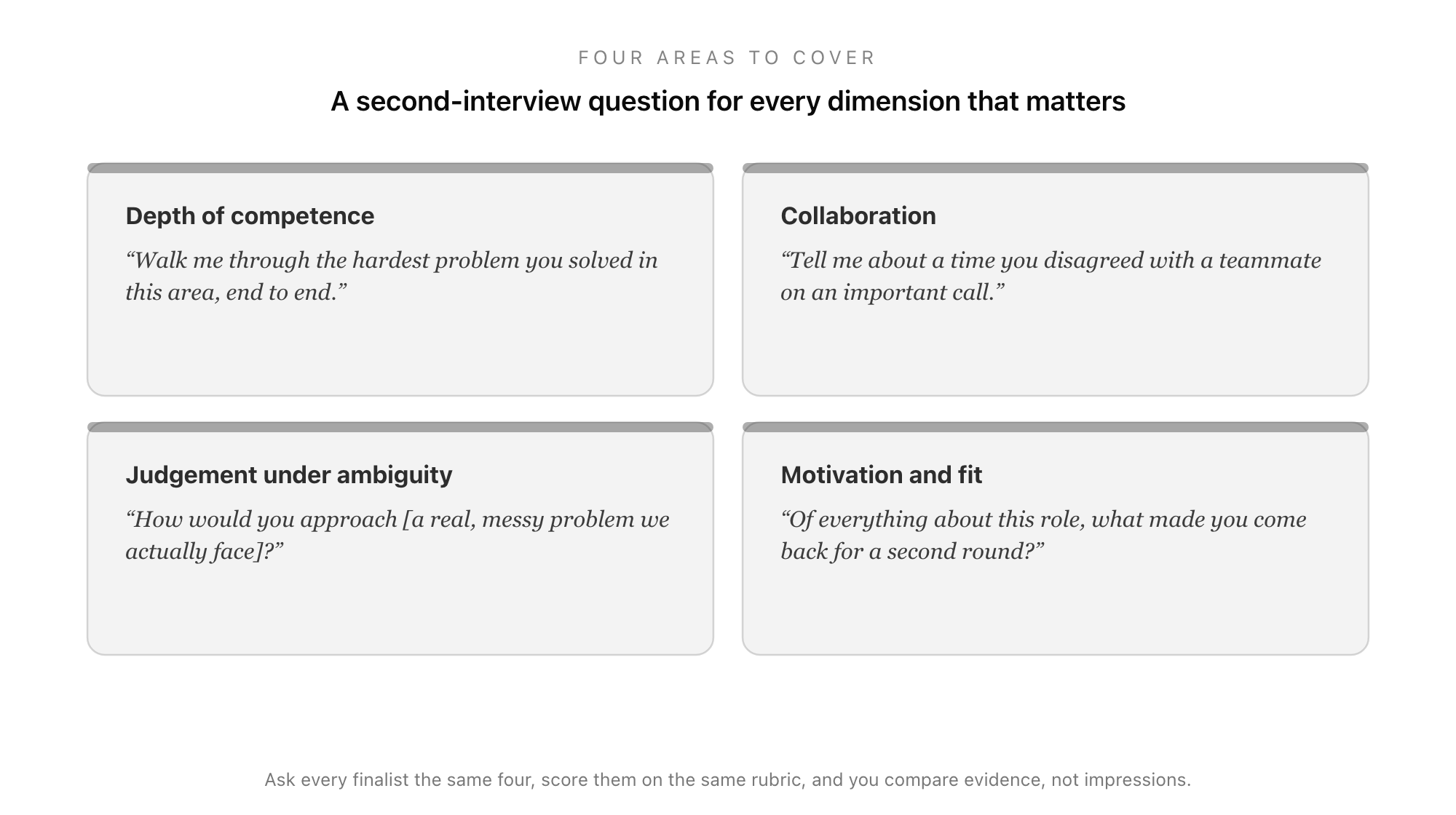
- A second interview should go deep on four dimensions: depth of competence, collaboration, judgement under ambiguity, and genuine motivation for this specific role.
- The single highest-value technique is to probe one real problem deeply rather than skim ten topics. Depth is where a strong candidate separates from a merely capable one.
- Ask every finalist the same core questions and score them on the same rubric, or you are comparing impressions instead of evidence.
- Clone the Good Form second-interview scorecard so every interviewer rates the same dimensions on the same scale and the hire decision rests on a consistent record.
What the Second Interview Is Actually For
The reason so many second interviews feel redundant is that no one has decided what they are for. The clearest way to think about it: the first interview is a screen-out, and the second is a select-in. The first round is deliberately broad and shallow, checking whether a candidate meets the basic requirements, communicates clearly, and is worth more of the team's time. It is designed to filter a large pool down to a few. Most of the people it lets through are, by definition, qualified.
The second interview starts from the opposite assumption. Everyone in front of you can probably do the job. The question is no longer "can they clear the bar?" but "is this the person we should hire over the others?" That shifts what you should ask. You are no longer confirming competence in general; you are probing the depth of it, the way the candidate works with others, how they think when the answer is not obvious, and whether their motivation for this role is real or generic. Those are harder things to assess, which is exactly why they deserve a dedicated round.
The practical consequence is that a good second interview goes deeper, not wider. Instead of ten surface questions across ten topics, you take a smaller number of areas and push hard on each until you can see how the candidate actually operates. That depth is where a genuinely strong hire separates from a merely acceptable one, and it is invisible in a first-round screen.
The Four Areas a Second Interview Should Cover
Depth is the principle; these four areas are where to apply it. Every strong second interview covers all four, and the scorecard at the end scores each one.
Depth of competence
The first interview established that the candidate has the skill. The second establishes how deep it goes. The best way to test this is to pick one real, substantial piece of their experience and follow it all the way down.
- "Walk me through the hardest problem you solved in this area, from the first symptom to the final outcome."
- "What did the first version of your solution get wrong, and how did you find out?"
- "Where did you get stuck, and what did you try that did not work?"
- "If you did that same project again tomorrow, what would you do differently?"
- "What part of this role do you expect to find genuinely difficult?"
The follow-ups matter more than the opening question. Anyone can tell a rehearsed success story. The depth shows in whether they can talk fluently about the messy middle: the dead ends, the trade-offs, the things that broke. A candidate who only has a clean narrative usually was not as close to the work as they claim.
Collaboration and communication
Most work happens with other people, and the second interview is where you test how the candidate operates inside a team, not just how they present in a room.
- "Tell me about a time you disagreed with a colleague on an important decision. What did you do?"
- "Describe a time you had to give someone difficult feedback."
- "When a project you were on started going badly, how did you find out, and what did you do?"
- "How do you like to receive feedback, and can you give me an example of feedback that changed how you work?"
- "Tell me about a time you had to bring someone around to your point of view."
You are listening for whether the candidate takes responsibility or assigns blame, whether they can hold a disagreement without it becoming personal, and whether they describe colleagues as collaborators or obstacles. These patterns predict how they will fit into an actual team far better than a claim to be "a great team player." For a deeper library of these, the behavioral interview questions guide covers the STAR-style probing that works best here.
Judgement under ambiguity
Real work rarely comes with clear instructions. The second interview is the place to see how a candidate thinks when there is no obvious right answer, and the most powerful way to do it is to hand them a genuine problem from your world.
- "Here is a real, messy problem we are actually facing right now. How would you approach it?"
- "What questions would you need answered before you could make a decision on this?"
- "Tell me about a time you had to make an important call without all the information you wanted."
- "How do you decide what to do first when everything feels urgent?"
- "When you are wrong about something, how do you usually realise it?"
Using a real problem does two things. It shows you how the candidate reasons in your actual context, and it tells the candidate something true about the work, which strong people appreciate. You are not looking for the right answer, which often does not exist. You are looking for the quality of the thinking: do they ask good clarifying questions, structure the problem, and reason toward a defensible approach, or do they jump to a confident answer that ignores the complexity?
Motivation and fit for this specific role
By the final round, the question of whether the candidate wants a job has been answered. The real question is whether they want this job, and whether what they want matches what the role actually is.
- "Of everything you have learned about this role, what made you come back for a second round?"
- "What would make this the right move for you, and what would make it the wrong one?"
- "What are you hoping to be doing in this role that you cannot do where you are now?"
- "What would need to be true in a year for you to feel this was a great decision?"
- "What questions do you have that would actually change whether you take this job?"
Generic enthusiasm ("I love your mission") is a weak signal. Specific, informed motivation ("I want to own the part of this role that involves X, because that is what I am missing now") is a strong one, because it means the candidate has thought concretely about the fit. The last question is also one of the most revealing: a candidate's questions at the final stage tell you what they actually care about.
Second Interview Mistakes That Waste the Round
Even with good questions, a few habits undermine the second interview.
- Repeating the first-round questions. The most common waste. If the second interview re-asks what the first already covered, it gathers no new information and just delays the decision.
- No plan, so every interviewer covers the same ground. When a panel or a sequence of interviewers all wing it, they tend to converge on the same easy topics, leaving whole dimensions untested. Assign areas deliberately. This is one of the reasons a structured panel interview works better than an unplanned one.
- Talking more than the candidate. Selling the role matters at this stage, but a second interview where the interviewer talks most of the time produces no evidence. Sell at the end; probe for the majority.
- Scoring on gut feel and calling it fit. "Culture fit" assessed by instinct is where bias enters hardest. Define what you mean, ask everyone the same questions, and score against a rubric.
- Not writing it down until later. Impressions decay and blur together within hours. Capture the assessment during or immediately after each interview, against the same criteria, or the final debrief becomes a memory contest.
Score Every Finalist on the Same Rubric
The questions are only half the job. The other half is making sure you can compare finalists fairly, and that requires structure. When each interviewer asks different questions and records a vague overall impression, the hiring decision comes down to whoever argues most confidently in the debrief. That is how strong-but-quiet candidates lose to confident-but-average ones, and how bias slips in unchallenged.
The fix is a structured scorecard: the same core questions for every finalist, the same dimensions rated on the same scale, and space for the specific evidence behind each rating. Done consistently, it turns the debrief from a debate about impressions into a comparison of evidence. It also creates a record you can point to if a hiring decision is ever questioned, and a feedback signal you can check against how the hire actually works out.
This is exactly what structured forms are built for, and it is why the second interview belongs on a scorecard rather than in a notebook. The Good Form second-interview scorecard puts the four dimensions (depth of competence, collaboration, judgement, and motivation) on a single form, each rated on a consistent scale with a field for the evidence behind the score and a final recommendation.
Clone the second-interview scorecard in Good Form →
It opens in the editor with every dimension wired up, so each interviewer scores the same things the same way and the debrief compares like with like. Pair it with the other hiring forms in the Good Form library (interview feedback, behavioral scorecard, reference check) and your whole interview process, from first screen to final decision, runs through one consistent, structured layer. Finish the loop with a solid reference check against the concerns the scorecard surfaced, and the hire decision rests on evidence at every stage.
The second interview is the most expensive hour in your hiring process and the one that decides the outcome. Spend it going deep on the things the first round could not reach, ask every finalist the same questions, and score them on the same rubric. Do that, and the best candidate wins on the evidence, which is the entire point of interviewing at all.