The best self evaluation examples have one thing in common, and it is not good writing. It is evidence. A self-evaluation is the one document in the review cycle where you, not your manager, decide what gets remembered, and most people waste it by writing the corporate equivalent of a horoscope: true of everyone, useful to no one. "I am a hard worker who is passionate about quality" tells your manager nothing they can put in a calibration meeting and defend to their own boss.
This guide gives you 40+ copy-paste self evaluation examples organized by competency (strengths, development areas, and goals), the one test that separates a line worth writing from filler, and a free self-evaluation form template you can clone and send to your team. The examples are written so you can lift the structure and drop in your own numbers. The point is never to copy the sentence. It is to copy the shape: a claim, plus the specific thing that proves it.
The short version:
- A self-evaluation that helps you is built on evidence, not adjectives. Every strength, every weakness, every goal should survive the question "could two people agree on whether this is true?"
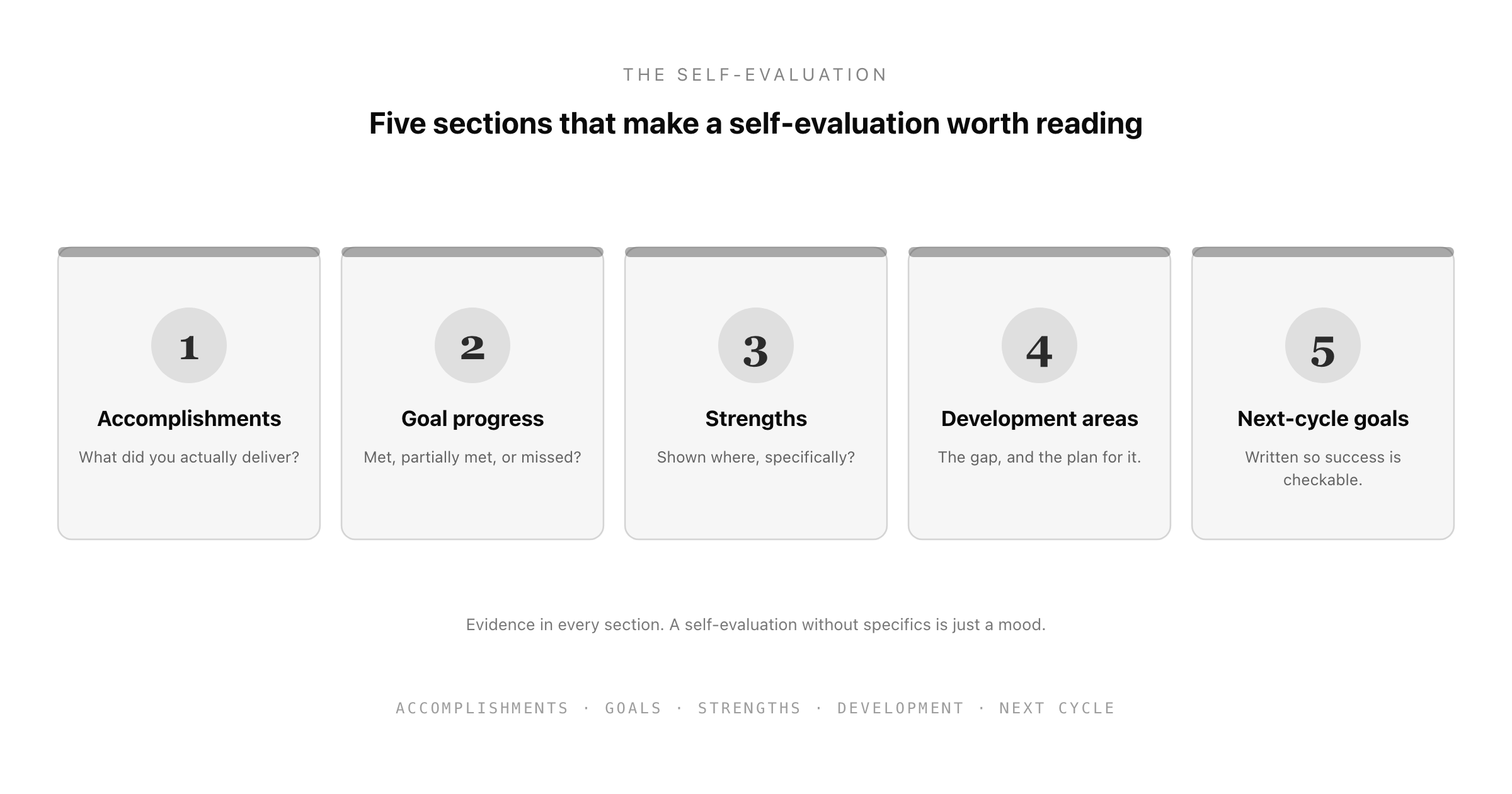
- The structure that works has five parts: accomplishments, progress against last cycle's goals, strengths with evidence, development areas with a plan, and goals for the next period.
- For strengths, lead with the outcome and a number. For weaknesses, name a real gap and pair it with what you will do, never a humblebrag dressed as a flaw.
- The examples below are templates, not scripts. Lift the shape (claim plus proof) and swap in your own situations, metrics, and dates.
- Clone the Good Form self-evaluation template so your whole team fills in the same structured sections every cycle, and the record is consistent and retrievable instead of scattered across five different Google Docs.
How to Write a Self Evaluation That Actually Helps You
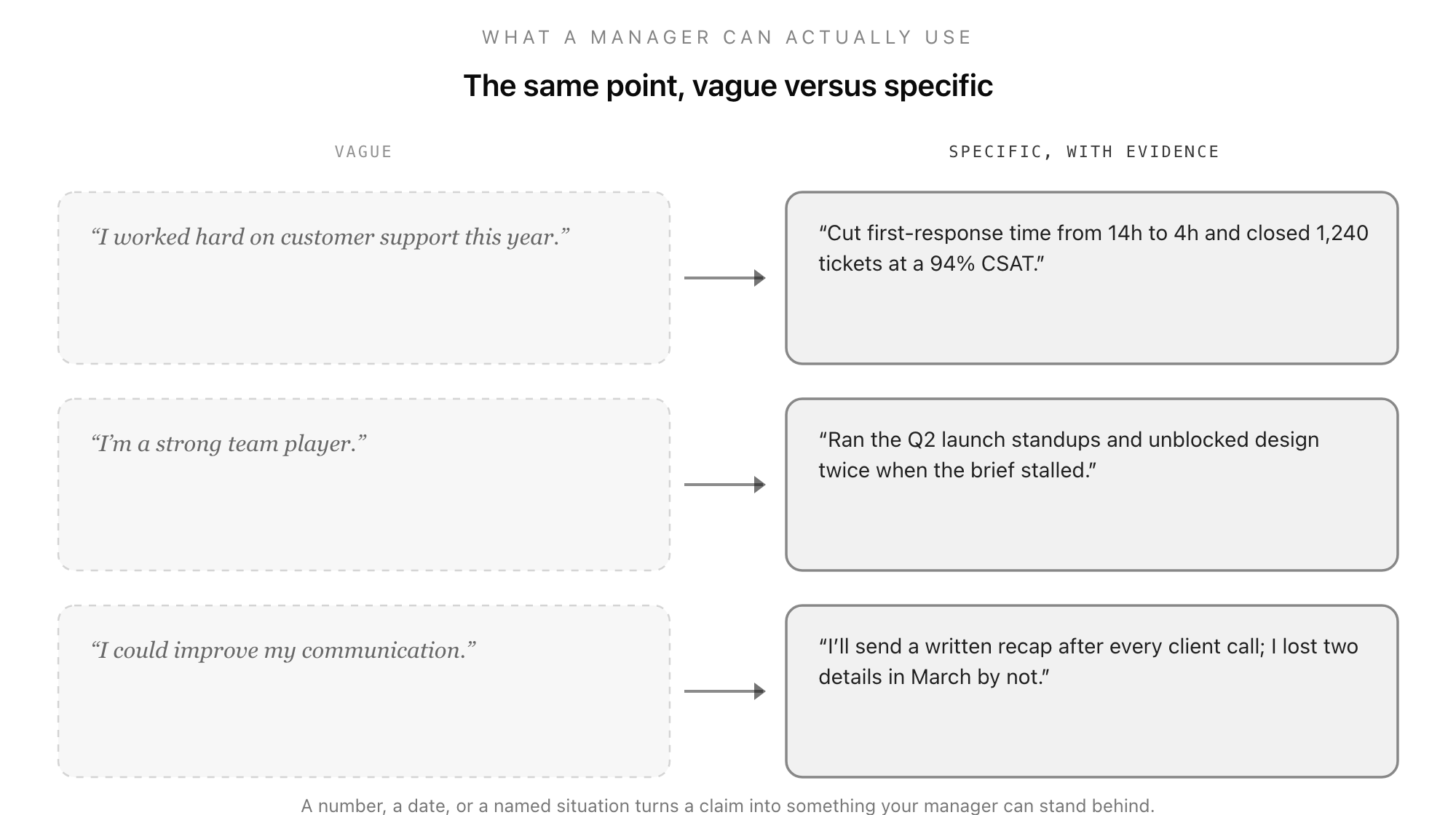
Before the examples, the rule that makes all of them work. A self-evaluation line is only worth writing if it passes the specificity test: could two different people, reading the same line, independently agree on whether it is true? "I improved our onboarding process" fails. Two people could argue about whether you improved it, by how much, and whether it was even you. "I rewrote the new-hire onboarding checklist and cut day-one setup time from two hours to twenty minutes, measured across the last six hires" passes. Nobody can argue with it because it carries its own proof.
This is the single biggest difference between a self-evaluation that moves your rating and one that gets skimmed. Managers run dozens of these during review season. The ones that stick are the ones that hand the manager a fact they can repeat in a calibration meeting without having to defend it.
So the working method for any self-evaluation, whatever the template, is three steps:
- Write the claim you want to make ("I am reliable under pressure").
- Find the evidence (the launch week in March where you held three deadlines while covering a teammate's absence).
- Throw the claim away and keep the evidence. The evidence is the line. The claim was just how you found it.
Everything below is built that way. Use the examples as scaffolding for your own evidence, not as sentences to paste verbatim, because a manager who has read fifteen self-evaluations can spot a templated line instantly.
Self Evaluation Examples: Strengths
Strengths are where most people get vague because praising yourself feels awkward, so they retreat into adjectives. Resist it. Lead with the result, then name the behaviour that produced it. Here are self evaluation examples for work strengths, grouped by the competency they demonstrate.
Results and ownership
- "Closed £140,000 in new business this half against a £120,000 target, with the two largest deals coming from accounts I sourced rather than inherited."
- "Took ownership of the migration nobody wanted, scoped it, and shipped it two weeks early with zero customer-reported incidents in the following month."
- "Reduced our average ticket resolution time from 14 hours to 4 hours by rewriting the triage rules, holding a 94% CSAT across 1,240 tickets."
Collaboration and communication
- "Ran the cross-team standups for the Q2 launch and unblocked design twice when the brief stalled, which kept the ship date intact."
- "Rewrote our internal handover doc after two messy handoffs in January; the next three project transitions happened without a single 'who owns this?' thread."
- "Mentored two junior hires through their first quarter, both of whom hit their ramp targets a month early."
Reliability and judgment
- "Held three deadlines during launch week in March while covering a colleague's caseload, and flagged the one at risk early enough to re-plan instead of slip."
- "Caught a pricing error in the Q1 contract template before it went to a client, saving an estimated £8,000 in mispriced renewals."
The pattern in every one: a verb, a specific situation, and a number or named outcome. If you cannot attach evidence to a strength, it is not a strength you should claim in a self-evaluation, it is a feeling. Save it for the conversation, not the form.
Self Evaluation Examples: Weaknesses and Development Areas
This is the section people fear, and the fear produces the worst writing in the entire document: the humblebrag weakness. "I care too much," "I work too hard," "I am a perfectionist." Every manager has read these a hundred times and every one of them reads as evasion. Naming a real development area does not lower your rating. Refusing to name one does, because it signals you either lack self-awareness or do not trust the process.
The format that works: name the gap, give it a boundary so it does not sound like a global failing, and pair it with a concrete plan. Here are self evaluation examples for development areas:
- "I delay sharing work until it feels finished, which cost us time on the Q1 report when an earlier draft would have caught the framing issue sooner. Next cycle I will share work-in-progress at the halfway point on anything that takes more than a week."
- "I am still slower than I want to be at SQL, which makes me dependent on the data team for ad-hoc pulls. I have started the internal analytics course and aim to self-serve the standard reports by the end of Q3."
- "I tend to over-commit in planning because I want to be helpful, and twice this half that meant a deadline slipped. I am now keeping a running capacity tracker and saying no, or proposing a later date, when the week is full."
- "My written updates after client calls have been inconsistent, and I lost two action items in March because of it. I have set myself a rule to send a written recap within an hour of every external call."
- "I avoid giving peers critical feedback because I worry about the relationship, which means problems surface later than they should. I am working on this by raising one small issue directly each week rather than saving it for a review."
Notice that each one ends with a plan, and the plan is specific enough to check. "I will work on my communication" is not a development plan. "I will send a written recap within an hour of every external call" is. The plan is what turns a confessed weakness into evidence of self-management, which is the thing a good manager is actually rating. For more on writing goals that are checkable rather than aspirational, the SMART goals guide walks through the same test applied to objective-setting.
Self Evaluation Examples: Goals for the Next Period
The last section of a strong self-evaluation looks forward. Two or three goals for the coming cycle, written so that you and your manager will agree at the next review whether each was met. This is where the SMART goals framework earns its keep: a goal that fails the specificity test will fail the review.
Weak goals and their fixed versions:
- Weak: "Get better at project management." Better: "Lead the website replatform end to end and deliver it within the agreed scope and timeline, with a written post-mortem by the end of Q4."
- Weak: "Improve my technical skills." Better: "Complete the advanced analytics certification and independently build the two monthly reports the data team currently runs for me, by end of Q3."
- Weak: "Be a better communicator." Better: "Run a fortnightly written update to stakeholders for the platform project, and gather feedback from two named partners at the halfway point."
- Weak: "Contribute more to the team." Better: "Own the new-hire onboarding for our function, taking the next two hires from offer to fully ramped, and document the playbook so it outlasts me."
A good next-cycle goal also tells your manager what you want, which is information they need and rarely get. If you want to move toward leadership, a goal that has you owning a project end to end says it more credibly than writing "I would like more responsibility" in the development box.
The Five-Part Structure Behind Every Good Self-Evaluation
The examples above slot into a structure. Whatever form your company uses, a self-evaluation that helps you covers five things, in this order:
- Accomplishments. Your three to five most significant results this period, each led by the outcome and a number. This is your headline; put your strongest result first because it is the line most likely to be remembered.
- Progress against last cycle's goals. Take each goal you were set and state plainly where it landed: met, partially met, or missed, with the evidence. Owning a missed goal honestly reads far better than quietly omitting it and hoping nobody checks.
- Strengths. Two or three, each with a specific situation behind it, drawn from the strengths examples above.
- Development areas. One or two real gaps, each paired with a plan, drawn from the weaknesses examples above.
- Goals for the next period. Two or three forward-looking, checkable goals.
The reason the order matters: managers read these under time pressure, often skimming the first two sections of each. Lead with your strongest evidence. A self-evaluation that buries its best result in paragraph six is one that does not get the result credited. This is the same logic behind a well-built performance review template, which sequences the manager's view around the same evidence-first principle, and the same reason a structured skills assessment beats an open-ended "rate yourself" prompt: structure forces specifics.
Self-Evaluation Phrases to Avoid
A quick reference for the lines that weaken a self-evaluation no matter how you dress them up:
- The fake weakness. "I am too much of a perfectionist." Reads as evasion. Name a real gap instead.
- The unevidenced superlative. "I consistently exceed expectations." Says nothing without the evidence. Show the exceeding; do not assert it.
- The passive credit. "Was involved in the launch." Involved how? Either you owned a piece of it, in which case name the piece, or you did not, in which case leave it out.
- The global adjective. "I am hardworking, dedicated, and passionate." Three words, zero information. A manager cannot calibrate on adjectives.
- The unbounded plan. "I will improve my time management." Improve it how, measured how, by when? An unbounded plan is a wish.
The test for all of them is the same one from the top of this guide: could two people agree on whether the line is true? If not, rewrite it until they could, or cut it.
Put Your Self-Evaluations on a Form, Not Five Different Docs
Most teams run self-evaluations as a Google Doc template that each person copies, renames, fills in differently, and emails back, which means by the time review season is in full swing the manager is reconciling fifteen documents with fifteen slightly different structures, half of them missing the goals section. The information you need to compare people fairly is exactly the information that is hardest to compare when everyone formats it their own way.
A self-evaluation is a structured intake problem: the same fields every cycle, the same sections from every person, timestamps the system records itself, and one retrievable record per employee instead of an inbox full of attachments. The Good Form self-evaluation template puts the five-part structure on a single form, so every person on the team answers the same questions in the same order and the manager gets a consistent, side-by-side set to work from.
Clone the self-evaluation template in Good Form →
It opens in the editor with all five sections wired up: accomplishments, goal progress, strengths, development areas, and next-cycle goals, plus an optional self-rating. Customise the prompts for your review cycle, share the link with your team, and collect every self-evaluation in one consistent place. Pair it with the other HR and review forms in the Good Form library (performance review, skills assessment, engagement survey) and your whole review cycle runs through one intake layer instead of a folder of mismatched docs.
A self-evaluation is the one part of the review you fully control. Spend it on evidence, not adjectives, and it does the job it is supposed to: making sure the work you actually did is the work that gets remembered.