A skills assessment is the part of hiring where you stop asking what a candidate can do and actually watch them do a small version of it. Instead of taking their word, or your gut read from an interview, you give them a short, realistic task and see the work. Done well, it is the single most predictive thing you can add to your process, because decades of research keep finding the same result: work-sample tests and structured interviews are the two best predictors of job performance there are, far better than unstructured chats, years of experience, or a polished CV. Done badly, a skills assessment becomes a multi-day unpaid project that drives good candidates away and tells you nothing fair. This is a recruiter's guide to running a skills assessment that earns its place: why it works, how to design one that respects the candidate, and how to score it so the result holds up.
The core idea is simple enough to state in one line: the best predictor of whether someone can do the job is a sample of the job. Everything below is about getting an honest, fair sample and scoring it consistently. To keep the scoring comparable across candidates, you can clone the Good Form skills assessment scorecard.
The short version:
- A skills assessment is a small, realistic sample of the actual work, scored against set criteria, used to predict performance.
- It out-predicts the interview. Work samples and structured interviews are the two strongest predictors of job performance in the research; use them together.
- Make it reflect the real job, not a clever puzzle or a trick question. Relevance is what gives it predictive power.
- Keep it short and respect the candidate's time. A 60-to-90-minute task, not a free-labour project. Pay for anything substantial.
- Score every candidate on the same rubric, blind to their name where you can, so the comparison is fair and defensible.
- It is one input, not the whole decision. Combine it with the interview and a reference check.
What Is a Skills Assessment?
A skills assessment (also called a pre-employment assessment, a work-sample test, or a practical exercise) is any structured task that measures whether a candidate can actually perform the work, rather than whether they can talk about it. It sits in the hiring process after an initial screen and usually alongside or just before the interviews, and it comes in several forms:
- Work-sample tests: a slice of the real job. A short writing task for a content role, a debugging exercise for a developer, a mock call for a salesperson, a case analysis for an analyst. The closer it mirrors the actual work, the better it predicts.
- Job-knowledge and technical tests: structured questions or problems measuring specific knowledge the role requires.
- Cognitive and aptitude tests: general reasoning ability, which predicts performance but raises more fairness and adverse-impact questions, so use with care and validation.
- Situational judgment tests: realistic scenarios where the candidate picks or ranks responses, useful for judgment-heavy roles.
For most hiring, the work-sample test is the workhorse, because it has the clearest link to the job and is the easiest to defend: you are judging the candidate on a version of the exact thing you are hiring them to do.
Why a Skills Assessment Out-Predicts the Interview
The case for assessments is not a hunch; it is one of the most replicated findings in the science of hiring. Large meta-analyses of selection methods (most famously the long line of work summarised by Schmidt and Hunter) consistently rank work-sample tests and structured interviews at the top for predicting who will actually perform, well ahead of unstructured interviews, years of experience, or education alone.
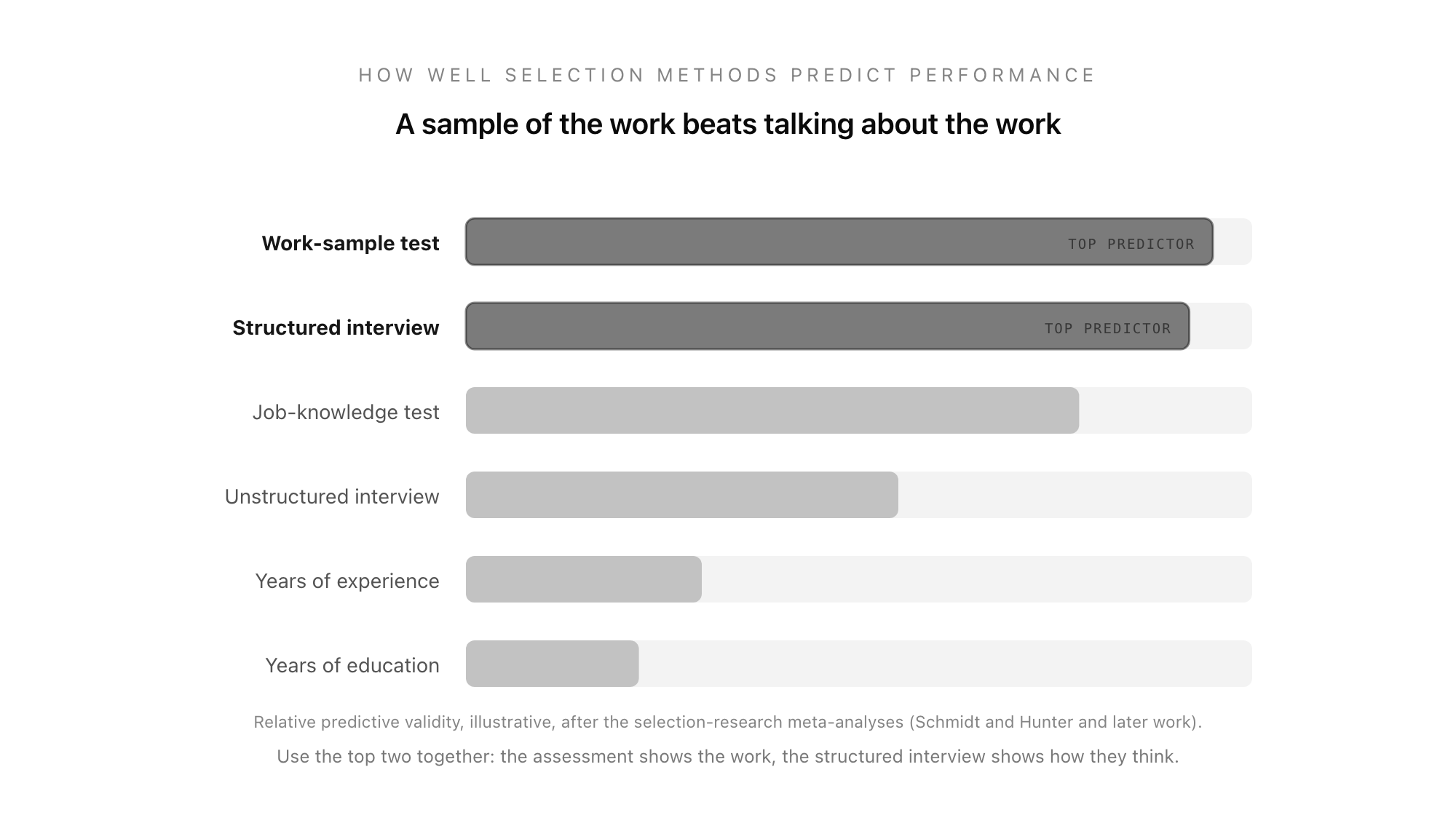
The reason is intuitive once you see it. An unstructured interview measures how well someone interviews: how they present, how likeable they are, how fluently they talk about past work. Those things correlate only weakly with doing the job. A work sample measures the job. It is much harder to talk your way through a task than through a conversation, and it surfaces the candidates who are genuinely strong but interview poorly, as well as the smooth talkers whose work does not match their pitch. It also reduces bias: when you score the output against fixed criteria, you are reacting to the work, not to a gut feeling about the person.
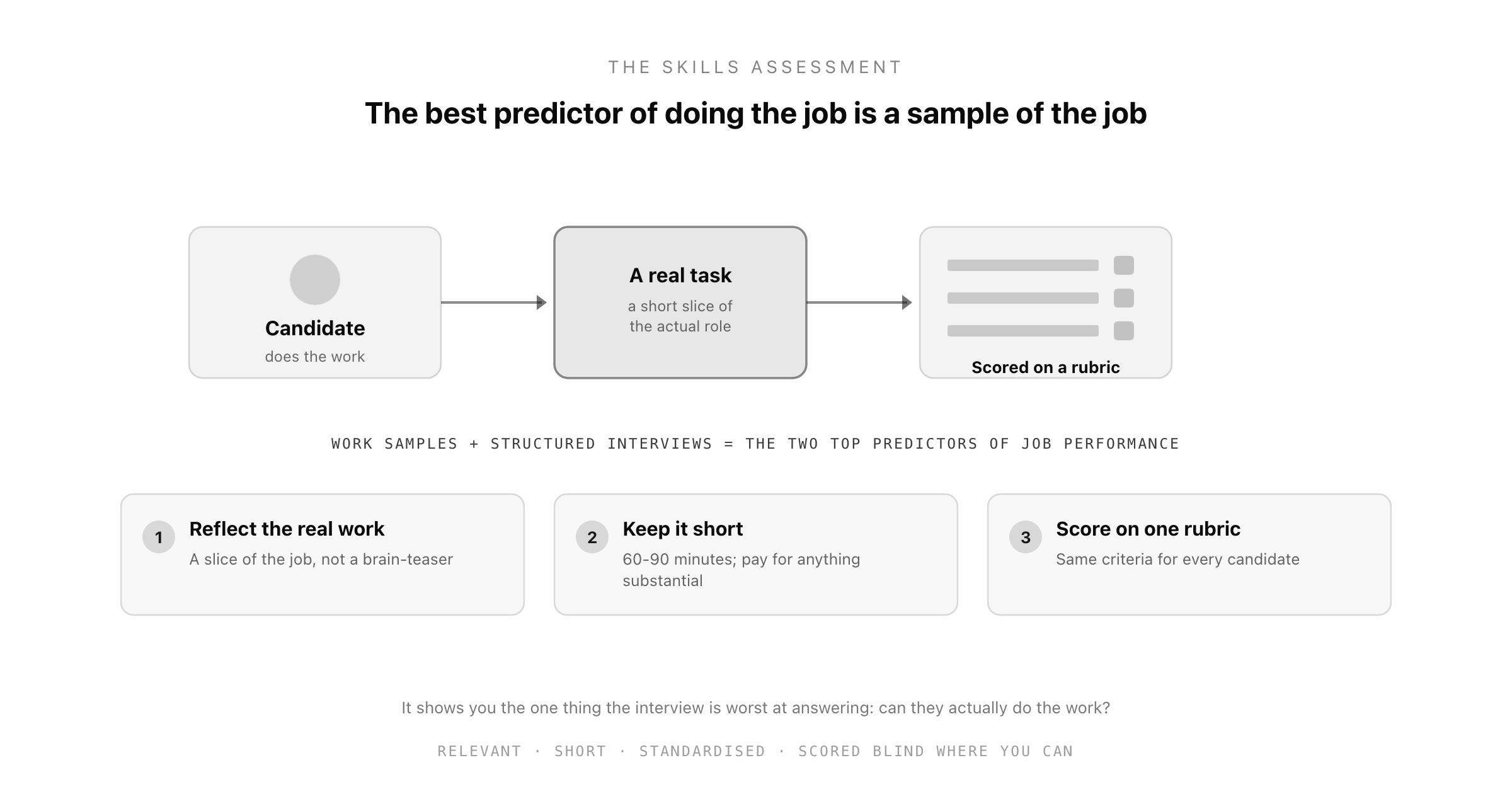
None of this means the interview is useless. It means the two work best together: the assessment shows you the work, the structured interview shows you how the person thinks and collaborates, and each catches what the other misses.
How to Design a Fair Skills Assessment
A good assessment is realistic, short, and consistent. Get those three right and most of the rest follows.
Make it reflect the real work
The predictive power of a work sample comes entirely from its relevance, so build the task from a genuine slice of the role, not from a puzzle that feels clever. If the job is writing customer help articles, ask for a short help article. If it is triaging bugs, give them three realistic bug reports to prioritise and explain. Resist brain-teasers ("how many golf balls fit in a bus"), which are fun, feel rigorous, and predict almost nothing.
Keep it short, and pay for substantial work
The fastest way to ruin an assessment is to make it a project. A 60-to-90-minute task is plenty to see how someone works; a multi-day build is a free-labour trap that the best candidates, who have other options, will simply decline. If you genuinely need something substantial, pay for it, and never use candidates' assessment work in your actual product. Respecting the candidate's time is not just ethics; it protects your candidate experience and your employer brand, and it keeps your strongest applicants in the process.
Standardise it
Give every candidate for a role the same task, the same instructions, the same time, and the same scoring criteria. Consistency is what makes candidates comparable and what makes the process defensible if a rejected applicant ever challenges it. Define what "good" looks like in advance, as a short rubric, before you see a single submission.
Reduce bias where you can
Score the work blind to the candidate's name where the format allows, so you are reacting to the output rather than to who produced it. Be alert to assessments that quietly disadvantage some groups (a tight unpaid time window penalises caregivers and people with disabilities; a test that assumes tools only some candidates have access to is unfair), and make reasonable accommodations. A skills assessment should widen the funnel to people who can do the work, not narrow it to people who interview or test like you.
How to Score a Skills Assessment
The assessment only adds value if you score it consistently, and that means a rubric: a short list of the criteria that matter for the role, each rated on the same scale, decided before you review anything.
For a writing sample, the criteria might be clarity, accuracy, structure, and tone. For a coding exercise, correctness, readability, edge-case handling, and communication. Rate each on a simple scale (a 1-to-4 scale avoids the fence-sitting middle of a 1-to-5), add a short note citing what in the work earned the score, and resist collapsing it all into a single vague "felt strong." The point is the same as it is for a structured interview: you are scoring the evidence, not your overall impression of the person, and a rubric is what keeps you honest.
When more than one person reviews, have each score independently before discussing, so the first opinion voiced does not anchor everyone else, exactly as you would in a panel interview. Then compare. Because everyone scored the same work against the same criteria, a disagreement is a real one worth talking through.
Where the Assessment Fits in the Process
A skills assessment is one input, not the whole decision. A strong process usually runs: a quick screen to check the basics, a skills assessment to see the work, a structured interview to understand how the person thinks and collaborates, and a reference check to verify and add context. Each step measures something the others cannot, and the final decision weighs them together against the bar for the role.
Used this way, the assessment does the heavy lifting on the one question interviews are worst at answering, can they actually do the work, while staying in proportion: it informs the decision, it does not dictate it. A brilliant work sample from someone who would be miserable on the team is still a no; a merely good sample from someone who is clearly strong elsewhere is still a maybe.
Capture and Score It on One Form
A skills assessment falls apart when the submissions sit in scattered inboxes and the scores live in reviewers' heads. The fix is the same one that makes every hiring step defensible: collect the work and score it on one structured form, the same rubric for every candidate.
This is exactly what Good Form is built for. You can clone the skills assessment scorecard template and use it for every candidate on a role: it captures the candidate and role, a rating against each criterion with a note citing the evidence, time taken, and an overall recommendation, so every submission is scored the same way and the comparison is genuinely fair. Pair it with a structured interview scorecard, a fair panel interview, and a final reference check, and you have a hiring process built on what actually predicts performance, from first task to final decision. Show the work, score the evidence, and let the form keep everyone honest.