The 1099-INT form is how a bank, credit union, brokerage, or other payer reports the interest income it paid you during the year. If a financial institution paid you $10 or more of interest, on a savings account, a CD, a money-market account, a bond, or a Treasury obligation, it sends you a 1099-INT and files a copy with the IRS, and you use it to report that interest on your return. It is not a form you fill in. It is the payer's report, and it exists so that the interest you earned is matched against the interest you declare.
This is the 2026 walkthrough of the 1099-INT form for the payer who has to file it, and the recipient who has to read it: what a 1099-INT is, the box-by-box breakdown of the ones that matter, the $10 and $600 thresholds, the difference between the 1099-INT and its siblings the 1099-DIV and 1099-OID, and the furnishing and e-filing deadlines. If you pay reportable interest and want a clean way to capture each recipient's details before your filing vendor needs them, you can build a 1099-INT intake form in Good Form in minutes.
The short version:
- The 1099-INT reports interest income a payer paid during the year. The payer files it; the recipient uses it to complete their return.
- The threshold is $10 for most interest (Box 1), but $600 for interest paid in the course of a trade or business, and any amount if backup withholding was taken.
- Key boxes: Box 1 interest income, Box 2 early-withdrawal penalty, Box 3 interest on US Savings Bonds and Treasury obligations, Box 4 federal income tax withheld (backup withholding at 24%), Box 8 tax-exempt interest.
- Do not confuse it with the 1099-DIV (dividends) or 1099-OID (original issue discount). Different income, different form.
- Deadlines: furnish the recipient by January 31, file with the IRS by February 28 on paper or March 31 electronically. E-filing is required at 10 or more information returns.
What Is a 1099-INT?
A 1099-INT is an information return that reports interest income of $10 or more paid to a person or entity during the tax year. The "payer" is whoever paid the interest, typically a bank or other financial institution, and the "recipient" is whoever earned it. The payer sends one copy to the recipient and files another with the IRS, so the two sides can be matched.
The purpose is simple and it is enforcement: interest is taxable income, and the 1099-INT makes sure the IRS knows how much interest you were paid, whether or not you remember to report it. When you file your return, the interest from all your 1099-INTs is reported as taxable interest, and if your total taxable interest exceeds $1,500 you generally have to itemise the sources on Schedule B. The form you receive is the payer's statement of what they paid you; your job is to make sure it lands on your return.
Because the form is the payer's responsibility, the obligations fall on the institution paying the interest. If you run a business that pays reportable interest, you are the payer, and the rest of this guide is about getting that filing right.
The 1099-INT Box by Box
The 1099-INT has more boxes than most filers ever use, because it has to cover everything from a plain savings account to specified private activity bond interest. These are the ones that matter.
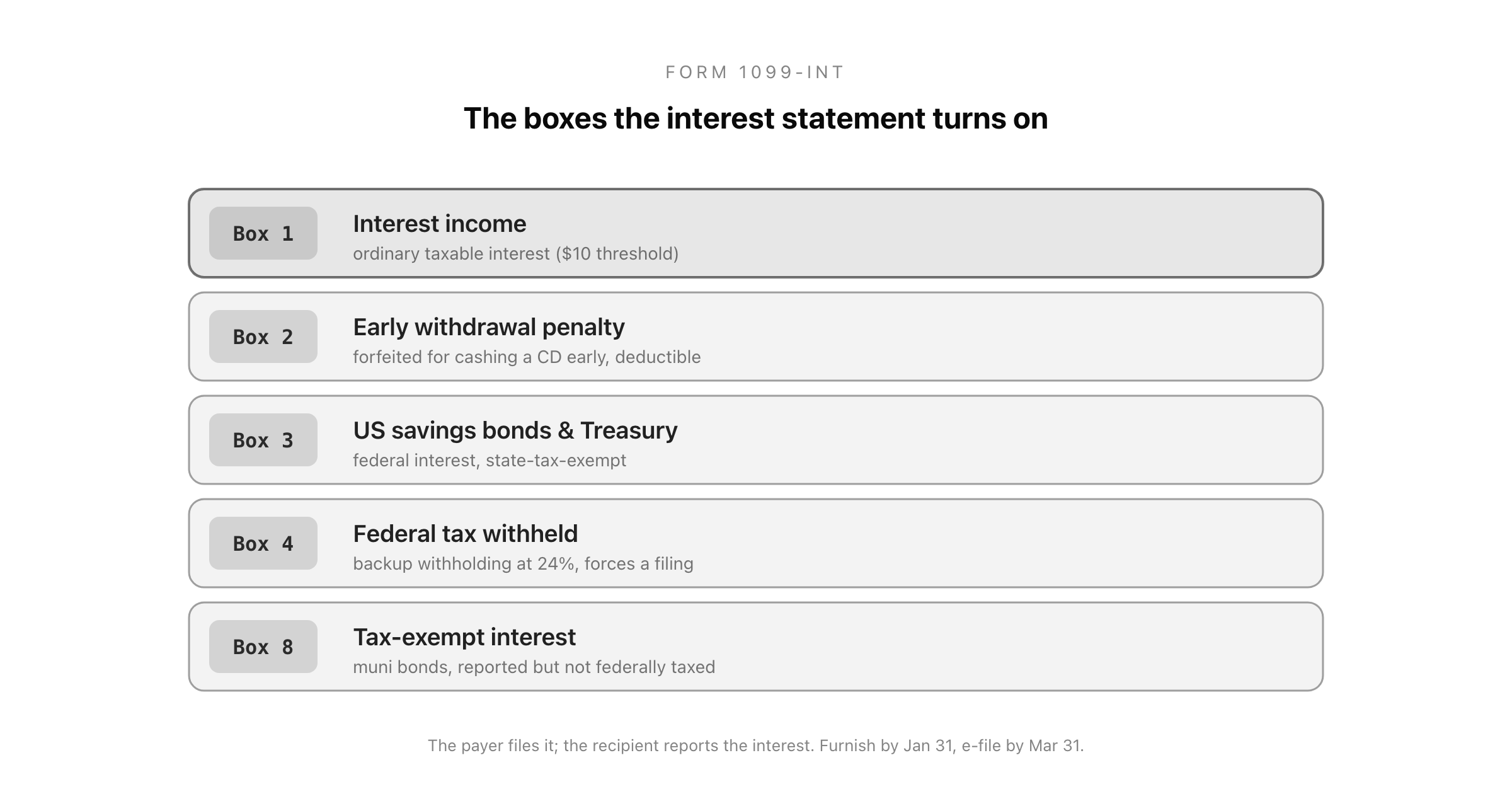
Box 1, Interest income. The main box: ordinary taxable interest paid during the year, from savings accounts, CDs, money-market accounts, and most other interest-bearing accounts. This is the number that flows onto the recipient's return as taxable interest. The reporting threshold for Box 1 is $10.
Box 2, Early withdrawal penalty. The penalty a saver forfeited for cashing in a CD or time deposit before maturity. It matters to the recipient because it is deductible as an adjustment to income, so they get it back even if they do not itemise.
Box 3, Interest on US Savings Bonds and Treasury obligations. Interest from federal instruments, reported separately because it is taxable at the federal level but exempt from state and local tax. Keeping it out of Box 1 lets the recipient claim that state exemption.
Box 4, Federal income tax withheld. Backup withholding, tax the payer was required to withhold, currently at 24%, usually because the payee failed to certify a correct taxpayer identification number. Any backup withholding forces a 1099-INT to be filed regardless of the amount of interest, and the recipient claims the withheld amount as tax already paid.
Box 8, Tax-exempt interest. Interest from municipal bonds and similar instruments that is exempt from federal income tax. It still has to be reported to the IRS on the 1099-INT even though it is not taxable, because it can affect other calculations on the recipient's return.
Other boxes handle foreign tax paid (Box 6), bond premium (Boxes 11-13), and specified private activity bond interest (Box 9), but the five above are where the ordinary 1099-INT lives.
The Thresholds: $10, $600, and Any Amount
The 1099-INT has three trigger points, and knowing which applies keeps you from both over- and under-filing.
$10 is the general threshold. If you paid $10 or more of ordinary interest (Box 1) or tax-exempt interest (Box 8) to a recipient, you must file a 1099-INT. This low threshold is why almost anyone with a savings account that paid a few dollars of interest receives one.
$600 applies to interest paid in the course of your trade or business that is not otherwise reportable, a narrower category than the everyday bank interest most people think of.
Any amount triggers a filing if you withheld federal income tax under the backup withholding rules, even if the interest was less than $10. Backup withholding always forces the form.
1099-INT vs 1099-DIV vs 1099-OID
The 1099-INT is one of a family of investment-income returns, and mixing them up is a common error. The distinction is simply what kind of income the money is.
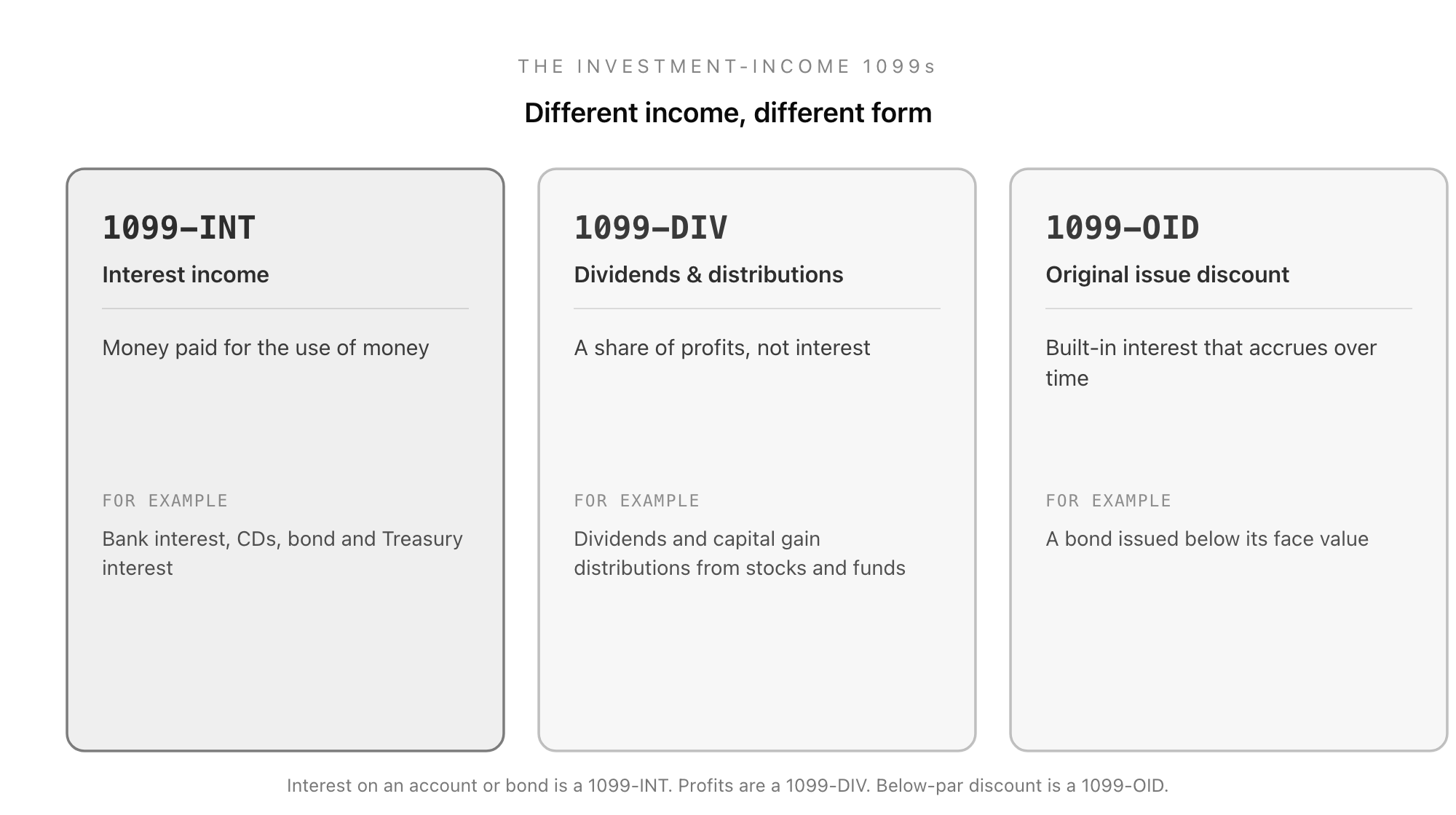
1099-INT reports interest, money paid for the use of money: bank interest, bond interest, Treasury interest. If the income is interest, it belongs here.
1099-DIV reports dividends and distributions, the payments and capital gain distributions that stocks, mutual funds, and other investments pay out to their holders. Dividends are a share of profits, not interest, so they go on their own form.
1099-OID reports original issue discount, the built-in interest that accrues when a bond or note is issued at a price below its face value. It is economically a form of interest, but because it accrues over the life of the instrument rather than being paid out, it has its own return.
The rule of thumb: interest paid on an account or bond is a 1099-INT; a share of a company's or fund's profits is a 1099-DIV; the discount that accretes on a below-par bond is a 1099-OID. This 1099-INT sits alongside the wider family covered in our guides to the 1099-MISC and the 1099-K.
The 1099-INT Deadlines
The 1099-INT runs on the standard information-return calendar, and missing the dates carries penalties that rise the longer you wait.
Furnish the recipient by January 31. The recipient needs their copy early so they can file their own return, so the deadline to get the statement to them is January 31.
File with the IRS by February 28 on paper, or March 31 electronically. The IRS filing deadline is later than the recipient's copy, and e-filers get an extra month.
E-filing is required at 10 or more returns. Under the rules now in force, if you are filing 10 or more information returns of any type in aggregate for the year, you must file them electronically rather than on paper. For most payers of any size, that means the 1099-INT is an e-filed form.
As with all 1099s, the recipient copies are transmitted to the IRS on paper under a 1096 transmittal, or electronically through the IRS system, and late or incorrect filings draw per-form penalties, so getting the recipient details right the first time is worth the effort.
Capture Your 1099-INT Details in Good Form
The filing itself goes through your tax software or filing vendor, but the part that trips payers up is gathering clean, correct recipient information, the legal name, address, and taxpayer identification number for every person you paid interest to, before filing season. A wrong or missing TIN is what triggers backup withholding and correction notices in the first place.
You can build a 1099-INT intake form in minutes with the free form builder, collecting each recipient's details and W-9 information in one structured place so the data is clean and ready when your filing vendor needs it. The same approach powers intake for the rest of the 1099 family, including the 1099-MISC and the 1099-K, so all your information-return data lives in one organised system. If you are choosing a tool to run your tax-season intake on, the guide to the best free form builders covers what to look for.
Build your 1099-INT intake form in Good Form →
The 1099-INT is one of the most common information returns there is, precisely because its $10 threshold catches almost every interest-bearing account in the country. For the payer, getting it right comes down to the same fundamentals every year: report the interest in the correct box, apply the right threshold, watch for the backup withholding that forces a filing, and hit the January and February deadlines with clean recipient data. Do that, and the humble 1099-INT stops being a filing-season scramble and becomes a routine part of a well-run year.