Attendance is one of those things every organisation records and almost nobody records well. A workplace needs it for payroll and absence management, a school needs it because the law requires it, a training provider needs it to certify that someone completed the course, and a club or event needs it so that when the fire alarm goes off somebody knows who is in the building. The information is simple, who was expected and who actually turned up, and yet it commonly lives in a mixture of paper registers, someone's spreadsheet, and a memory of who was in the room.
This guide covers what attendance tracking is for, what an attendance record should actually capture, the status codes that make records comparable, how to calculate attendance and absence rates (including the Bradford Factor), what belongs in an attendance policy, the data protection considerations, and how to build an attendance form people will actually complete.
Why Attendance Gets Tracked
The reasons vary by context, and knowing which one you are serving determines how much detail you need.
Pay and billing. For hourly, shift, and sessional staff, attendance is the basis of pay, and for anything billed by session or by day it is the basis of the invoice. This overlaps with, but is not the same as, a timesheet: a timesheet records hours worked, an attendance record answers the simpler question of whether the person was there.
Legal and regulatory duties. Schools are legally required to keep attendance registers. Regulated training, apprenticeships, and funded programmes usually require evidence of attendance as a condition of the funding. In several sectors an inspector can ask to see the record.
Absence management. Consistent records are what let you see a genuine pattern, distinguish an unlucky run of illness from repeated short absences, and support someone appropriately. Without records you are relying on a manager's impression, which is both unreliable and unfair.
Safety and roll call. In an evacuation, the attendance record is the list you check against. This is the reason event and site attendance matters even when nobody is being paid.
Understanding participation. For classes, clubs, and voluntary programmes, attendance data shows what is working. A course with a steady drop-off from week three is telling you something specific.
What an Attendance Record Should Capture
A good record answers who, when, and what status, with enough context to be useful later.
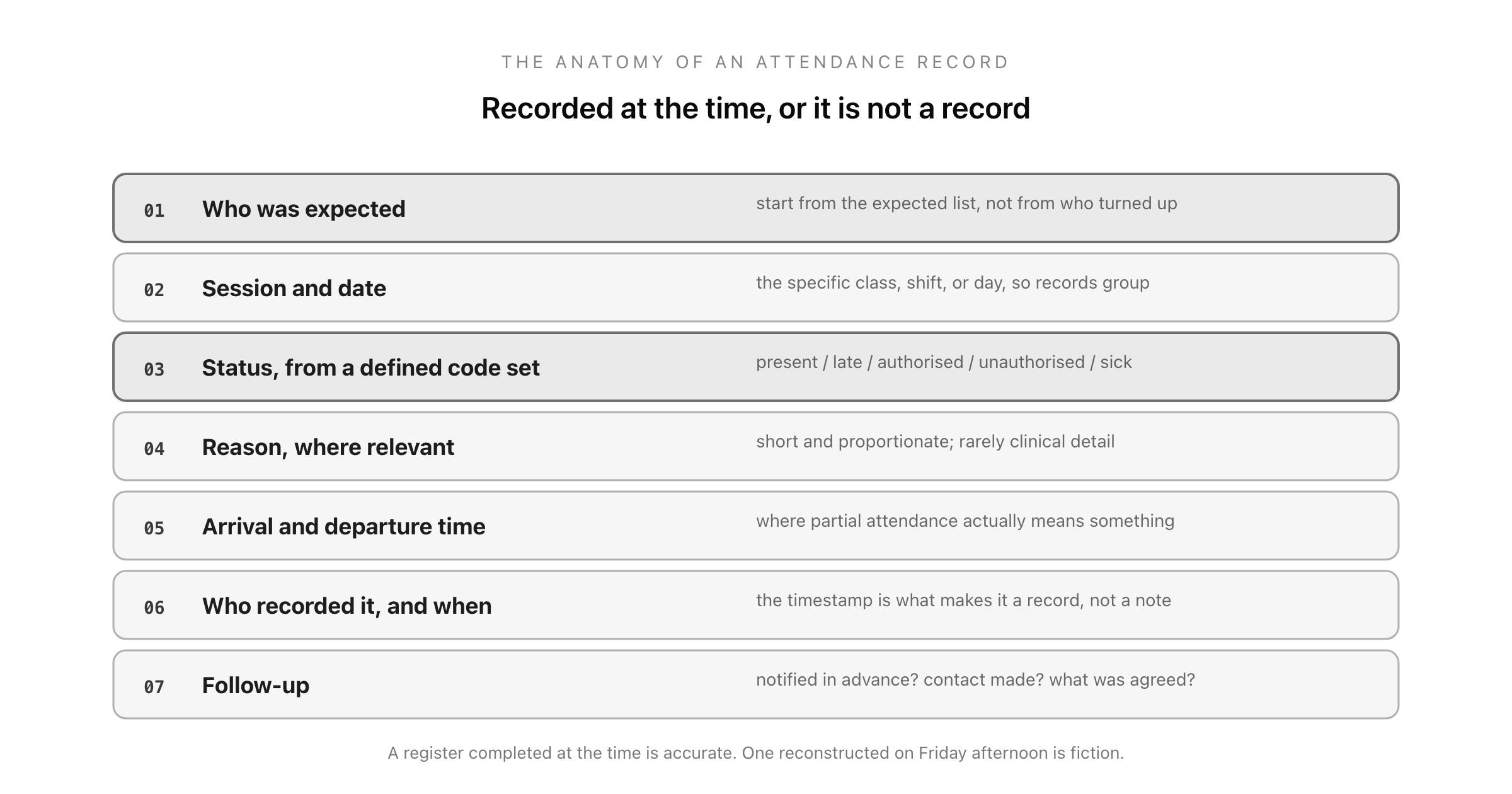
Who was expected. The register starts from an expected list, not from who showed up. This matters more than it sounds: a record built only from arrivals cannot show absence at all.
The session and date. The specific class, shift, day, or event, so records can be grouped and compared.
The status. Present, absent, late, excused, and so on, using a defined set of codes rather than free text.
The reason, where relevant. For absences, a short reason, and for lateness sometimes a note. Keep this proportionate; you rarely need clinical detail.
Arrival and departure time, if it matters. For sessions where partial attendance is meaningful, record times rather than a simple tick.
Who recorded it, and when. The name of the person taking the register and a timestamp. This is what turns a note into a record that can be relied on, and it matters most in exactly the situations where records get challenged.
Any follow-up. Whether an absence was notified in advance, whether contact was made, and what was agreed.
Status Codes: The Detail That Makes Data Usable
The single biggest improvement most organisations can make is to replace free-text status with a short list of codes. Free text produces "off sick", "sick", "unwell", "not in (ill)" and four other spellings of the same thing, none of which can be counted.
A workable set for most contexts:
Present. Attended as expected.
Late. Attended but arrived after the start, ideally with the arrival time.
Absent, authorised. Did not attend, with permission or a valid reason: booked leave, an approved appointment, a scheduled commitment.
Absent, unauthorised. Did not attend without permission or notice. This is the category that matters most and the one people are most tempted to fudge.
Sick. Absent due to illness. Worth separating from other authorised absence because it is managed differently and reported differently.
Excused or exempt. Not expected for this session for a legitimate structural reason, so it should not count against them.
Left early. Attended part of the session.
Keep the list short enough to remember and define each code in writing, because two people using the same code to mean different things is the fastest way to make a year of data worthless.
How to Calculate Attendance
Attendance is usually expressed as a percentage of possible sessions.
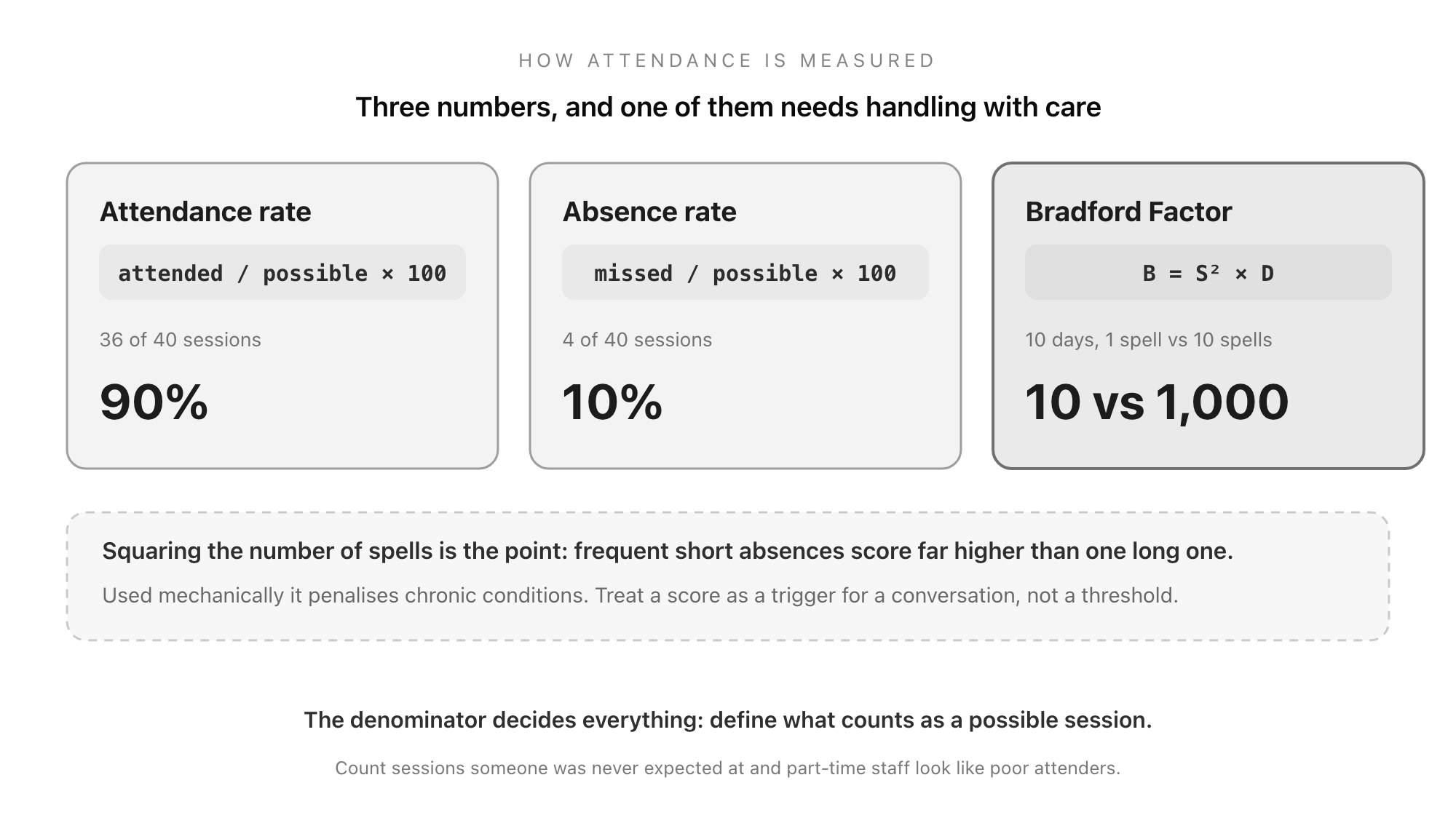
Attendance rate = (sessions attended / sessions possible) × 100.
If someone was expected at 40 sessions and attended 36, that is 36 / 40 × 100 = 90 percent.
Absence rate is the inverse: (sessions missed / sessions possible) × 100, so 4 / 40 × 100 = 10 percent. In workplace reporting this is often calculated in days or hours lost rather than sessions.
The number to be careful with is the denominator. Sessions possible should exclude sessions the person was never expected at, otherwise part-time staff and anyone on approved long-term leave will show artificially poor attendance. Deciding, and documenting, what counts as a possible session is more consequential than the arithmetic.
The Bradford Factor is worth knowing because it is widely used in UK workplaces and frequently misunderstood. It is calculated as:
B = S² × D
where S is the number of separate spells of absence and D is the total number of days absent. The squaring of the spell count means the score weights frequent short absences far more heavily than one long one. Ten days off in one spell scores 1² × 10 = 10. The same ten days taken as ten separate single days scores 10² × 10 = 1,000.
The logic is that frequent unplanned absence is more disruptive to a team than a single planned or extended one. The criticism, which is fair, is that used mechanically it penalises people with chronic or fluctuating conditions and can push people to come in when they should not. If you use it, use it as a trigger for a conversation rather than as an automatic disciplinary threshold, and be careful about disability-related absence.
What Belongs in an Attendance Policy
A policy is what stops attendance decisions from being made ad hoc, differently, by each manager.
Expected hours or sessions, and what counts as being present.
How to report an absence: who to tell, by when, and by what method. "Call your manager before 9am" is a policy; "let someone know" is not.
What evidence is required and when, such as self-certification for short absences and a fit note beyond a defined period, matching the rules in your jurisdiction.
How lateness is handled, including any tolerance.
Return-to-work process, which is one of the most effective and most neglected tools: a short, consistent conversation after every absence.
Trigger points, the thresholds at which a supportive conversation happens, and what that conversation is for.
How records are kept and who can see them.
Publish it, apply it consistently, and review it. An unevenly applied attendance policy causes more grievances than no policy at all, and it is the inconsistency rather than the strictness that people object to. Where absence relates to a health condition or disability, the policy should make clear that adjustments are considered rather than the trigger points being applied blindly.
Attendance Data Is Personal Data
Attendance records identify individuals, and absence records often reveal health information, which is treated as a special category of personal data in many jurisdictions and attracts stricter handling requirements.
Practically: collect the minimum needed (the fact of sickness absence, rarely the diagnosis), restrict access to those who need it, keep records only as long as you have a reason to, and be clear with people about what is recorded and why. A shared spreadsheet with everyone's sickness reasons visible to the whole team is a common and genuinely serious mistake.
Methods, and Why Most Fail
Paper registers are simple and work offline, but they are easy to lose, impossible to analyse without re-typing, and hard to audit because a paper mark can be added later with no trace.
Spreadsheets are better for counting and worse for collecting. They tend to get filled in retrospectively from memory, which is where accuracy dies, and they end up in several versions.
Self-reporting by message is convenient and produces no record at all. Absences reported by text to a manager's personal phone are, functionally, undocumented.
Digital forms fix most of this: an expected list, defined status codes, an automatic timestamp, and one place where every record lands, searchable later.
Card or biometric systems are accurate for site access but expensive, and they answer a narrower question (who entered the building) than most organisations actually need.
The recurring failure in all of these is not the technology, it is delay. A register completed at the time is accurate; a register reconstructed on Friday afternoon is fiction. Whatever method you use, the one that gets filled in immediately beats the more sophisticated one that does not.
Common Mistakes
Recording arrivals instead of expectations. A list of who came cannot show who did not.
Free-text status. Uncountable, and inconsistent between recorders.
Late completion. The single largest source of inaccuracy.
No definition of "possible sessions". Makes every percentage arguable.
Applying triggers mechanically. Especially where health conditions or disabilities are involved.
Oversharing absence reasons. A data protection problem and a trust problem at once.
Collecting it and never looking at it. Attendance data is only worth gathering if someone reviews the pattern and acts on it.
Build Your Attendance Form in Good Form
Attendance is a small, repetitive data-collection job, which is exactly the kind of thing that should be a form rather than a habit. The value is not in any single register, it is in having every session recorded the same way, at the time, in one place you can search a year later.
You can build an attendance form in minutes with the free form builder, capturing the session, the expected list, a defined status for each person, a reason where needed, and an automatic timestamp, with every submission collected in one structured place ready to report on. The same structure supports the workforce forms around it, like the timesheet for hours worked and the PTO request form for the planned absences that should never show up as unexplained gaps. If you are choosing a tool to run these on, the guide to the best free form builders covers what to look for.
Build your attendance form in Good Form →
Attendance looks like the most trivial record an organisation keeps, and it quietly sits underneath pay, compliance, safety, and how fairly people are treated when they are struggling. Start from an expected list, use a short set of defined codes, record it at the time rather than later, be clear about what counts as a possible session, handle the health information carefully, and actually look at the resulting pattern. None of that is difficult, and it turns a scrappy register into something you can rely on when it matters.