The Likert scale is the most widely used survey question format in the world, and one of the most widely misused. You have answered thousands of them: a statement, followed by a row of options running from "strongly disagree" to "strongly agree." Done well, a Likert scale turns something fuzzy like a person's attitude or satisfaction into a number you can track, compare, and act on. Done badly, with leading statements, unbalanced options, or the wrong number of points, it produces data that looks rigorous and means nothing. The difference is almost entirely in the details, and those details are learnable.
This guide explains what a Likert scale is, how to choose between a 4, 5, or 7-point scale, how to write statements that actually measure what you intend, examples for the surveys businesses run most, and the mistakes that quietly ruin the results. Whether you are measuring employee engagement, customer satisfaction, or how a training session landed, the same principles make the difference between a number you can trust and one you cannot.
What Is a Likert Scale?
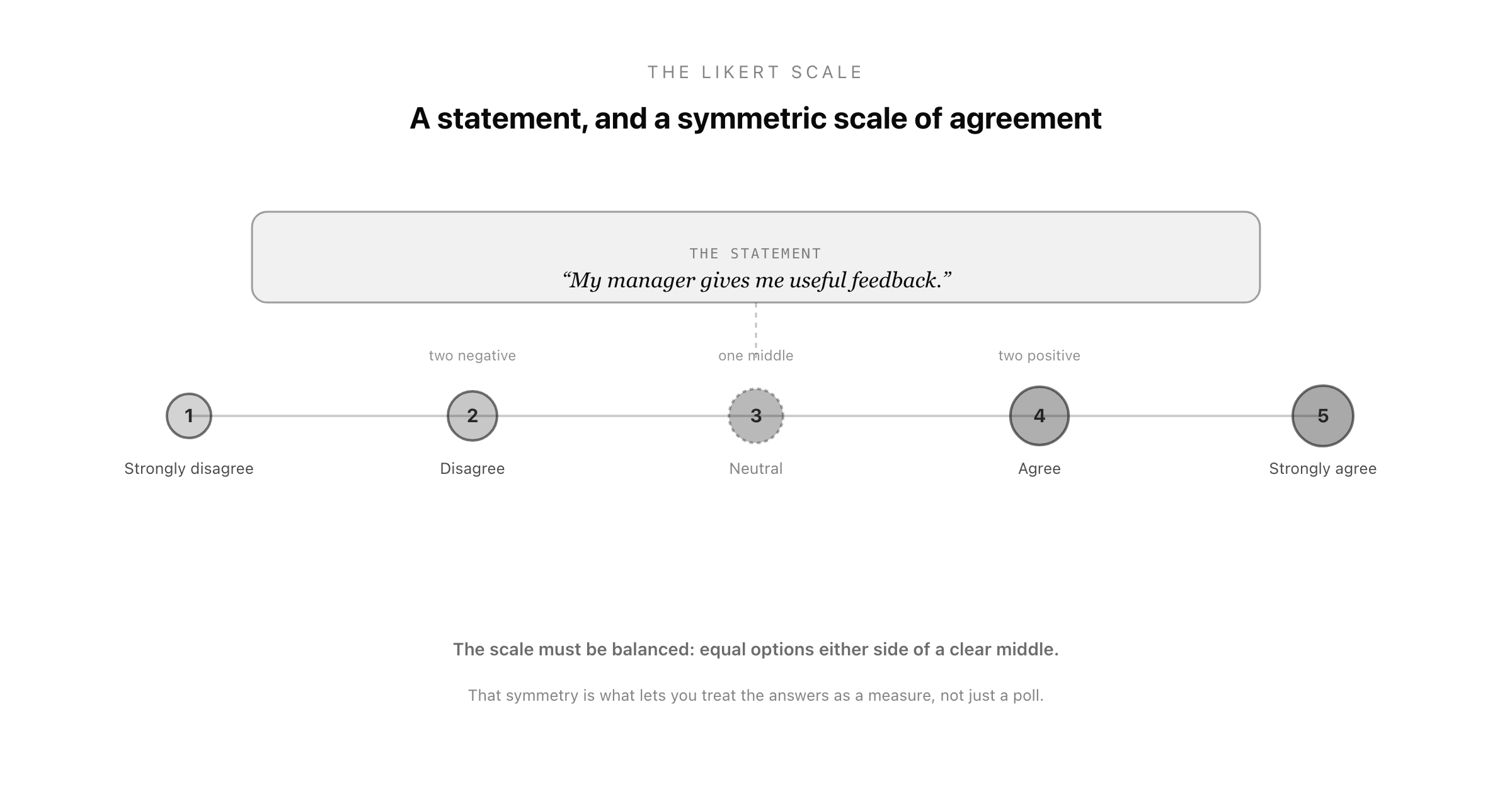
A Likert scale is a survey format that measures attitudes or opinions by asking respondents how much they agree or disagree with a statement, on a symmetric scale of responses. It is named after the psychologist Rensis Likert, who developed it in 1932 as a way to quantify subjective attitudes that had previously been hard to measure. The defining features are two: a declarative statement (not a question), and a balanced set of ordered response options with a clear middle.
That balance is the heart of it. A proper five-point Likert scale has two options on the negative side (strongly disagree, disagree), one in the middle (neither agree nor disagree), and two on the positive side (agree, strongly agree). The symmetry matters because it is what lets you treat the responses as a scale, a measure of intensity, rather than just a tally of opinions. If the options were lopsided, three positive and one negative, the instrument would be biased before anyone answered.
It is worth distinguishing the terms. Strictly, a single agree-disagree item is a "Likert item," and a "Likert scale" is several related items combined into one overall score, for example five statements about a manager averaged into a single leadership score. In everyday use, people call the individual rating scale a Likert scale, and that is fine. What matters is understanding that the real power comes from combining several well-written items, because any single question is noisy and a set of them is far more reliable.
How Many Points: 4 vs 5 vs 7
One of the first decisions is how many points the scale should have, and the most consequential part of that decision is whether to include a neutral midpoint.
Five points is the default for good reason. It offers enough gradation to capture intensity (strongly agree versus agree is real information) without overwhelming respondents, and the labels are intuitive. For most business surveys, five points is the right starting choice.
Seven points adds two more gradations (something like "somewhat agree" between neutral and agree). It can capture finer distinctions and tends to increase the reliability of the measure slightly, which is why academic and psychometric research often uses it. The cost is that respondents have to work a little harder, and the extra labels are harder to word cleanly. Use seven points when precision genuinely matters and your respondents are engaged.
Four points (or any even number) removes the neutral midpoint, forcing respondents to lean positive or negative. This is the "forced choice" approach, and it is a real trade-off, not just a preference. Removing the midpoint stops people hiding in the middle when they actually have an opinion, which can be useful. But it also frustrates the genuinely neutral, who are pushed into a position they do not hold, and it can distort your data by manufacturing opinions that were not there. The rule of thumb: keep the midpoint unless you have a specific reason to believe people are using it to avoid answering, and even then, consider whether a "not applicable" option would serve better.
Whatever you choose, be consistent across the survey. Mixing a five-point scale on one question and a seven-point on the next makes the results harder to compare and the survey harder to fill in.
How to Write a Good Likert Statement
The scale itself is the easy part. Nearly every problem with Likert-scale data traces back to how the statements are worded, and a few disciplined rules prevent the most common failures.
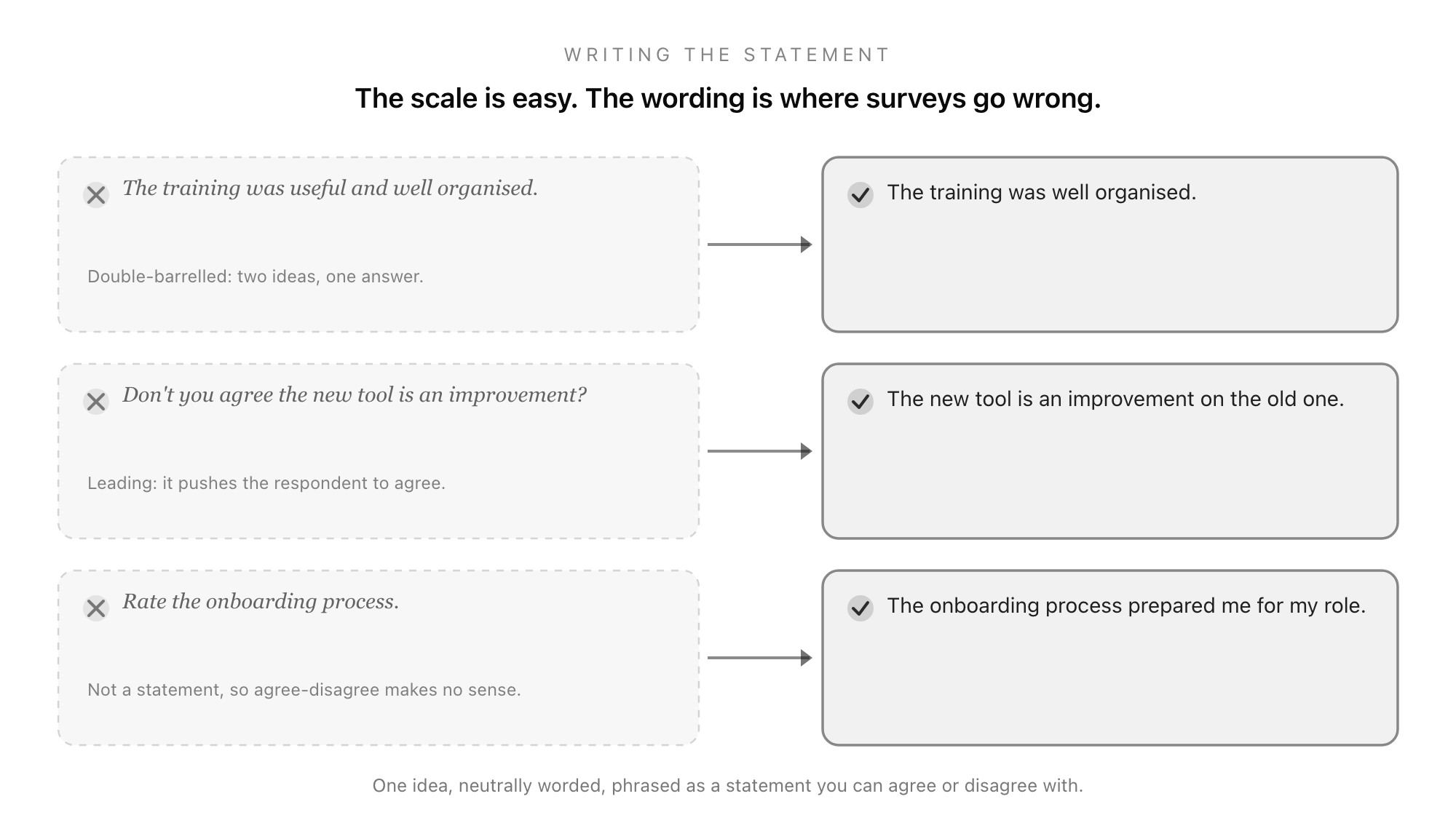
Make it a statement, not a question. "Rate the onboarding process" cannot be answered on an agree-disagree scale. "The onboarding process prepared me for my role" can. The whole format depends on the item being something you can agree or disagree with.
One idea per statement. The most common error is the double-barrelled item: "The training was useful and well organised." If someone found it useful but disorganised, they cannot answer honestly, and you cannot interpret their response. Split it into two statements, one per idea.
Keep it neutral, never leading. "Don't you agree the new tool is an improvement?" pushes people toward agreement and poisons the result. State it flatly: "The new tool is an improvement on the old one." The statement should not reveal which answer you are hoping for.
Watch acquiescence bias. People have a mild tendency to agree with statements as worded. A well-designed scale sometimes mixes in a few negatively-worded statements ("I often feel unclear about what is expected of me") to catch respondents who are agreeing on autopilot. Use this carefully, because negatively-worded items are easy to misread, but a few can improve data quality.
Keep the language simple and specific. Short, concrete statements in plain language get more honest, more consistent answers than long or abstract ones. If a statement needs a second reading, rewrite it.
Likert Scale Examples by Use Case
The same format adapts to almost any attitude you want to measure. Here are statement examples for the surveys businesses run most often, all designed for a five-point agree-disagree scale.
Employee engagement. These are the backbone of any engagement survey, measured as agree-disagree statements rather than vague mood questions:
- "I understand how my work contributes to the company's goals."
- "My manager gives me useful feedback."
- "I have the resources I need to do my job well."
- "I would recommend this company as a good place to work."
For a full breakdown of building one of these, see the guide to the employee engagement survey, which is built almost entirely on Likert statements like these.
Customer satisfaction. Attitude toward a product or service:
- "The product was easy to set up."
- "Customer support resolved my issue quickly."
- "The product is good value for the price."
Training and event feedback. How a session landed:
- "The training was well organised."
- "The content was relevant to my role."
- "I feel more confident about the topic after the session."
Skills and self-assessment. Confidence and capability, which pair naturally with a structured skills assessment:
- "I am confident using our project management tools."
- "I can handle difficult customer conversations without escalating them."
The pattern across all of them is the same: a specific, single-idea statement, phrased neutrally, that a respondent can locate themselves on. Change the topic, keep the discipline.
Common Likert Scale Mistakes
Even with good statements, a few structural errors undermine the results.
- Unbalanced options. Three positive options and one negative is not a Likert scale; it is a biased poll. Keep equal numbers either side of the midpoint, with balanced labels ("strongly disagree" mirrors "strongly agree").
- Inconsistent scales across the survey. Switching the number of points, or flipping the direction (agree on the left in one question, right in the next), confuses respondents and corrupts comparisons. Keep it uniform.
- Too many items. A survey of forty Likert statements produces fatigue, and tired respondents "straight-line," picking the same option down the page. A focused set of well-chosen statements beats an exhaustive one.
- Treating one item as gospel. Any single Likert item is noisy. Where a topic matters, use several related statements and look at them together, which is more reliable than leaning on one question.
- Analysing it carelessly. Likert data is ordinal (the gap between "agree" and "strongly agree" is not necessarily the same as between "neutral" and "agree"), so reporting the distribution and the median is often safer than averaging, especially on a single item. Averages across a multi-item scale are more defensible.
Build a Likert Scale That Holds Up
A Likert scale is only as good as the form it lives on. Writing balanced statements is the hard intellectual work; the form should make the easy part easy, presenting a consistent, clearly-labelled scale for every statement, keeping the direction uniform, and collecting the responses in a structured way you can actually analyse. That consistency is exactly what a good form builder provides and what a hand-made spreadsheet survey usually gets wrong.
The Good Form employee engagement survey template is built on properly-constructed Likert items, with the balanced five-point scale already set up, so you can see the format done right and adapt the statements to whatever you are measuring.
Start from the engagement survey template in Good Form →
You can build any Likert-based survey in minutes with the free form builder, keeping the scale consistent across every question and collecting responses in one structured place. When you are choosing a tool to run it on, the guide to the best free form builders covers what to look for. Whatever you build it on, the principles are the same: a balanced scale, one clean idea per statement, neutral wording, and enough items to be reliable.
The Likert scale endures because it does something genuinely useful: it turns opinion into measurement. But that only works if the instrument is built with discipline. Get the statements right, keep the scale balanced and consistent, and use enough items to be reliable, and a simple row of agree-disagree options becomes one of the most powerful tools you have for understanding what people actually think.