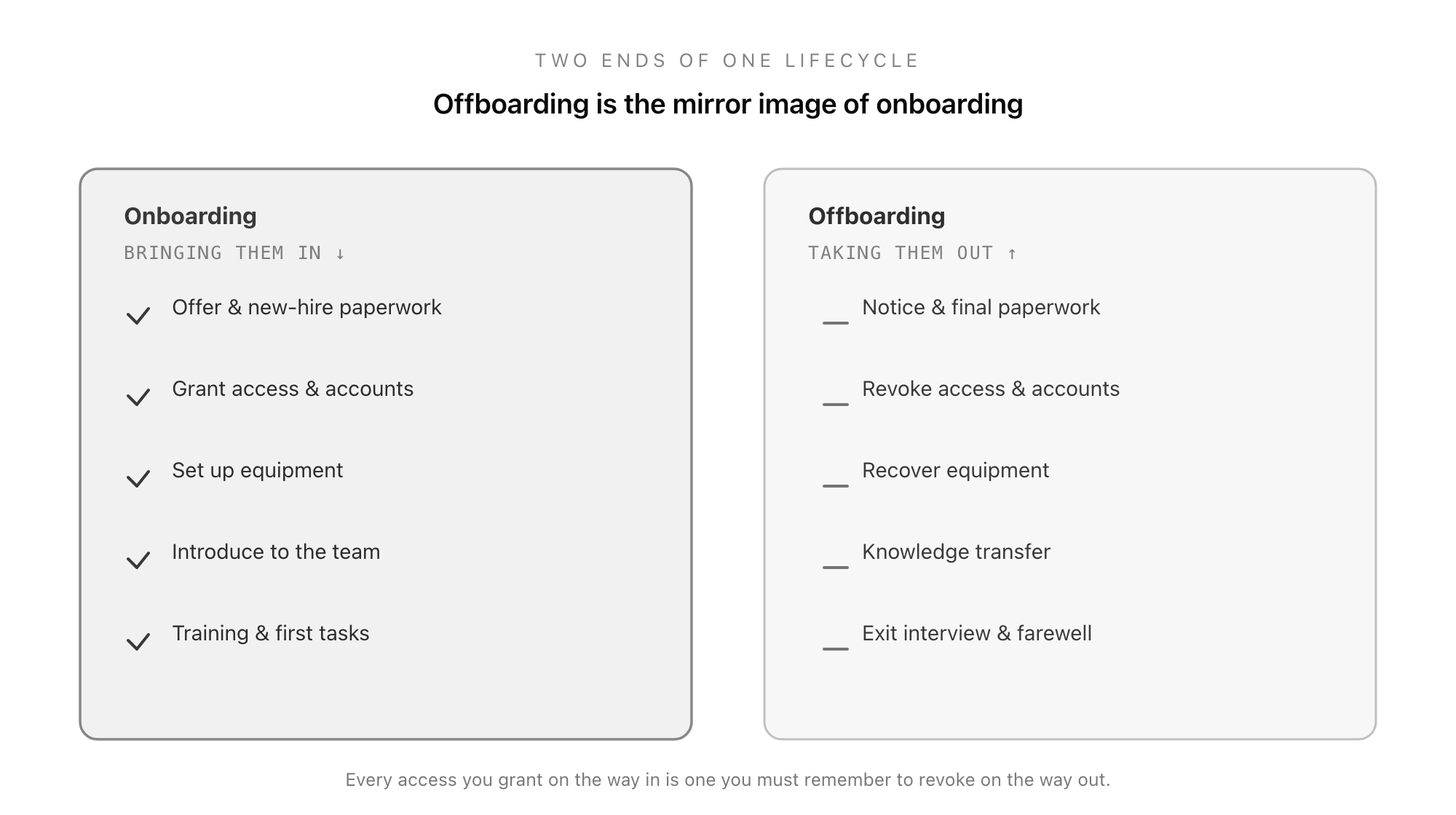
Offboarding is the process almost every company gets wrong, because it happens at the exact moment everyone has stopped paying attention. When someone resigns or leaves, the focus shifts to backfilling the role, and the departure itself gets handled as an afterthought: a rushed last day, a laptop that never comes back, a system login that stays active for months, and a departing employee who leaves feeling like they did not matter. Good offboarding is the mirror image of good onboarding, a structured, respectful, complete process, and it protects your company, your data, and your reputation in ways that are easy to underestimate until something goes wrong.
This guide covers what offboarding is, why it matters as much as onboarding, a step-by-step checklist you can actually follow, how to run the exit interview, the forms that hold the process together, and the common mistakes that turn a departure into a liability. Whether someone is resigning, retiring, or being let go, a consistent offboarding process makes the transition cleaner for everyone.
What Is Offboarding?
Offboarding is the structured process of managing an employee's departure from your organisation, covering everything from the moment they give notice to their final day and beyond. It is the counterpart to onboarding: where onboarding brings someone into the company cleanly, offboarding takes them out of it cleanly, making sure nothing important is left undone.
A complete offboarding process handles several strands at once. There is the administrative side (final pay, benefits, and paperwork), the security side (recovering equipment and revoking access), the knowledge side (capturing what the departing person knows before it walks out the door), and the human side (a respectful exit and a genuine goodbye). Handle all four and the departure is smooth; neglect any one and you create a gap that surfaces later as a security hole, a compliance problem, or a piece of lost institutional knowledge nobody can recover.
Offboarding applies to every kind of departure, voluntary resignations, retirements, and terminations, though the tone and specifics differ. What stays constant is the value of doing it consistently, so that nothing falls through the cracks regardless of the circumstances.
Why Offboarding Matters as Much as Onboarding
It is tempting to treat a departure as a low priority, but good offboarding protects the company in ways that more than justify the effort.
Security and data protection. A departing employee often has access to email, systems, files, and sometimes customer data. Every access point that is not revoked, and every device that is not returned, is a live risk. Structured offboarding is your defence against former employees retaining access they should not have, which is one of the most common and avoidable security failures.
Knowledge transfer. People carry institutional knowledge that exists nowhere else: how a process really works, who to call, where things are. When they leave without transferring it, that knowledge is gone. Offboarding is your one chance to capture it before the door closes.
Compliance and legal protection. Final pay, benefits continuation, and the return of property all carry legal obligations that vary by jurisdiction. A documented offboarding process is your evidence that these were handled correctly.
Reputation and the alumni effect. People talk. An employee who leaves feeling respected becomes an advocate, a potential rehire, and a good reference for your company; one who leaves feeling discarded becomes the opposite. In an age of public reviews, how you treat people on the way out shapes how you are seen by everyone watching.
The Offboarding Checklist
A reliable offboarding process runs through the same core steps every time. Here is the checklist.
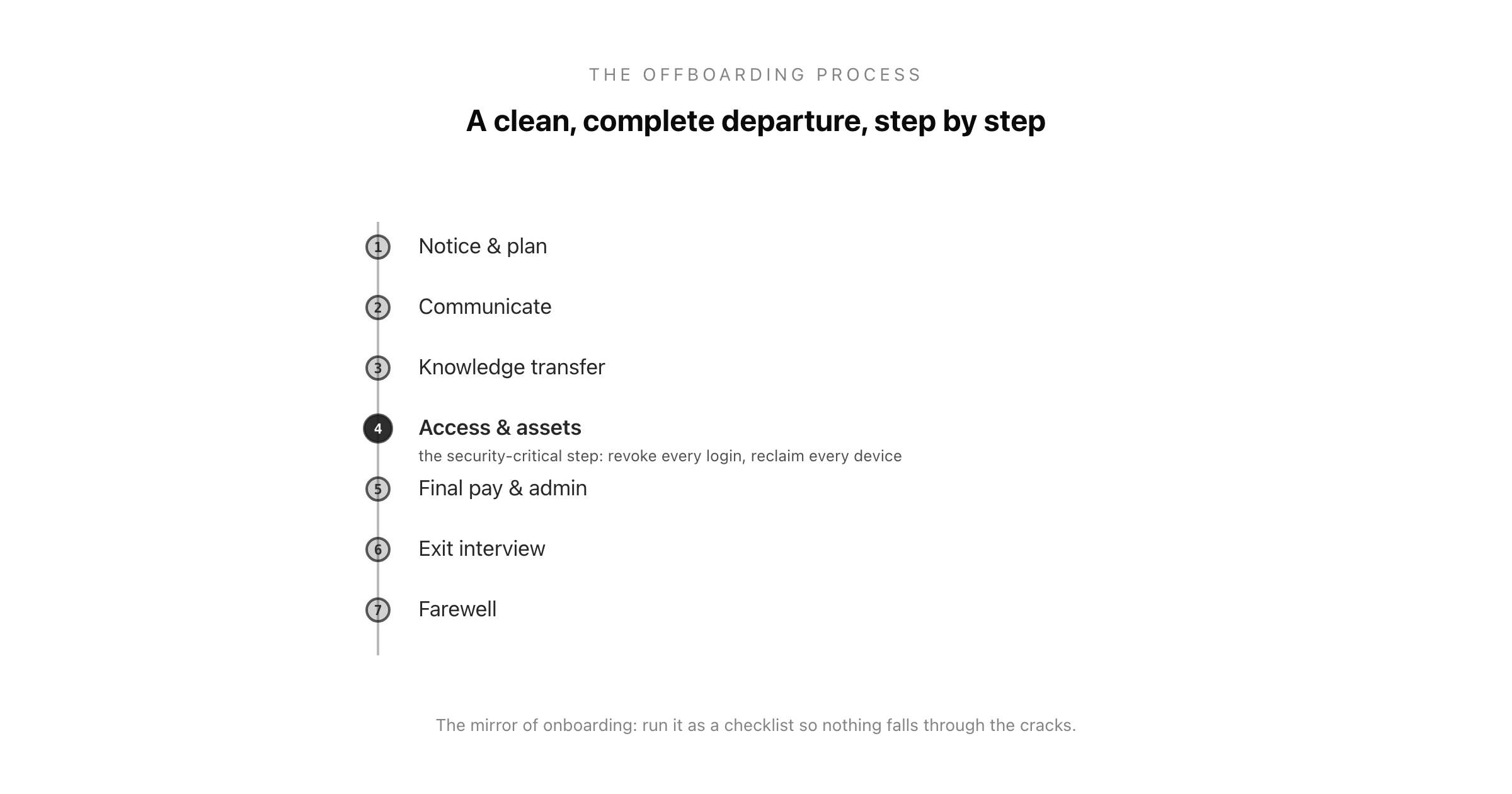
1. Acknowledge the notice and set the plan. Confirm the resignation or termination in writing, agree the last day, and map out what needs to happen before it. A clear timeline prevents the last-minute scramble.
2. Communicate the departure. Tell the team and any affected clients appropriately and in good time, so the transition is managed rather than a surprise.
3. Plan knowledge transfer. Have the departing person document their key responsibilities, ongoing work, contacts, and anything only they know, and hand it over to whoever is picking it up. This is the step most often skipped and most often regretted.
4. Recover access and assets. Make a list of every system, account, and piece of equipment the person has, and reclaim or revoke each on their last day: laptops, phones, keys, badges, and every login. This is the security-critical step.
5. Handle the administration. Process final pay, unused leave, benefits and pension arrangements, and any final paperwork, in line with the law in your jurisdiction.
6. Run the exit interview. Capture why they are leaving and what they honestly think, which is often your most candid feedback of all.
7. Say a proper goodbye. A genuine farewell, however small, closes the relationship well and reinforces to everyone still there that people are valued.
Running this as a consistent checklist, rather than improvising each time, is what separates offboarding that protects the company from offboarding that quietly creates risk.
The Exit Interview
The exit interview deserves its own mention, because it is the part of offboarding with the most untapped value. A departing employee has little reason to hold back, which makes their feedback more honest than anything you will hear from current staff. Done well, exit interviews reveal patterns, recurring reasons people leave, problems with a particular manager or process, that you can actually act on to improve retention.
The keys are to ask consistent questions so you can spot trends across departures, to keep the tone genuinely open rather than defensive, and to actually review what you learn. For a full set of questions worth asking, see the guide to exit interview questions. One caveat: treat any single exit interview as one data point, since a leaver's view is shaped by their reasons for going; the value is in the patterns across many.
Voluntary vs Involuntary Departures
The core checklist stays the same for every departure, but the tone and handling differ depending on how someone is leaving, and getting that difference right matters.
Voluntary departures, resignations and retirements, are usually the smoothest. The person has chosen to go, there is typically a notice period to work through, and there is time to plan knowledge transfer properly and part on good terms. These are your best opportunities for a genuine exit interview and for turning a leaver into an advocate, so lean into the human side and use the notice period well.
Involuntary departures, terminations and redundancies, are more sensitive and carry more risk. They often need to happen quickly, which makes the security steps, revoking access and recovering assets promptly, more urgent, while the human handling needs even more care because the stakes for the individual are higher. Consistency and documentation matter most here: a clear, respectfully-run process, properly recorded, protects both the departing person's dignity and the company's legal position. Whatever the circumstances, applying the same underlying checklist is what keeps involuntary exits from becoming chaotic or legally exposed.
Common Offboarding Mistakes
- Forgetting to revoke access. The single most dangerous error. An active login or un-returned device left with a former employee is a standing security risk. Have a definitive list and clear every item.
- Skipping knowledge transfer. Letting someone leave with critical, undocumented knowledge in their head guarantees a painful gap later. Capture it while you can.
- Treating it as pure admin. A cold, transactional departure damages morale and your reputation. The human side matters as much as the checklist.
- Being inconsistent. Improvising each departure means things get missed. A standard process applied every time is what makes offboarding reliable.
- Rushing the final day. Cramming everything into the last afternoon guarantees something is forgotten. Start the process when notice is given, not on the way out the door.
Build Your Offboarding Forms in Good Form
Offboarding is a process made of records: the resignation acknowledgement, the knowledge-transfer document, the asset-return checklist, the exit interview. When these live in scattered emails and paper, things get missed, and the whole point of offboarding, that nothing falls through the cracks, is lost. When they live in one structured place, the process runs the same way every time and leaves a clean, documented trail.
You can build your offboarding checklist, asset-return form, and exit interview in minutes with the free form builder, keeping every departure organised and on record. The same structure sits behind good new-hire paperwork and the employee handbook that opens the employment relationship, so onboarding and offboarding become two ends of one consistent system.
Build your offboarding forms in Good Form →
Offboarding is easy to treat as an afterthought and expensive to get wrong. Handle the security, the knowledge, the admin, and the human side with the same care you put into onboarding, run it as a consistent checklist, and capture the whole thing in structured forms, and a departure stops being a loose end and becomes what it should be: a clean, respectful close that protects the company and leaves the door open.