An employee handbook is the single document that tells your team how your organisation actually works: what it stands for, what is expected of them, what they are entitled to, and where to turn when something goes wrong. Done well, it saves you from answering the same questions a hundred times, protects the company legally, and gives every new hire a consistent, welcoming introduction to the place they have just joined. Done badly, or not at all, it leaves policy to word of mouth, invites inconsistency, and exposes you to disputes you could have avoided. For any growing team, a clear employee handbook is one of the highest-leverage documents you can build.
This guide covers what an employee handbook is, the essential sections to include, how to structure and write one so people actually read it, the onboarding forms that go alongside it, and the common mistakes that make a handbook useless or risky. Whether you are writing your first handbook for a team of five or tightening up an existing one, the same principles apply.
What Is an Employee Handbook?
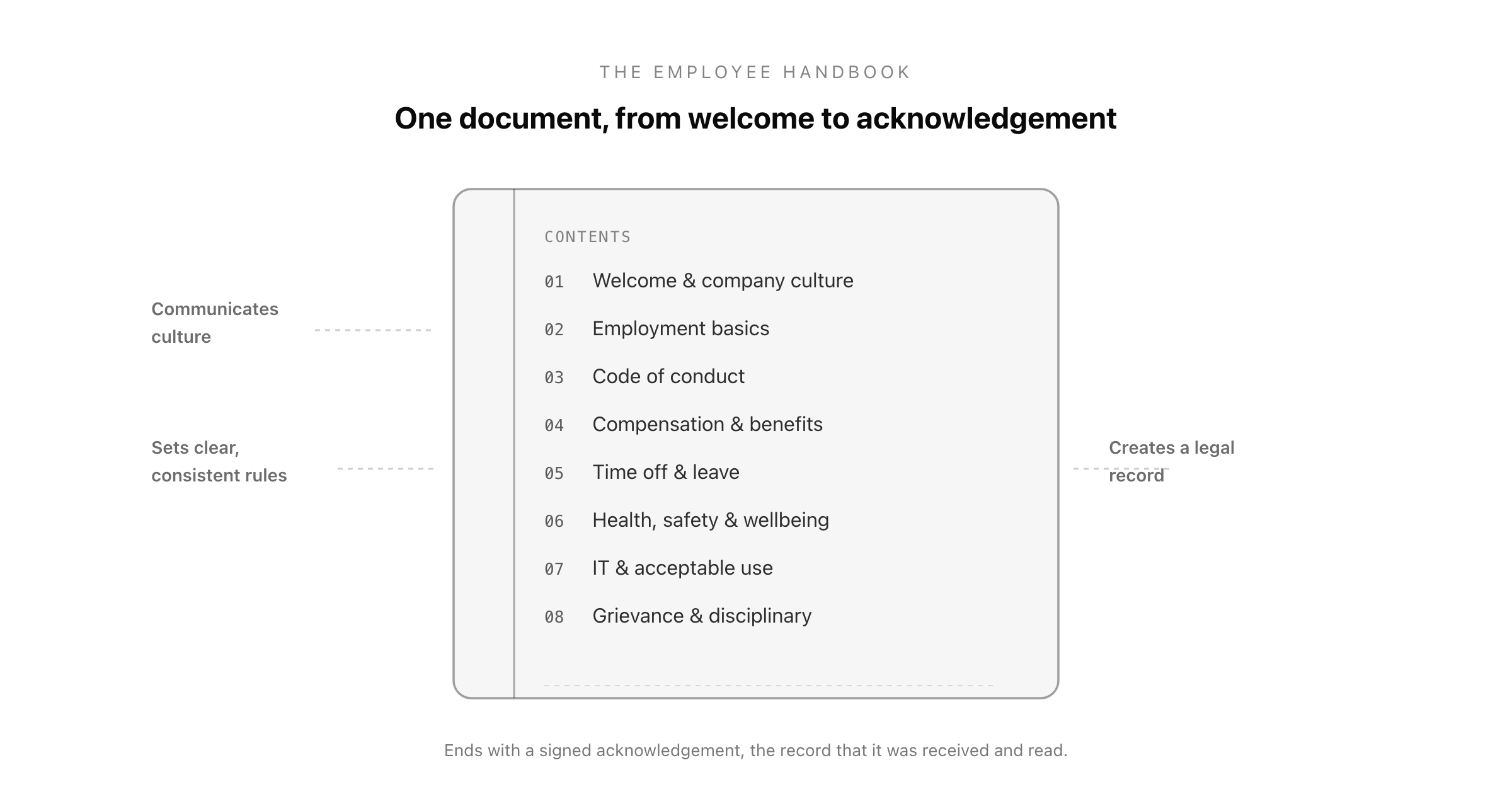
An employee handbook, sometimes called a staff handbook or employee manual, is a document given to employees that sets out the company's policies, expectations, culture, and the practical information they need to do their jobs and understand their rights. It serves three jobs at once: it communicates culture and values, it lays down clear and consistent rules, and it provides a legal record that employees were told about key policies.
That third function is easy to underestimate. When a dispute arises, over conduct, pay, leave, or dismissal, a clear handbook that the employee acknowledged in writing is often the difference between a straightforward resolution and a costly argument. The handbook is not just an onboarding nicety; it is a piece of infrastructure that protects both the employee, who knows where they stand, and the employer, who can show a policy was communicated fairly and applied consistently.
It is worth being clear about what a handbook is not. It is not a legally binding contract of employment, and most handbooks say so explicitly, to preserve the flexibility to update policies. The contract sets the core terms; the handbook explains how the workplace runs day to day.
What to Include in an Employee Handbook
The exact contents vary by size, industry, and country, but a strong employee handbook almost always covers the same core sections. Here is what to include.
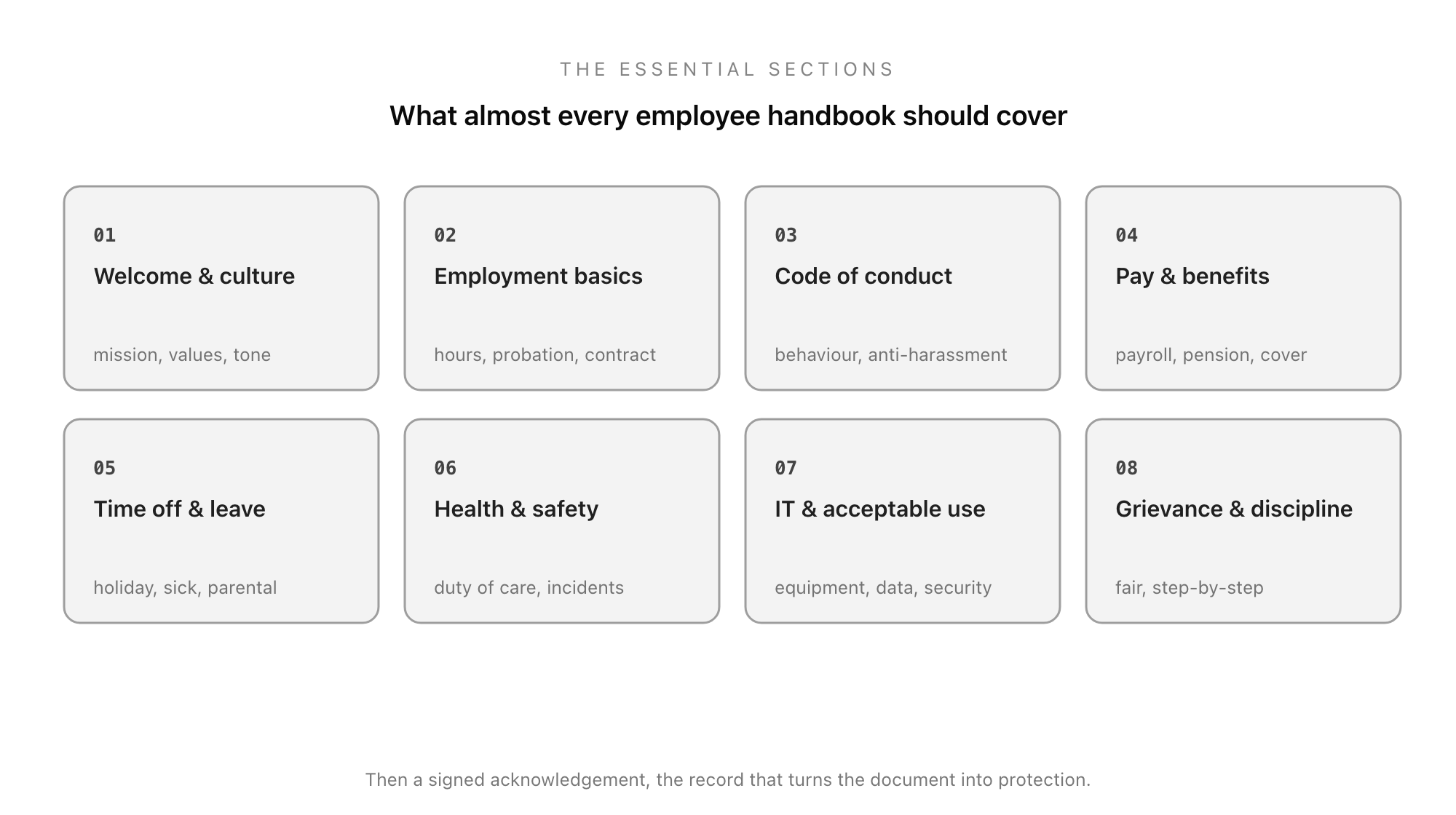
Welcome and company culture. An introduction to the organisation: its mission, values, and a warm welcome. This sets the tone and is the part new hires actually enjoy reading.
Employment basics. The practical framework: employment types, working hours, probationary periods, attendance expectations, and how the handbook relates to the contract of employment.
Code of conduct. The behaviour expected of everyone: professional standards, dress code if relevant, anti-harassment and anti-discrimination policies, conflicts of interest, and confidentiality. This is the heart of the handbook and the section most often relied on in disputes.
Compensation and benefits. How and when people are paid, and what they are entitled to: salary and payroll basics, bonuses, pensions or retirement plans, health cover, and any other benefits.
Time off and leave. The policies people look up most: annual leave and how to request it, sick leave, parental and family leave, public holidays, and any other absence. Link this clearly to how requests are actually made, for example a PTO request form.
Health, safety, and wellbeing. The company's duty of care: safety procedures, reporting of incidents, and any wellbeing or support provisions.
IT, security, and acceptable use. How company equipment, email, internet, and data are to be used, plus privacy and security expectations, increasingly important with remote and hybrid work.
Grievance and disciplinary procedures. How an employee raises a concern, and how the company handles misconduct and performance issues, set out as a clear, fair, step-by-step process so everyone knows what to expect.
Acknowledgement. A final section, and a signed acknowledgement that the employee has received, read, and understood the handbook. This is what turns the document into a record.
How to Structure and Write It
A handbook only works if people can actually use it, and a surprising number fail on readability alone.
Write in plain language. Drop the legalese wherever you can. A handbook full of dense, formal clauses does not get read, and an unread handbook protects no one. Write as if explaining to a new colleague, clearly and directly.
Organise it so people can find things. A clear table of contents, logical sections, and a search-friendly digital format matter more than polish. People come to a handbook with a specific question ("how much notice do I give for leave?"), so make answers easy to locate.
Have it legally reviewed. Employment law varies by country and changes over time. The culture and structure are yours to write, but the policy sections, especially conduct, leave, pay, and dismissal, should be checked by someone qualified for your jurisdiction. A friendly tone does not exempt you from getting the law right.
Keep it current. A handbook is a living document. Set a schedule to review it at least annually and whenever laws or major policies change, and re-issue it with a fresh acknowledgement when you make significant updates. An out-of-date handbook can be worse than none, because it documents a policy you no longer follow.
The Handbook and the Forms Around It
A handbook does not stand alone; it sits at the centre of a small system of forms that put its policies into practice. The acknowledgement itself is a form, a simple, dated, signed confirmation that the employee received and read the handbook, and keeping those acknowledgements collected and searchable is exactly the kind of record you want when a question arises later.
Around it sit the forms the handbook refers to: the new-hire paperwork completed on day one, the employee onboarding form that gathers a starter's details, leave requests, and incident reports. When these are scattered across email and paper, the handbook's policies are only as good as your ability to administer them. When they live in one structured place, the whole system holds together.
Digital vs Paper: How to Deliver It
How you distribute the handbook matters almost as much as what is in it, and the shift to digital has real advantages worth taking.
A digital handbook, a shared document, an internal wiki page, or an onboarding portal, is searchable, easy to update, and simple to distribute to a distributed team. When a policy changes, you update one source and everyone has the current version, rather than reprinting and re-circulating a booklet that is out of date the moment it is bound. It also pairs naturally with a digital acknowledgement, so the signed record is captured and stored automatically rather than chased on paper.
The one thing to preserve when going digital is the acknowledgement discipline. A handbook nobody has formally confirmed reading offers little protection, so whatever format you choose, make sure each employee actively acknowledges the current version, and that you keep a dated record of it. A searchable digital handbook with a clean set of acknowledgements is the best of both worlds: easy for employees to use, and a solid record for you.
Common Employee Handbook Mistakes
- Not having one. Leaving policy to word of mouth guarantees inconsistency and removes your best protection in a dispute. Even a short handbook beats none.
- Copying a generic template unchanged. A handbook that does not reflect your actual policies, culture, and legal jurisdiction is misleading at best and unenforceable at worst. Templates are a starting point, not a finished document.
- Writing it in impenetrable legalese. If nobody reads it, it does not do its job. Clarity is a feature, not a compromise.
- Never collecting acknowledgements. Without a signed record that employees received the handbook, its legal protection largely evaporates. The acknowledgement is not optional.
- Letting it go stale. An unreviewed handbook drifts out of line with the law and your real practices. Schedule reviews and re-issue after major changes.
Build the Handbook's Forms in Good Form
The handbook itself is a document, but the acknowledgements, onboarding forms, and requests that make it work are exactly where a good form builder earns its place, collecting signed confirmations and starter details in one structured, searchable place instead of a drawer of paper and a cluttered inbox.
You can build the handbook acknowledgement, onboarding, and leave-request forms in minutes with the free form builder, keeping every record in one place and tied to the right employee. If you are choosing a tool to run your HR forms on, the guide to the best free form builders covers what to look for.
Build your onboarding and acknowledgement forms in Good Form →
An employee handbook is one of those documents that feels like a chore to write and then quietly earns its keep for years. Cover the essential sections, write it so people actually read it, get the policy checked, keep it current, and collect the acknowledgements that turn it into a record. Do that, and the handbook stops being a box to tick and becomes what it should be: the clear, fair, single source of truth for how your organisation works.