Reimbursement is what happens when somebody spends their own money on the organisation's behalf and the organisation pays them back. It sounds like the simplest transaction in business, and it is the one that most reliably generates friction: claims submitted weeks late with no receipts, managers approving things they have not read, finance chasing people for a description more useful than "taxi", and the quiet resentment of an employee who is a few hundred pounds out of pocket because a form is sitting in somebody's inbox. None of that is a money problem. It is a process and evidence problem, and it is fixable.
This guide covers what reimbursement is and how it differs from the alternatives, what an expense claim must contain, how mileage works, what belongs in an expense policy, how approval should actually be structured, the controls that prevent both honest errors and dishonest ones, and how to build a claim form people will complete properly.
What Is Expense Reimbursement?
Expense reimbursement is repayment to an individual for costs they incurred personally in the course of doing their job: travel, accommodation, mileage, materials, subsistence, professional subscriptions, and so on. The defining feature is that the money left the employee's own account first, which is why the emotional temperature around reimbursement is higher than around any other finance process. A delayed invoice annoys a supplier; a delayed expense claim means somebody has personally lent the business money without agreeing to.
Two consequences follow, and they are worth stating before any of the detail. Speed matters more than people in finance usually assume. And clarity in advance matters more than scrutiny afterwards, because the most damaging version of this process is one where the employee spends in good faith and is told later that it will not be paid.
Reimbursement, Company Cards, Allowances, and Advances
Four mechanisms, often confused, with genuinely different implications.
Reimbursement. The employee pays, then claims. Maximum control, maximum evidence, and the cash-flow burden sits with the employee.
Company card. The organisation pays directly. Removes the personal cost, but the receipt discipline still has to happen, and it usually happens worse, because the pressure of being out of pocket is what makes people submit promptly.
Allowance or per diem. A fixed amount for a defined situation, such as a daily rate for meals while travelling. Vastly less admin because it removes receipt-by-receipt claiming, but it needs a defensible rate and, depending on jurisdiction, may be treated as taxable pay if it exceeds a permitted level.
Advance. Money paid before the spend, reconciled afterwards. Useful when asking someone to fund a significant cost personally would be unreasonable, which is a fairness point worth being deliberate about: a policy that assumes everyone can absorb a £600 hotel bill for a month quietly disadvantages your lowest-paid staff.
Most organisations end up using several. What matters is that people know which applies to what, before they travel.
What an Expense Claim Must Contain
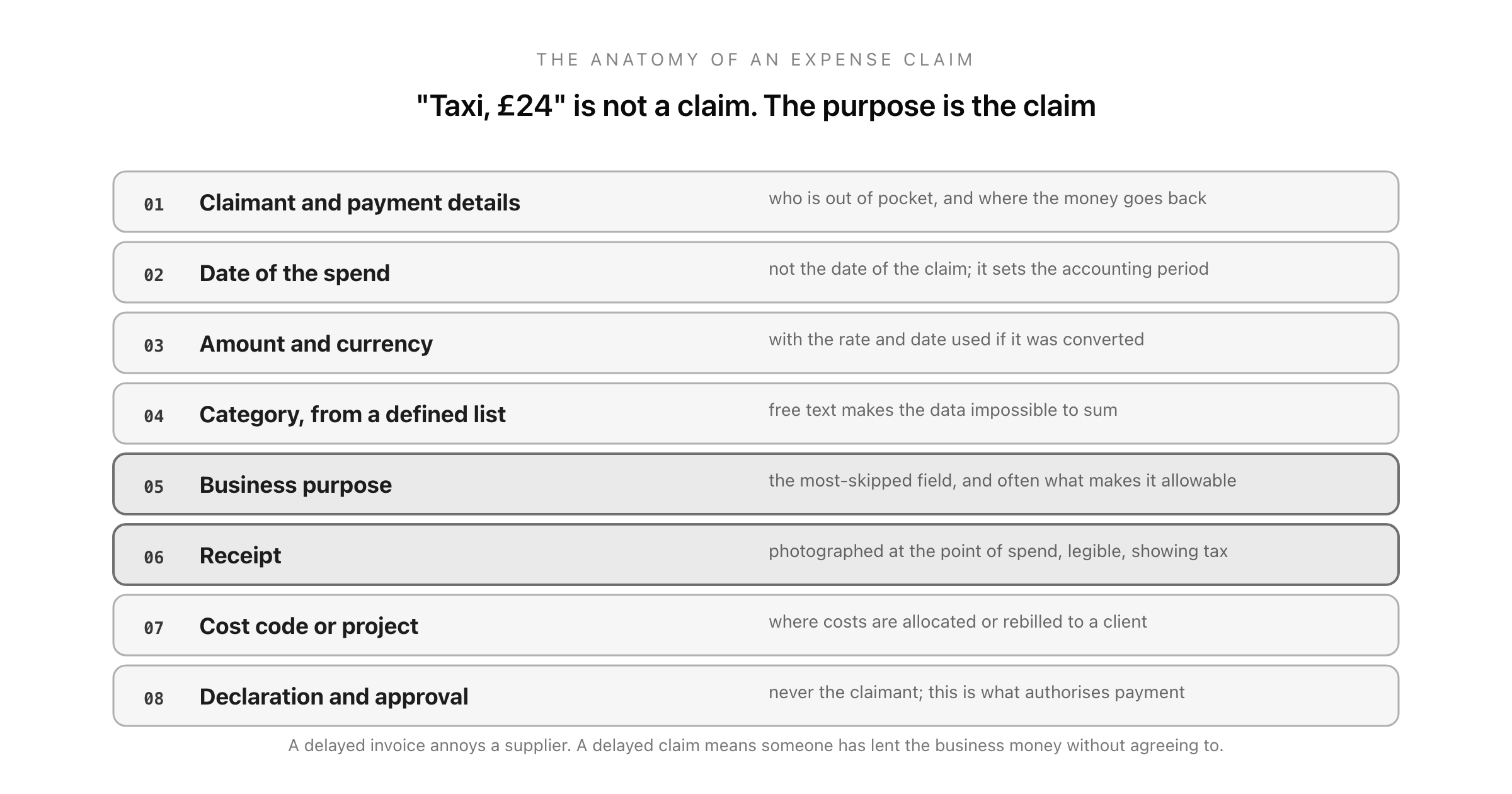
Who is claiming, and where the payment goes.
The date of the spend, not the date of the claim. This matters for the accounting period and for spotting claims submitted far outside the window.
The amount and currency, with the exchange rate and date used if converted.
The category. Travel, accommodation, subsistence, mileage, materials, and so on, from a defined list rather than free text, so the data can be summed and analysed.
The business purpose. The single most-skipped and most-important field. "Taxi, £24" is not a claim; "Taxi from Euston to client site, Acme project kickoff, £24" is. In many tax systems the business purpose is precisely what makes the expense allowable, and a claim without it may fail an audit even though it was entirely legitimate.
Who else was present, for meals and entertaining, since the rules differ sharply between a meal alone while travelling and a meal with a client.
The receipt. A photograph is fine and is now the norm. It should be legible and show the vendor, date, amount, and tax.
The cost code, project, or client, where costs are allocated or rebilled.
A declaration that the expense was genuinely incurred for business purposes and has not been claimed before.
Approval. Named approver and date, which is what converts a request into an authorised payment.
Mileage
Mileage is the claim type that causes the most confusion, because it is not a reimbursement of a receipt but of a calculated cost.
The standard approach is a per-mile (or per-kilometre) rate intended to cover fuel plus wear, insurance, and depreciation. Most tax authorities publish an approved rate, and paying at or below it is typically simple and tax-free, while paying above it usually creates a taxable benefit on the excess. The specific rates and rules vary by country and change over time, so check your own tax authority's current figure rather than a number someone remembered.
The claim itself should record the date, the start and end points, the purpose, and the miles claimed, and it should be clear whether the journey is measured from home or from the normal workplace, because ordinary commuting is generally not reimbursable and the boundary between commuting and business travel is where most mileage disputes live. Setting that rule explicitly in the policy removes almost all of the argument.
What Belongs in an Expense Policy
What is reimbursable, and what is not, with examples rather than principles. People need to know about the specific cases: alcohol, upgrades, spouse travel, tips, laundry, parking fines (never), personal items bought on a business trip.
Limits. Per-night accommodation caps by city, meal limits, and the travel class allowed at different journey lengths.
Pre-approval thresholds. Above what value does something need agreeing before it is spent, rather than argued about afterwards.
How and when to claim. The form, and a deadline, typically within 30 to 90 days of the spend.
How quickly you will pay. State it. This is the half of the policy most organisations leave out, and it is the half employees care about.
What happens with a missing receipt. Have a defined route, usually a declaration with the manager's approval, rather than leaving people to improvise.
Who approves what, and what happens when the claimant is the approver's manager.
Write it in plain language and keep it short. A twelve-page expenses policy is not read, and an unread policy provides no protection to anyone.
The Approval Workflow
Approval should do three things: confirm the expense was genuine, confirm it was reasonable, and confirm it is coded correctly. In practice most approval is a reflex click, which is worth designing around rather than complaining about.
Route to someone with context. A manager who knows whether that trip happened can spot a wrong claim; a central finance team usually cannot.
Never let anyone approve their own. This is the single most important control, and it needs an explicit route for the top of the organisation, where it is most often quietly ignored.
Set thresholds. Small routine claims can flow through with light-touch approval, while larger or unusual ones get real scrutiny. Treating a £4 coffee and a £2,000 flight with identical process guarantees that neither is checked properly.
Make rejection specific. "Rejected" with no reason produces a resubmission cycle and a resentful employee. Say what is missing.
Pay promptly and predictably. A fixed cycle people can plan around beats fast-but-erratic.
The Controls That Matter
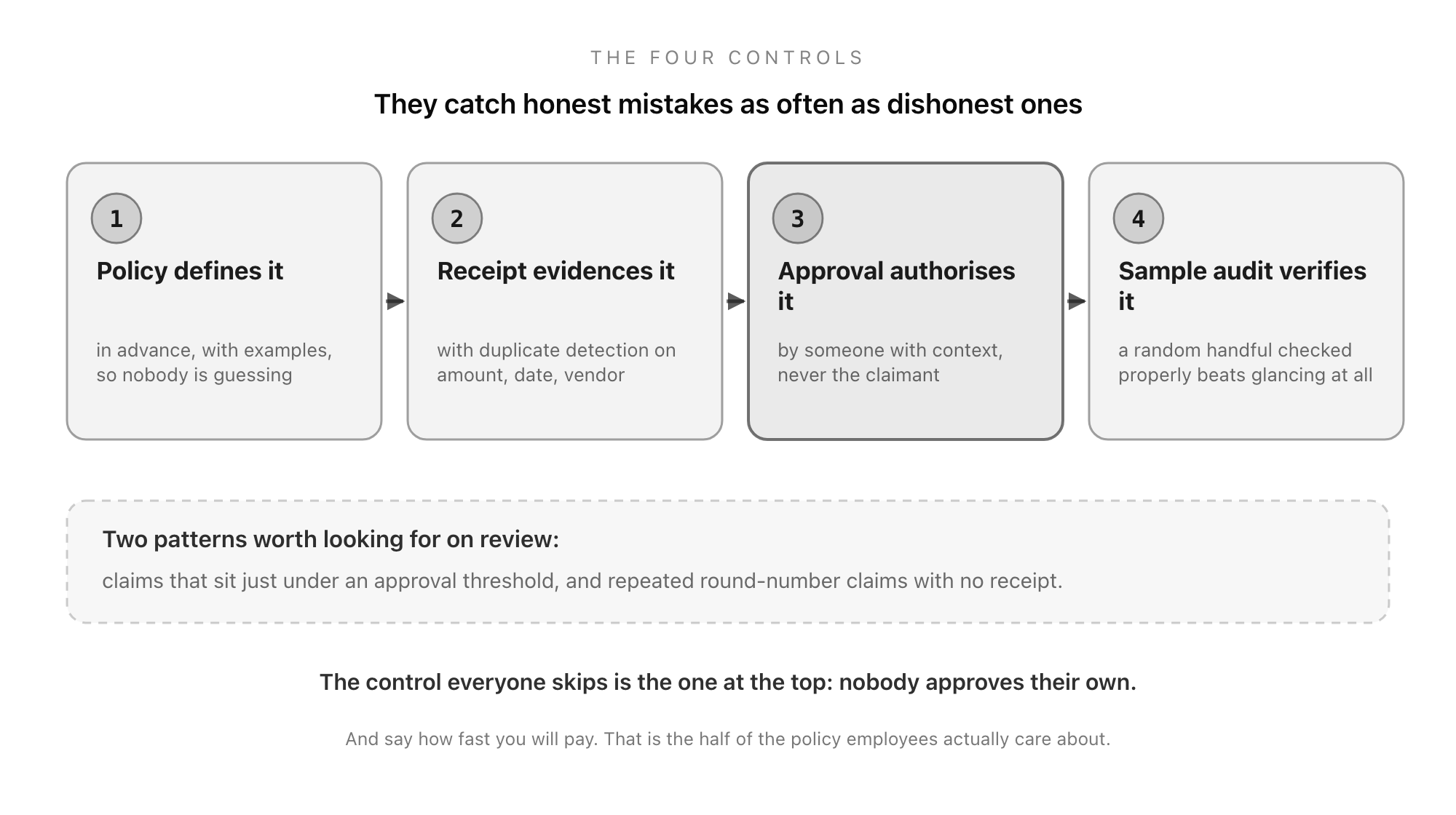
Expense fraud is usually small, repeated, and opportunistic rather than dramatic: personal items slipped into a business claim, inflated mileage, a receipt claimed twice, or a claim for something already paid on a company card. Four controls catch nearly all of it, and, more importantly, catch honest mistakes too.
The policy defines it in advance, so nobody is guessing.
The receipt evidences it, with duplicate detection on amount, date, and vendor.
Approval authorises it, by someone with context and never the claimant.
A sample audit verifies it. Checking a random handful thoroughly is far more effective than glancing at everything, and knowing that any claim might be examined properly is what makes the system work.
Two patterns deserve a look whenever you review: claims that sit just under an approval threshold, and repeated round-number claims without receipts.
Common Mistakes
No stated payment timescale. The largest single source of ill feeling in the whole process.
Business purpose treated as optional. Turns a legitimate expense into an unsupportable one.
Free-text categories. Makes the data unanalysable, so nobody ever looks at it.
A policy written for edge cases. Long, defensive, unread.
Paper receipts. They fade, they get lost, and they cannot be searched. Photograph at the point of spend.
Self-approval at the top. Undermines the whole control framework, and it is always noticed.
No deadline, or a deadline nobody enforces. Produces claims arriving in the next financial year.
Rules and tax treatment vary by country and change; treat this as general guidance and confirm the specifics with your accountant or tax authority.
Build Your Reimbursement Form in Good Form
Nearly everything that makes reimbursement work is a data-capture problem: the same fields every time, a receipt photographed at the moment of spending, a business purpose that is required rather than optional, a category from a list, and a claim that lands somewhere an approver will actually see it.
You can build an expense claim form in minutes with the free form builder, with defined categories, required business purpose, receipt upload, mileage fields, and cost codes, collecting every claim in one searchable place ready for approval and payment. The same structure supports the workforce records around it, like the timesheet for hours worked and the PTO request form for planned absence. If you are choosing a tool to run these on, the guide to the best free form builders covers what to look for.
Build your expense claim form in Good Form →
Reimbursement is a small process that people judge an employer by, because it is one of the few where the organisation is holding the employee's own money. Define what is allowed before people spend, require the business purpose and the receipt at the point of claiming, route approval to someone with context, never let anyone approve their own, audit a sample properly rather than everything superficially, and above all say how fast you will pay and then pay that fast. Do that and expenses stop being a monthly irritation and become what they should be: a boring, reliable process nobody has to think about.