Survey questions look simple, and that is exactly why so many surveys fail. Anyone can string together a dozen questions and send them out, but the gap between a survey that produces something you can act on and one that produces a pile of unusable answers comes down almost entirely to the questions themselves: what type you use, how you word them, and whether you have quietly biased the result before anyone clicks submit. Good survey questions turn a fuzzy thing like an opinion, a preference, or a level of satisfaction into data you can count and compare. Bad ones give you numbers that feel rigorous and mean nothing.
This guide covers the eight main types of survey questions and when to reach for each, the rules that separate a clean question from a leading one, examples for the surveys businesses actually run, and the common mistakes that quietly corrupt the results. Whether you are measuring employee engagement, customer satisfaction, or how an event landed, the same principles apply.
Closed vs Open-Ended: The Two Families
Before the individual types, it helps to see the one distinction that sits above all of them. Every survey question is either closed-ended or open-ended, and the choice shapes what kind of answer you get back.
Closed-ended questions give the respondent a fixed set of options to choose from: multiple choice, rating scales, yes/no, and so on. Their great advantage is that the answers are structured and countable. If a hundred people pick from the same five options, you can chart the result in seconds and compare it next quarter. The cost is that you only learn what you thought to ask about; a closed question cannot surface something you did not anticipate.
Open-ended questions let the respondent answer in their own words. Their strength is discovery: they capture the reason behind a rating, the complaint you never saw coming, the phrasing your customers actually use. The cost is that free text is slow to analyse, impossible to average, and prone to being skipped when respondents are tired.
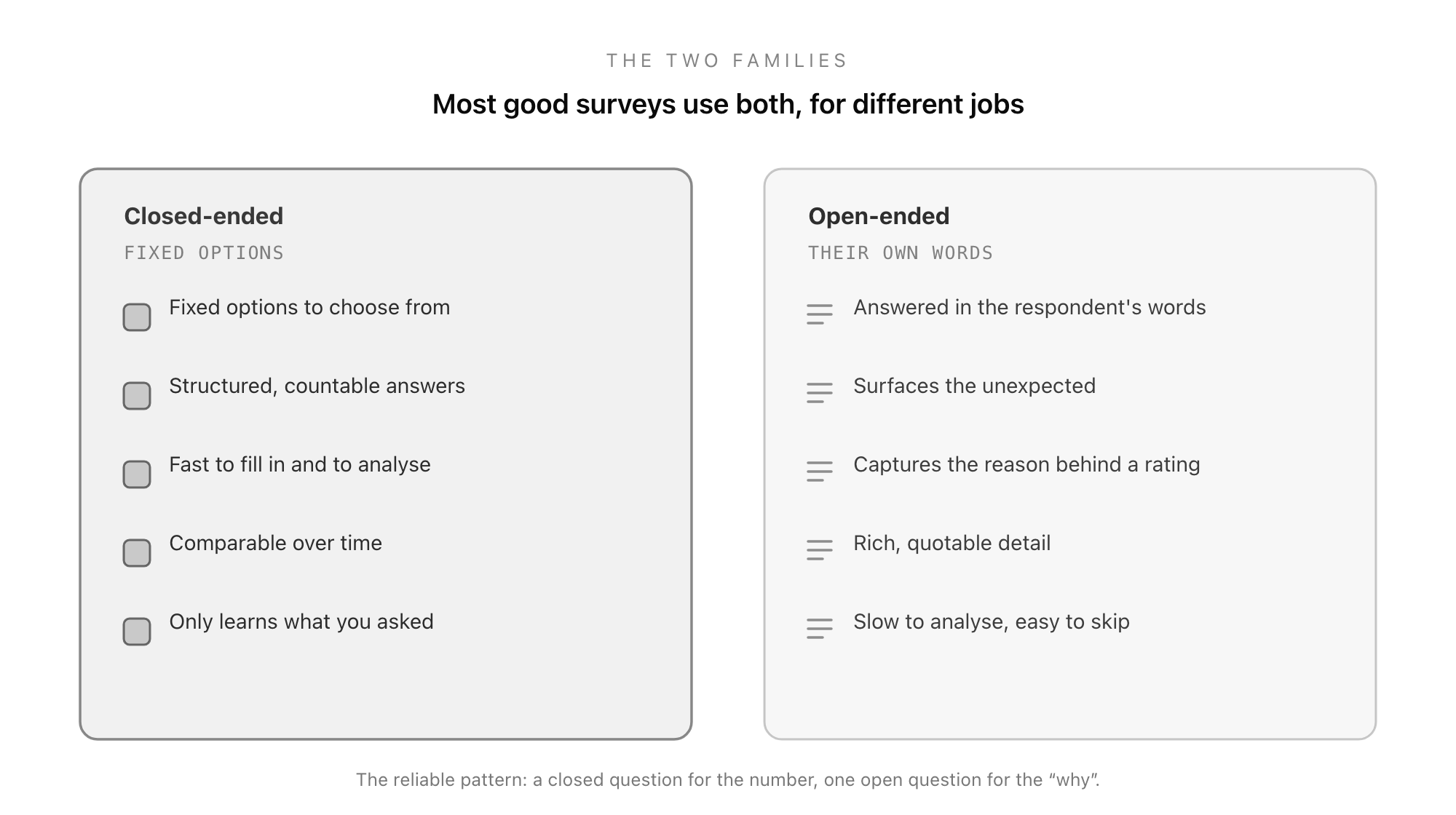
The practical rule most good surveys follow: lean on closed questions for the bulk of the survey so you get clean, comparable data, and add a small number of open-ended questions at key moments, often a single "anything else you'd like to add?" at the end, to catch what your fixed options missed. A survey that is all open text is exhausting to fill in and to analyse. A survey with no open text learns nothing you did not already expect.
The 8 Types of Survey Questions
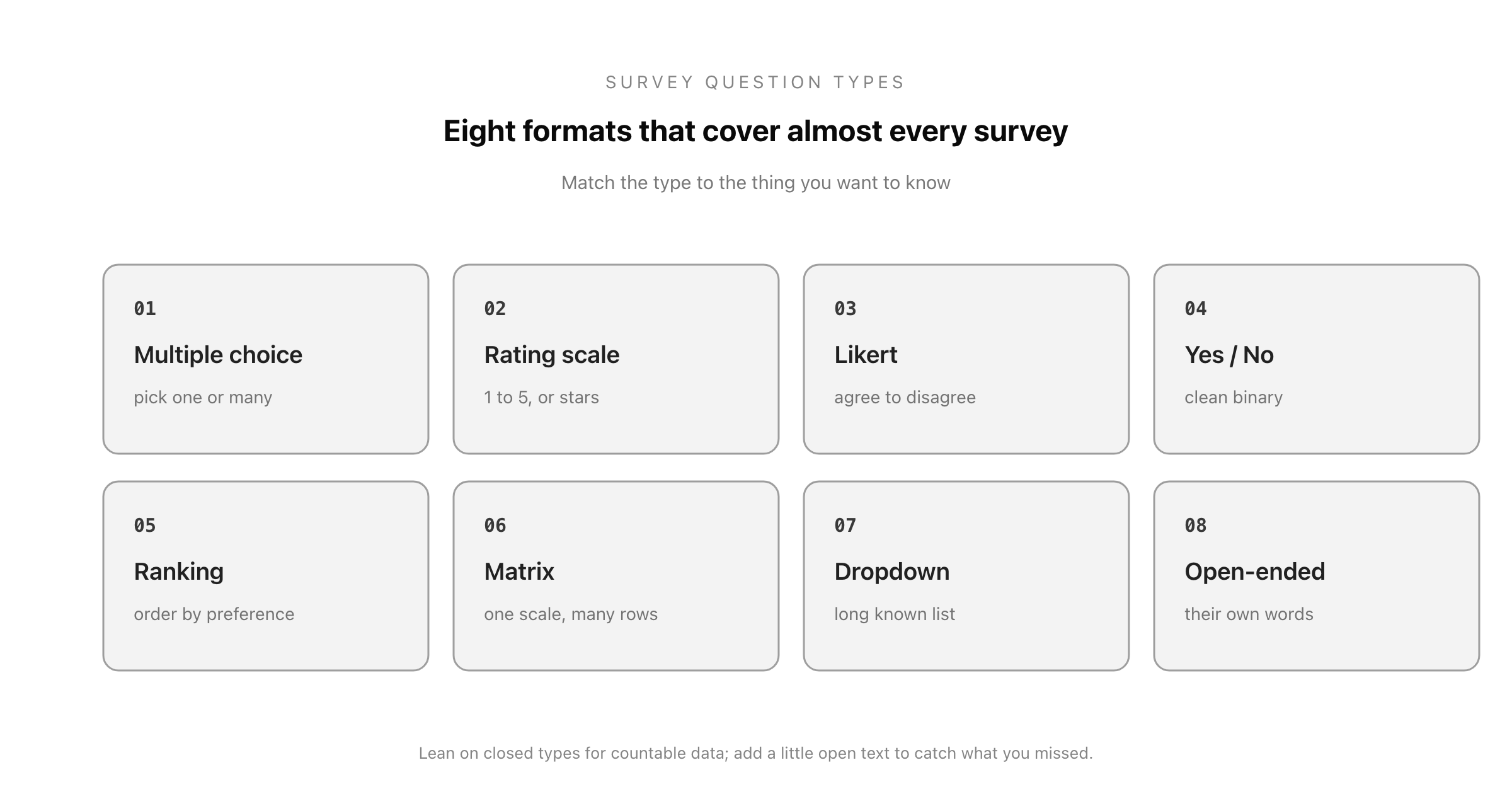
Within those two families sit the specific question formats you will actually build. Here are the eight that cover almost every survey, with examples and the situations each suits best.
1. Multiple choice. The workhorse of surveys: a question with several fixed options, where the respondent picks one (single-select) or several (multi-select). Use it whenever the possible answers are known and finite. "Which of these features do you use most?" The key discipline is that single-select options must be mutually exclusive and collectively exhaustive, which usually means adding an "Other" or "None of these" so nobody is forced into a wrong box.
2. Rating scale. A numeric scale, often 1 to 5 or 1 to 10, or a row of stars, that measures intensity. "On a scale of 1 to 10, how likely are you to recommend us?" Rating scales are fast for respondents and produce a clean average, which makes them ideal for tracking a single dimension over time. Always label what the ends mean (1 = very unlikely, 10 = very likely) so the numbers are comparable across people.
3. Likert scale. A specific, powerful kind of rating: a statement paired with a symmetric agree-disagree scale ("strongly disagree" to "strongly agree"). It is the standard tool for measuring attitudes and satisfaction because it captures direction and intensity in one balanced instrument. It is also the most commonly misused format, so it is worth understanding properly; the full guide to the Likert scale covers how many points to use and how to word the statements.
4. Dichotomous (yes/no). The simplest closed question: two options, usually yes/no or true/false. Perfect for a clean fork ("Have you contacted support in the last month?") that routes people to the right follow-up, and for unambiguous facts. The limitation is obvious: it captures no nuance, so use it for genuine binaries, not for opinions that live on a spectrum.
5. Ranking. Asks respondents to put a set of options in order of preference or importance. "Rank these five priorities from most to least important." Ranking is valuable when you need to know relative preference rather than absolute approval, because people who rate everything "very important" on a scale will still reveal what they truly value when forced to order it. Keep the list short; ranking more than about six items becomes a chore.
6. Matrix. A grid that applies the same scale to several items at once, most often a set of Likert statements sharing one row of response options. It is efficient, letting you ask ten related questions in the space of one, which is why engagement and satisfaction surveys rely on it. The risk is "straight-lining," where tired respondents pick the same column down the grid, so keep matrices reasonably short.
7. Dropdown. Functionally a multiple choice with a long option list collapsed into a menu: country, state, department, job title. Use it purely to keep a long but known list tidy. For short lists (five options or fewer), visible radio buttons are easier to answer than a dropdown that hides the choices.
8. Open-ended text. A free-text box for answers in the respondent's own words. Use it sparingly and deliberately: to capture the "why" behind a rating ("What is the main reason for your score?"), or as a catch-all at the end. One well-placed open question often yields your most useful quotes; five of them yield a survey nobody finishes.
How to Write Good Survey Questions
Choosing the right type is half the job. The other half is wording each question so it measures what you intend without nudging the answer. A handful of rules prevent the most common failures.
Ask one thing per question. The classic error is the double-barrelled question: "Was our support team fast and friendly?" Someone who found you fast but rude cannot answer honestly, and you cannot interpret the response. Split every question that contains an "and" into two.
Keep it neutral, never leading. "How much did you enjoy our excellent new dashboard?" tells the respondent which answer you want. State it flatly: "How would you rate the new dashboard?" The question should never reveal the answer you are hoping for.
Use plain, specific language. Avoid jargon, acronyms, and abstractions. A question that needs a second reading gets a careless answer or none at all. Short and concrete beats long and precise.
Avoid absolutes and loaded words. Words like "always," "never," and emotionally charged terms push people to a position. "Do you always struggle with the checkout?" invites a different answer than "How often do you have trouble with the checkout?"
Make options balanced and complete. For closed questions, offer equal room on both sides (as many negative options as positive) and cover the full range of plausible answers, including an escape hatch like "Other" or "Not applicable" so nobody is trapped in a box that does not fit.
Respect the respondent's time. Every extra question lowers your completion rate. Ask what you will actually act on and cut the rest. A focused ten-question survey beats a sprawling forty-question one that half your audience abandons.
Survey Question Examples by Use Case
The same types adapt to almost any topic. Here are starting sets for the surveys businesses run most often.
Employee engagement. Best measured as Likert statements combined into scores rather than one-off mood questions:
- "I understand how my work contributes to the company's goals." (Likert)
- "My manager gives me useful feedback." (Likert)
- "How likely are you to recommend this company as a place to work?" (0 to 10 rating)
- "What is one thing that would make this a better place to work?" (open-ended)
For a full build, the employee engagement survey guide walks through a complete question set.
Customer satisfaction. A mix of a headline score and a diagnostic follow-up:
- "How satisfied are you with your recent purchase?" (1 to 5 rating)
- "Which of these best describes what you were trying to do?" (multiple choice)
- "What is the main reason for your score?" (open-ended)
Event or training feedback. How a session landed:
- "The content was relevant to my role." (Likert)
- "Rank these topics by how useful they were to you." (ranking)
- "What would you change about the session?" (open-ended)
Product research. Understanding priorities before you build:
- "How important is each of these features to you?" (matrix of Likert items)
- "Which single feature would you most want us to add next?" (multiple choice)
Notice the pattern: a closed question to get the countable number, sometimes an open one to explain it. That pairing, a rating plus a "why," is the most reliable structure in survey design.
Common Survey Question Mistakes
Even with the right types and careful wording, a few structural errors undermine the results.
- Double-barrelled questions. Asking two things at once ("fast and friendly?") produces answers you cannot interpret. One idea per question, always.
- Leading or loaded wording. Any question that signals the "right" answer biases the whole dataset. Read each question and ask whether a competitor's survey would word it the same neutral way.
- Overlapping or incomplete options. Answer choices that overlap (ages "20-30" and "30-40") or leave gaps force arbitrary picks. Make ranges mutually exclusive and cover every case.
- Too many open-ended questions. Free text feels thorough but tanks completion rates and buries you in unstructured answers. Use it deliberately and rarely.
- A survey that is too long. The single biggest killer of response quality. Every question past the point of usefulness costs you completions and invites straight-lining. Cut anything you would not act on.
- Inconsistent scales. Switching from a 5-point scale to a 10-point one, or flipping the direction mid-survey, confuses respondents and corrupts comparisons. Keep formats uniform.
Build a Survey That Gets Real Answers
Good survey questions are only half the equation; they have to live on a form that presents them cleanly, keeps the scales consistent, and collects the responses in a structured way you can actually analyse. That is exactly where a spreadsheet-and-email survey falls down and a proper form builder earns its place, handling the multiple choice, rating, Likert, and matrix formats with consistent labelling so your data comes back ready to read.
The Good Form employee engagement survey template is built from properly-constructed questions, with balanced scales already set up, so you can see the principles in this guide applied and adapt the questions to whatever you are measuring.
Start from the engagement survey template in Good Form →
You can build any survey in minutes with the free form builder, mixing question types while keeping the scales consistent and the responses in one structured place. If you are still choosing a tool to run it on, the guide to the best free form builders covers what to look for. Whatever you build it on, the discipline is the same: the right question type for each thing you want to know, one clean idea per question, neutral wording, and a survey short enough that people finish it. Get those right and your survey stops collecting noise and starts telling you something true.