A complaint is somebody telling you that something went wrong. That is worth stating plainly, because most organisations treat complaints as an attack to be managed rather than as information they would otherwise have to pay for. The person complaining has done you the favour of describing a failure in your own operation, in detail, for free, and has given you a chance to fix it before they simply leave and tell other people instead. Most unhappy customers never complain at all, which means every complaint you receive represents a much larger number of people who had the same experience and said nothing.
This guide covers what counts as a complaint, what a complaint record must capture, the stages of a workable complaints procedure and realistic timescales, how to write a response that actually resolves things, why internal complaints need a different route, and how to turn the pattern across complaints into changes rather than a filing cabinet.
What Counts as a Complaint
A useful working definition is: any expression of dissatisfaction, whether justified or not, that requires a response. Three parts of that matter.
Any expression. Complaints do not arrive labelled. They come as an angry email, a comment in a survey, a one-star review, a remark to a member of staff on the way out. If you only count the ones submitted through the official form, your complaint volume is fiction and your data is worse than useless, because it will be systematically biased towards the most determined complainers.
Whether justified or not. Whether the organisation was at fault is the outcome of the process, not the entry criterion. Filtering at the front door, deciding something is not really a complaint because you do not think it is valid, is the most common way complaint handling goes wrong.
Requires a response. This is what separates a complaint from feedback. Feedback is information you can act on or not; a complaint is a request for something to be done, and it is not closed until the person has been told what happened.
It is also worth distinguishing complaints from the neighbouring processes. A customer complaint concerns service or product failure. A grievance is an employee raising a workplace concern, which runs through a different, usually formal, employment procedure. An incident report records something that happened, often for safety purposes, and may or may not involve anyone being dissatisfied. Keeping the routes separate matters, because sending an employee's grievance through the customer complaints inbox is both a legal and a human error.
Why Complaints Are Worth Having
The honest case for taking complaints seriously does not need overstating.
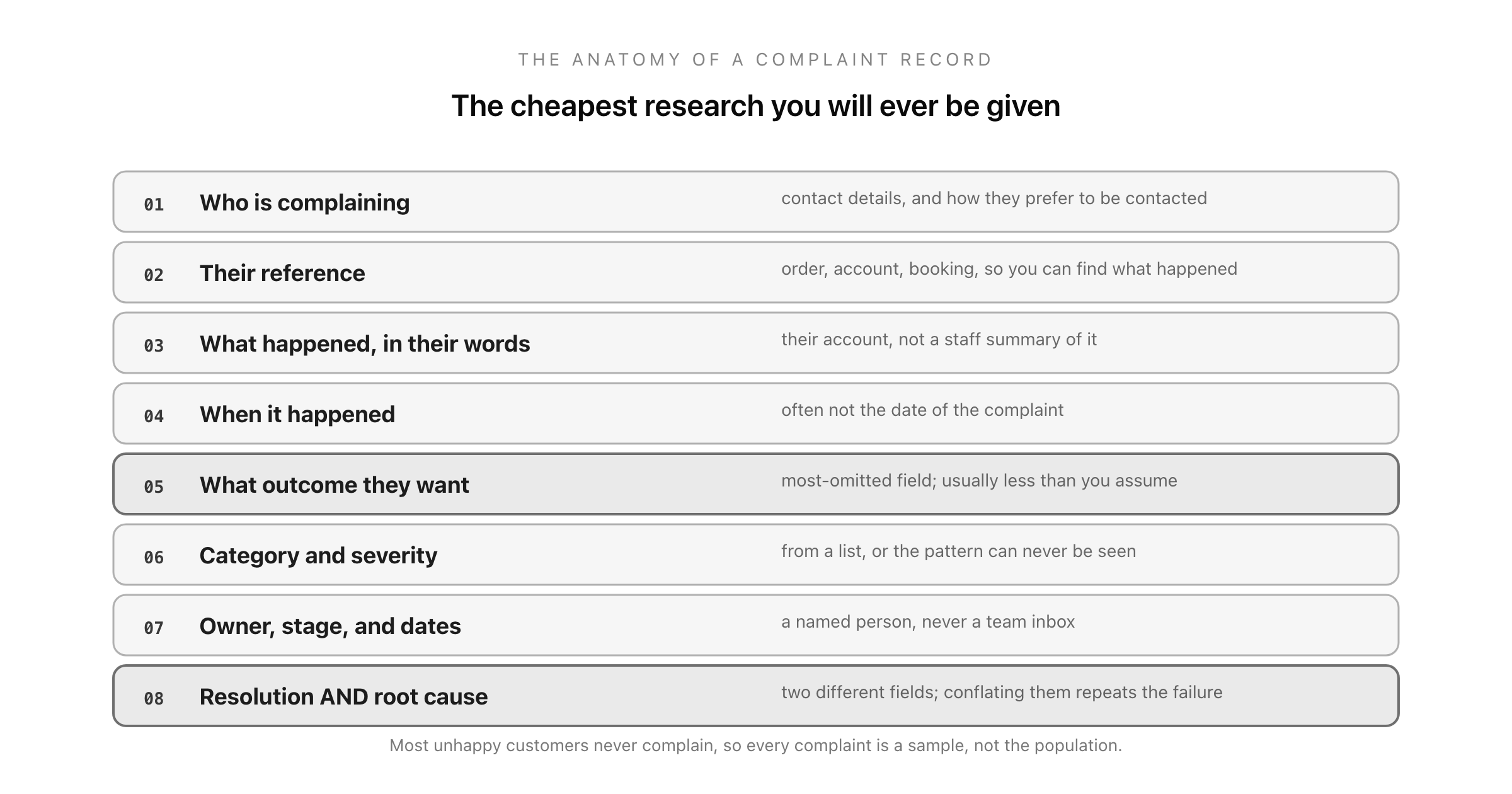
They are the cheapest research you will ever get. A complaint is a detailed, specific description of a failure, written by the person who experienced it, at no cost to you.
They are the tip of a much larger number. Most people who have a bad experience do not complain, they just leave. The complaint you receive is a sample, not the population.
Handling one well genuinely helps. There is a long-standing idea called the service recovery paradox, which claims that a customer whose problem is resolved well ends up more loyal than one who never had a problem. The research on it is mixed and the effect is not reliable, so it is not a reason to be relaxed about failures. What is well supported is the simpler version: a badly handled complaint reliably makes things much worse, and a well-handled one usually recovers most of the ground.
They surface systemic problems. One complaint is an incident. Fifteen complaints about the same step in your process is a design fault, and it is invisible unless you are categorising them consistently.
What a Complaint Record Must Capture
Who is complaining, with contact details and how they prefer to be contacted.
Their reference, such as an order, account, booking, or case number, so you can find what actually happened.
What happened, in their words. A free text field is essential here, and it should be the complainant's account rather than a staff summary of it.
When it happened, which is often different from the date of the complaint and matters for both investigation and any time limits.
What they want. The single most useful and most frequently omitted field. People often want considerably less than organisations assume, an explanation, an apology, or a promise that it will not happen to someone else, and a process that jumps straight to compensation frequently resolves the wrong thing.
A category, from a defined list, because this is what turns complaints into data. Free text categories make pattern analysis impossible.
Severity or priority, so that a safety-related complaint does not sit in the same queue as a billing query.
The owner. A named person, not a team inbox.
Stage and key dates. Received, acknowledged, target response, actual response, closed.
The resolution, and the root cause. What was done for this person, and separately, why it happened. Those are two different fields and conflating them is why organisations resolve the same complaint repeatedly.
The Stages of a Complaints Procedure
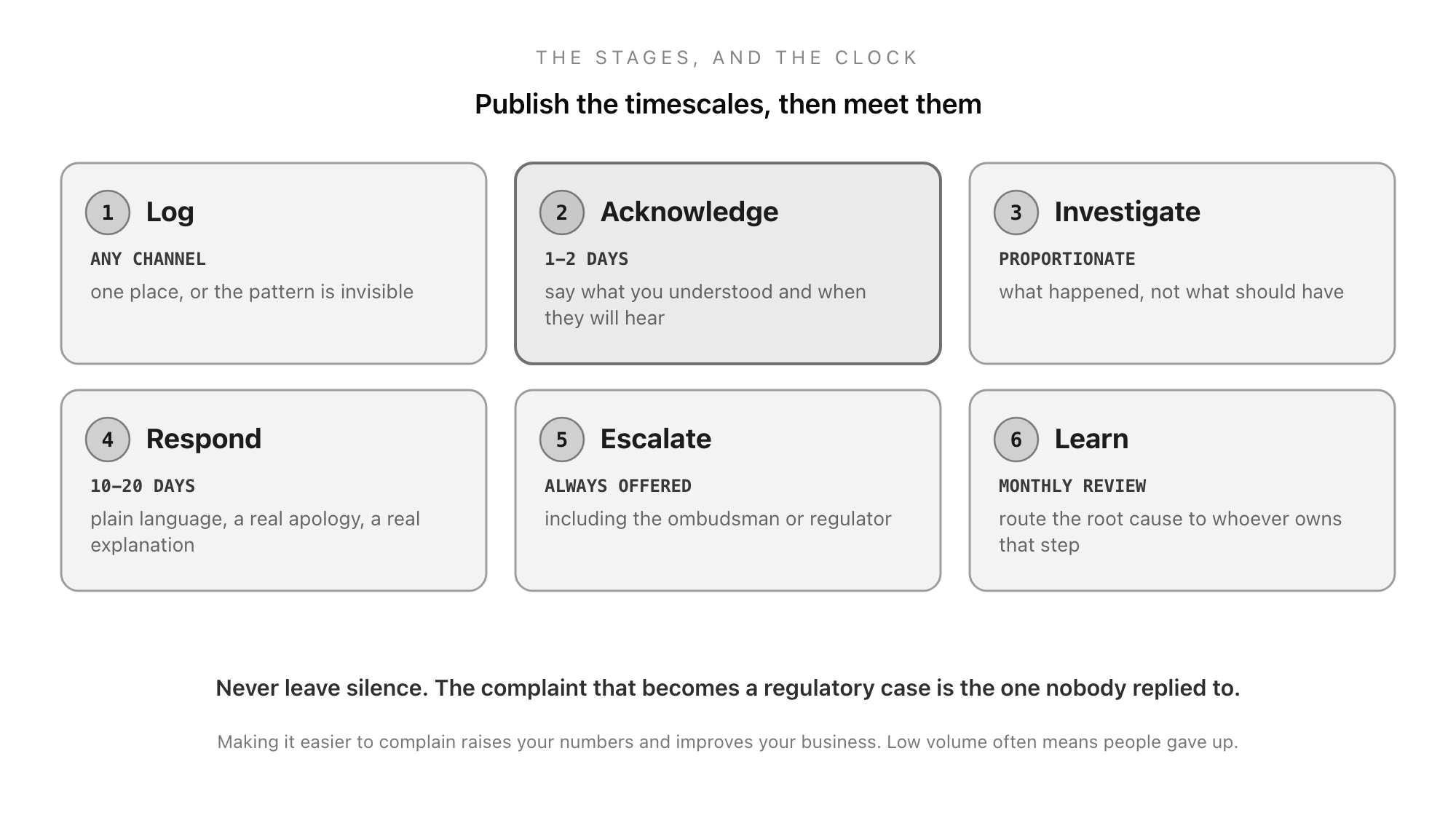
1. Receive and log. Through any channel, into one place. If complaints arrive in five inboxes, nobody can see the pattern and some will simply be lost.
2. Acknowledge, quickly. Within one or two working days, confirming what you have understood the complaint to be and when they will hear back. Acknowledgement is not resolution, but a fast acknowledgement removes most of the anxiety that makes complaints escalate.
3. Investigate. Look at the records, talk to the people involved, and establish what actually happened rather than what the process says should have happened. Investigate proportionately: a delayed delivery does not need the treatment a safety complaint needs.
4. Decide. Was something done wrong, and what is the right outcome. Decide on the merits, not on how forcefully the person is complaining, because rewarding volume trains your customers to shout.
5. Respond in writing. Covered below.
6. Offer an escalation route. Tell people what to do if they remain unhappy, including any external body such as an ombudsman or regulator where one applies. Concealing the escalation route is both wrong and counterproductive; people find it anyway, more annoyed.
7. Feed it back. Record the root cause and route it to whoever owns that part of the operation.
Timescales
State them publicly and meet them. Common defaults, adjusted for your sector's rules:
Acknowledge within 1 to 2 working days.
Substantive response within 10 to 20 working days, with a holding update if it will take longer.
Never leave silence. The complaint that becomes a regulatory case or a public review is almost always the one where nobody replied. If an investigation is genuinely taking six weeks, saying so at week two costs nothing and changes everything.
Regulated sectors have their own binding rules on this, financial services, healthcare, utilities, housing, and others, and they usually specify both maximum timescales and the external escalation route you must tell people about. Check your own regulator rather than adopting a generic policy.
Writing the Response
Say what you found, plainly. Vagueness reads as evasion, and the person already knows what happened to them.
Apologise for the actual thing. "We are sorry you feel that way" is not an apology and is widely recognised as an insult. An apology for what went wrong is not usually an admission of legal liability, though in unusual cases it is worth checking.
Explain, without excusing. A short explanation of why it happened helps; a paragraph about how busy you were does not.
Say what you are doing about it, both for them and, where relevant, to stop it recurring. The second part is what most complainants actually wanted.
Avoid template language. People can tell, and a form letter converts a resolvable complaint into a grievance about being fobbed off.
Give the escalation route and a named contact.
Learning From the Pattern
This is the step that separates organisations that handle complaints from organisations that improve because of them.
Categorise consistently and review the categories monthly. Look for the same root cause appearing repeatedly rather than counting total volume, since total volume mostly measures how easy you have made complaining, and a rise can be a good sign. Watch how long complaints take by category, because the slow ones usually indicate an unclear owner. And treat repeat complaints from the same person as a signal that the first resolution did not work rather than as a difficult customer.
One counterintuitive point worth holding on to: making it easier to complain will increase your complaint numbers and improve your business. The organisations with the lowest recorded complaint volumes are often simply the hardest to complain to.
Common Mistakes
Filtering at the front door. Deciding something is not a real complaint before investigating it.
Multiple inboxes. Complaints in email, social media, and a form, with no single record.
No named owner. Complaints assigned to a team drift.
Silence during investigation. The single largest cause of escalation.
Resolving without recording the root cause. Guarantees you will handle the same complaint again.
Rewarding persistence. Giving more to whoever complains loudest is unfair to everyone else and trains bad behaviour.
Treating volume as the metric. Falling complaint numbers can mean people have given up on you.
Build Your Complaint Form in Good Form
Good complaint handling depends on capturing the same information every time, in one place, with an owner and a clock running. That is a forms problem before it is a customer service philosophy: most complaint processes fail not because people do not care but because the complaint arrived somewhere nobody was tracking.
You can build a complaint form in minutes with the free form builder, capturing the complainant's account in their own words, what outcome they want, a defined category, severity, and reference number, with every submission landing in one searchable place ready to assign and track. The same structure supports the related routes, like the incident report form for things that go wrong operationally and the customer satisfaction survey that catches the dissatisfaction which never becomes a formal complaint. If you are choosing a tool to run these on, the guide to the best free form builders covers what to look for.
Build your complaint form in Good Form →
Complaints are unpleasant to receive and genuinely valuable to have. Take them from any channel, log them all in one place, acknowledge fast, investigate proportionately, decide on the merits rather than the volume, respond in plain language with a real apology and a real explanation, always give the escalation route, and record the root cause separately from the resolution. Do that and complaints stop being a queue to survive and become the most specific, cheapest feedback your organisation gets.