A customer satisfaction survey is the most direct way to find out what your customers actually think, and one of the easiest to get wrong. Send the right questions at the right moment and you get a clear, trackable signal you can act on. Send a vague, badly-timed, ten-minute questionnaire and you get a low response rate, biased answers, and a number nobody trusts. The difference is not the tool; it is understanding what you are measuring, which metric fits the question, and how to word and time the survey so people actually answer it honestly.
This guide covers what a customer satisfaction survey is, how CSAT compares to the other two big satisfaction metrics (NPS and CES), the questions worth asking, when to trigger the survey, and the mistakes that quietly ruin the results. Whether you are measuring a support interaction, a purchase, or overall sentiment, the same principles make the difference between data you can act on and noise.
What Is a Customer Satisfaction Survey?
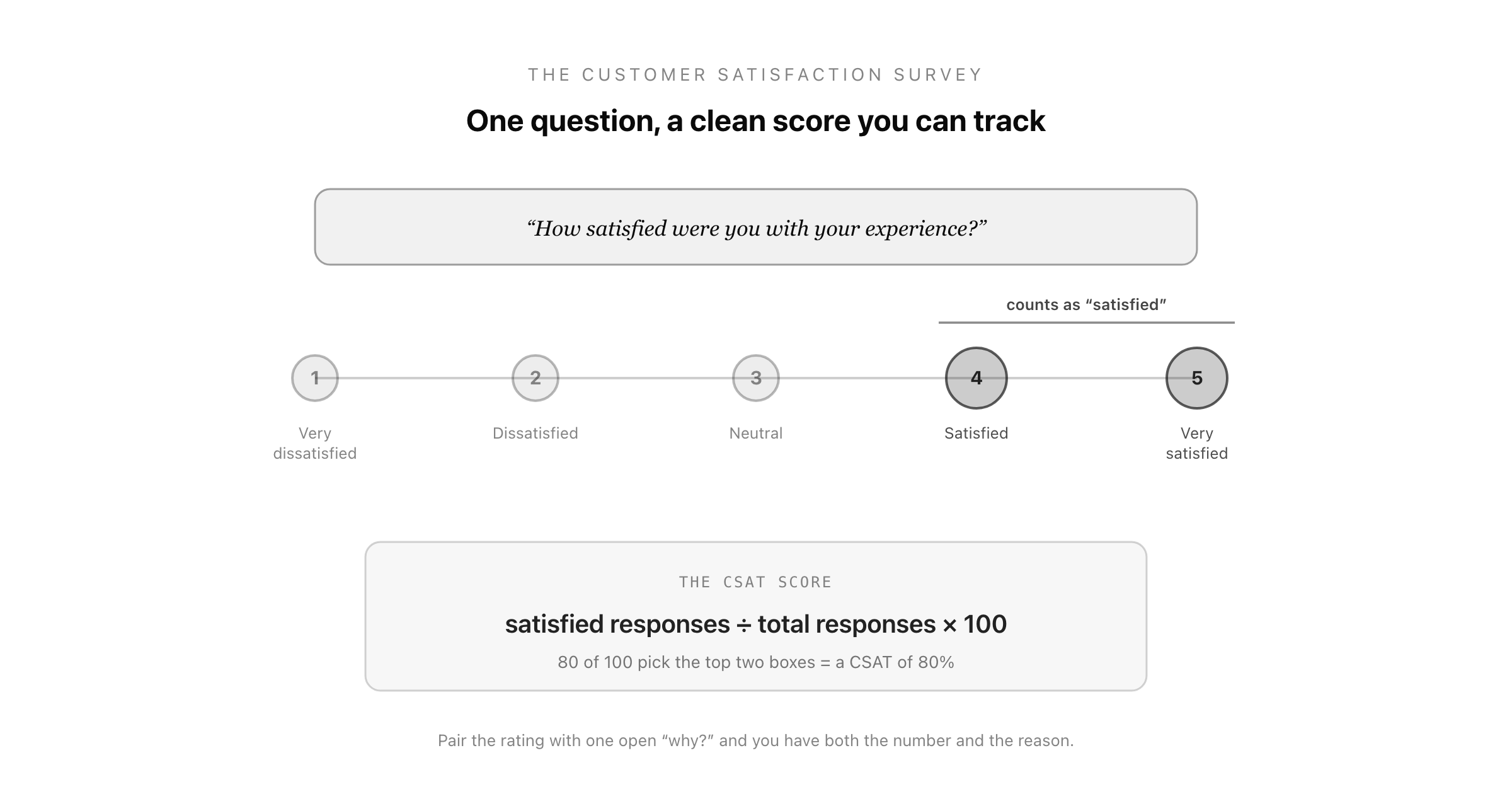
A customer satisfaction survey is a short questionnaire that measures how satisfied a customer is with a product, service, or specific interaction. Its most common form produces a CSAT score (Customer Satisfaction Score), built from a single question like "How satisfied were you with your experience?" answered on a scale, usually one to five, from very dissatisfied to very satisfied.
The CSAT score itself is simple: it is the percentage of respondents who chose a satisfied option (typically the top two, "satisfied" and "very satisfied") out of everyone who answered. If eighty of a hundred respondents pick one of the top two boxes, your CSAT is eighty percent. That simplicity is the point. It gives you one clean number you can track over time, compare across teams, and tie to a specific moment in the customer journey.
What makes a satisfaction survey powerful is not the score alone but the pairing of a closed rating with an open follow-up. The rating tells you how people feel; a single "What is the main reason for your score?" tells you why. That combination, a number plus a reason, is the backbone of every survey worth running.
CSAT vs NPS vs CES: Which Metric to Use
"Customer satisfaction" is measured by three different metrics that people often confuse, and choosing the right one matters because they answer different questions.
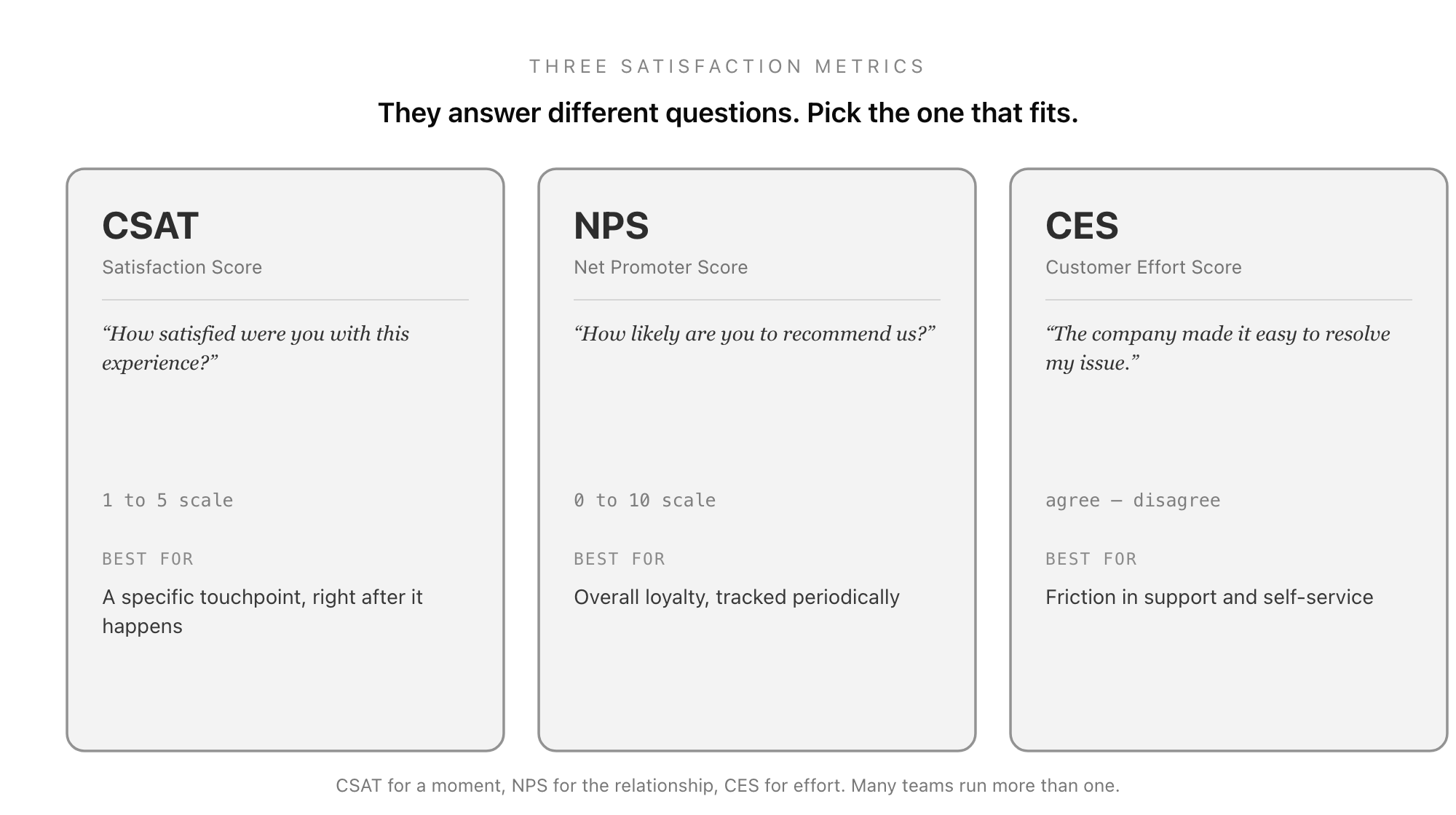
CSAT (Customer Satisfaction Score) measures satisfaction with a specific experience, right after it happens. "How satisfied were you with this purchase?" It is best for evaluating a particular touchpoint: a support ticket, a delivery, an onboarding call. It is immediate, intuitive, and easy to act on.
NPS (Net Promoter Score) measures overall loyalty rather than a single moment. It asks one question, "How likely are you to recommend us to a friend or colleague?" on a zero-to-ten scale, and sorts respondents into promoters (9-10), passives (7-8), and detractors (0-6). NPS is a relationship metric, best measured periodically to track how your whole customer base feels, not after every interaction.
CES (Customer Effort Score) measures how much effort a customer had to expend, usually with a statement like "The company made it easy for me to handle my issue," answered on an agree-disagree scale. It is especially predictive for support and self-service, because ease of resolution often drives loyalty more than delight does.
The rule of thumb: use CSAT to evaluate a specific experience, NPS to track the overall relationship, and CES to diagnose friction in support and process. Many teams run more than one, but each should be asked at the moment it fits.
Customer Satisfaction Survey Questions
A good satisfaction survey is short, usually a rating question plus one or two follow-ups. Here are the questions worth including, grouped by purpose.
The core satisfaction question. Always a rating, phrased around the specific experience:
- "How satisfied were you with your recent purchase?" (1 to 5)
- "How would you rate the support you received today?" (1 to 5)
The diagnostic follow-up. One open-ended question to capture the reason behind the score, which is where the actionable insight lives:
- "What is the main reason for your score?"
- "What could we have done better?"
Targeted closed questions. A small number of specific rating or Likert scale statements about the parts of the experience you can control:
- "The product was easy to set up." (agree-disagree)
- "Customer support resolved my issue quickly." (agree-disagree)
- "The product is good value for the price." (agree-disagree)
An optional recommendation question. If you also want a loyalty signal, add the NPS question: "How likely are you to recommend us?" (0 to 10).
The discipline is the same as in any well-built survey: one idea per question, neutral wording, a balanced scale, and few enough questions that people finish. For the full set of rules on writing questions that measure rather than mislead, see the guide to survey questions.
When and How to Send It
Timing shapes your data as much as wording does. A satisfaction survey sent at the wrong moment gets ignored or answered carelessly.
Trigger CSAT surveys immediately after the experience. The value of CSAT is freshness: send it right after the support chat closes, the order arrives, or the onboarding call ends, while the experience is vivid. A satisfaction survey about a purchase sent three weeks later measures memory, not experience.
Keep transactional surveys to one or two questions. The higher your response rate, the more representative your data. A one-click rating with an optional comment will always beat a ten-question form for completion, and completion is what protects you from bias.
Send relationship surveys (NPS) on a schedule, not per interaction. Quarterly or twice a year is typical. Asking the recommend question after every ticket produces fatigue and meaningless swings.
Make the first click the survey itself. Embedding the rating scale directly in the email or the post-interaction screen, rather than linking to a separate page, dramatically raises response rates. Every extra step loses respondents.
How to Read Your CSAT Score
Collecting the number is only useful if you interpret it well, and a raw CSAT figure is easy to misread in isolation.
Judge it against your own trend, not a universal benchmark. There is no single "good" CSAT score that applies everywhere; expectations differ wildly between industries and touchpoints. What matters far more than hitting an arbitrary target is the direction of your own number over time. A CSAT that climbs from 78 to 84 percent tells you something real; the same 84 percent compared to a competitor's self-reported figure tells you almost nothing.
Read the distribution, not just the average. Two surveys can share a CSAT score while telling opposite stories: one with everyone clustered on "satisfied," another split between delighted and furious. Looking at the full spread of responses, and especially the size of the dissatisfied group, reveals problems a single percentage hides.
Segment where you can. A blended company-wide score averages away the detail you need. Breaking CSAT down by product, channel, team, or customer type usually shows that the headline number is masking one area doing very well and another quietly failing. The segments are where the action is.
Treat the open comments as the real report. The score tells you that satisfaction moved; the free-text answers tell you why, and they are where the specific, fixable issues surface. Reading a sample of comments each week is often more valuable than watching the number itself.
Common Customer Satisfaction Survey Mistakes
Even a well-intentioned survey can produce data you cannot use. The usual culprits:
- Surveying too late. Asking about an experience long after it happened measures a faded memory. Trigger on the event.
- Making it too long. Every question past the essential ones costs completions and invites straight-lining. A satisfaction survey should be short by design.
- Leading or loaded wording. "How much did you love our fast, friendly service?" biases the answer. Keep every question neutral.
- Only collecting the number. A score with no "why" tells you something changed but not what to do about it. Always pair the rating with one open question.
- Never closing the loop. Collecting satisfaction data and doing nothing visible with it trains customers to stop responding. Acting on the feedback, and being seen to, is what keeps response rates alive.
- Ignoring who did not respond. The happiest and angriest customers answer most; the silent middle is easy to forget. Read your response rate alongside your score.
Build a Customer Satisfaction Survey That Gets Answered
A satisfaction survey lives or dies on execution: the right metric, a short set of clean questions, the right trigger, and a form simple enough that people actually finish it. That is exactly where a proper form builder earns its place over a spreadsheet-and-email setup, presenting a consistent rating scale, keeping the survey to the essentials, and collecting responses in one structured place you can chart and track over time.
You can build a customer satisfaction survey in minutes with the free form builder, keeping the rating scale consistent and the responses organised from the first submission. The same discipline that powers an employee engagement survey, built on balanced, well-worded questions, applies directly to measuring customers.
Build your customer satisfaction survey in Good Form →
If you are still choosing a tool to run it on, the guide to the best free form builders covers what to look for. Whatever you build it on, the principles hold: pick the metric that fits the question, ask a short set of clean, neutral questions, trigger the survey while the experience is fresh, and always pair the number with a reason. Get those right and a customer satisfaction survey stops being a vanity metric and starts telling you exactly where to improve.