Open-ended questions are how you find out what you did not know to ask. Where a multiple choice question hands the respondent a fixed set of boxes to tick, an open-ended question gives them a blank space and invites them to answer in their own words, and that difference is the whole point. Open questions surface the reason behind a rating, the complaint you never anticipated, the phrase your customers actually use, the detail no checklist would have captured. They are also easy to overuse and hard to analyze, which is why knowing when to reach for them, how to word them, and what to do with the answers matters as much as the questions themselves.
This guide covers what open-ended questions are, how they differ from closed ones, when they genuinely earn their place, how to write open questions that get real answers rather than one-word replies, and, crucially, how to make sense of the free-text responses they produce. Whether you are running a survey, interviewing candidates, or gathering customer feedback, the principles are the same.
What Are Open-Ended Questions?
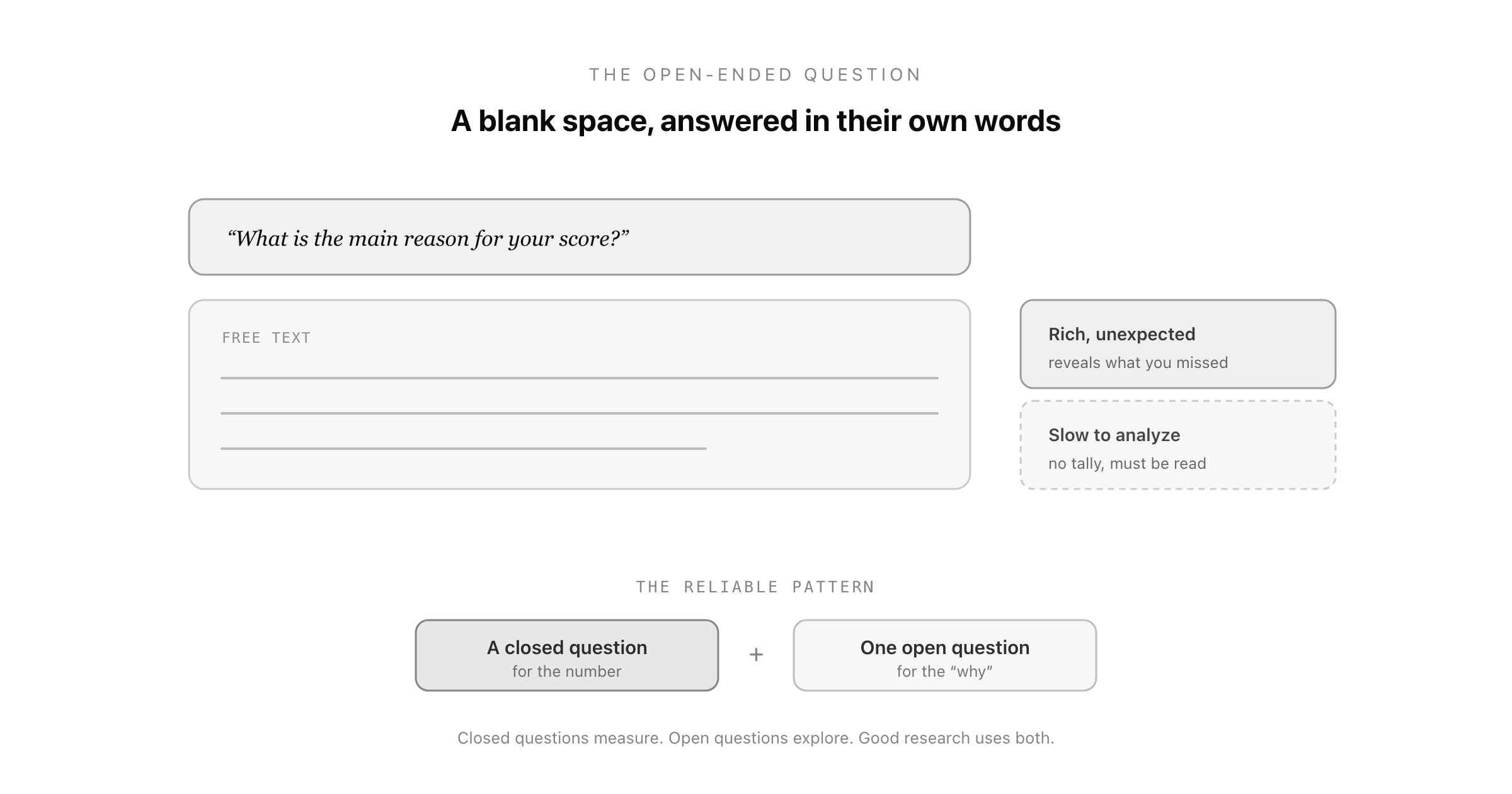
An open-ended question is one that cannot be answered with a single word or a choice from a fixed list; it invites the respondent to answer freely, in their own words, at whatever length they choose. "What did you think of the onboarding process?" is open-ended. "Did you find onboarding useful? Yes or No" is not. The defining feature is that the answer is generated by the respondent, not selected from options you wrote.
That produces a fundamentally different kind of data. Closed questions give you structured, countable answers, perfect for tracking and comparing, but they can only ever return the options you thought to include. Open-ended questions give you qualitative data: rich, detailed, and capable of surprising you. Their great strength is discovery, they can reveal things you did not know to look for, which is exactly what a closed question cannot do. Their great weakness is that free text is slow to analyze, impossible to average, and easy for respondents to skip when they are tired.
Understanding open-ended questions really means understanding that trade-off. They are not better or worse than closed questions; they are a different tool for a different job, and the skill is in knowing which job you are doing.
Open-Ended vs Closed-Ended Questions
The cleanest way to think about it is that closed questions measure and open questions explore. A multiple choice question or a rating scale is built to quantify: it turns opinion into countable data you can chart and track over time. An open-ended question is built to understand: it captures the nuance, the reasoning, and the unexpected that no fixed set of options could hold.
Most good research uses both, deliberately. The single most reliable structure in survey design is a closed question paired with an open one: a rating to get the number, and a "what is the main reason for your score?" to explain it. You get the trackable metric and the human reason behind it in two questions. For the full picture of how the question types fit together, see the guide to survey questions, which covers the whole toolkit.
When to Use Open-Ended Questions
Because open questions cost the respondent more effort and cost you more analysis, use them deliberately, where their strengths genuinely pay off.
To capture the "why" behind a number. After any rating, one open question turns a score you can track into feedback you can act on. This is their most valuable and most common use.
When you do not know the possible answers. If you cannot confidently list the options, forcing a closed question will miss the real answers. Open questions let the answers you never anticipated come through, which is invaluable in early research.
For depth and nuance. When you need to understand reasoning, feelings, or a complex experience, open questions give respondents room to explain in a way no scale can.
In interviews and conversations. Open questions ("Tell me about a time you handled a difficult client") draw out detailed, revealing answers, whereas closed questions shut a conversation down. This is why they are the backbone of good interviewing.
Sparingly, and rarely in bulk. The flip side: a survey made mostly of open questions exhausts respondents and buries you in text. One well-placed open question at the end ("Anything else you would like to add?") often yields your best insight; ten of them tank your completion rate.
How to Write Good Open-Ended Questions
A poorly-worded open question gets one-word answers or none. A few rules make the difference.
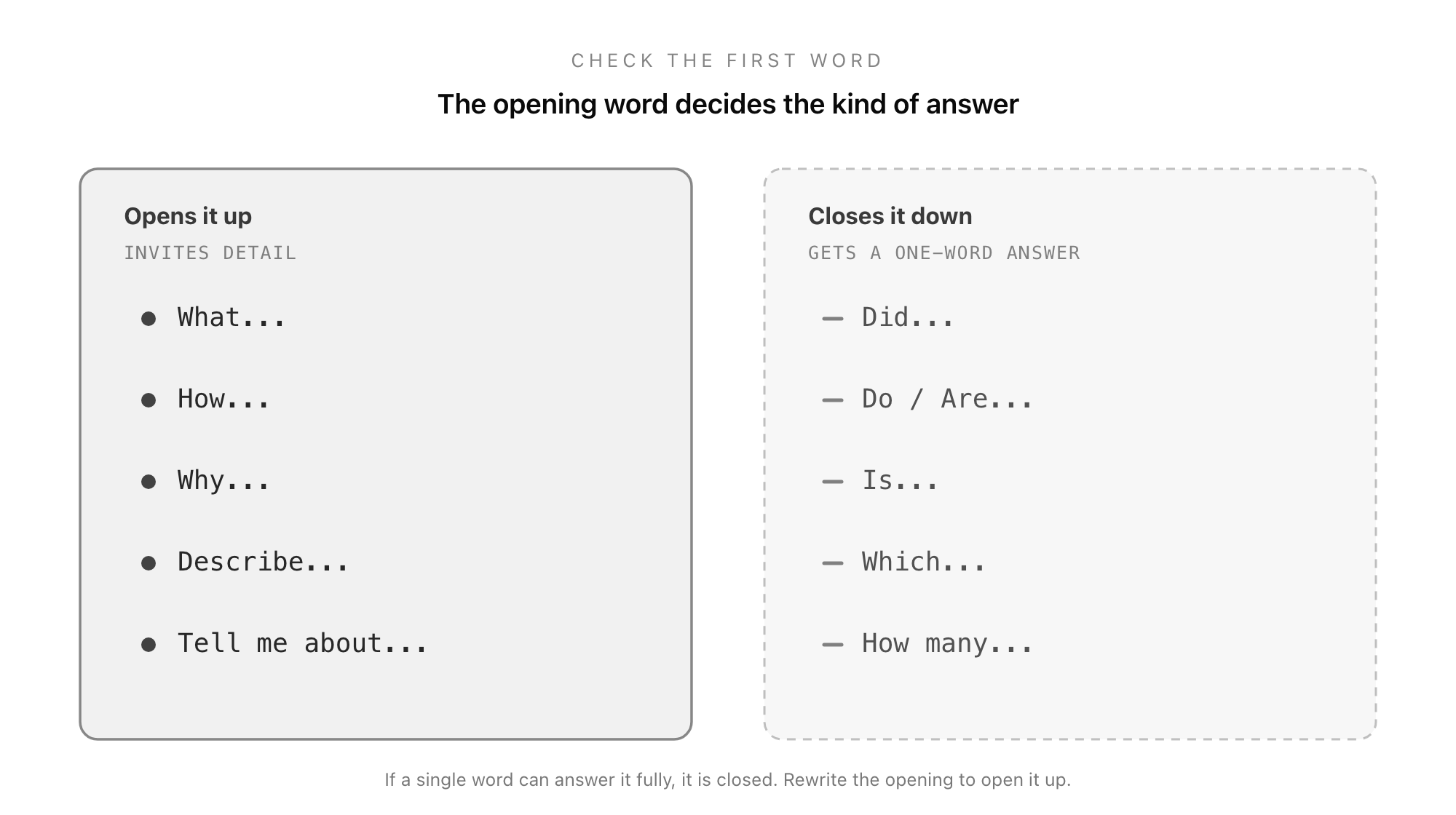
Start with the right words. Open questions naturally begin with "what," "how," "why," "describe," or "tell me about." Closed questions begin with "did," "do," "are," "is," "which," or "how many." If your question starts with a closed word, it will get a closed answer, so check the first word.
Avoid accidental yes/no phrasing. "Was the training helpful?" invites a one-word answer even though you wanted detail. "What did you find most and least helpful about the training?" opens it up. Phrase the question so a single word cannot fully answer it.
Ask about one thing. A sprawling question ("What did you think of the product, the price, and the support?") gets a vague, partial answer. Focus each open question on one topic so the respondent can actually address it.
Keep it neutral and specific. As with any question, do not lead ("What did you love about it?" assumes they loved it). And give enough specificity to guide the answer: "What is one thing we could improve?" gets a more useful response than a vague "Any feedback?"
Make it easy to answer. A focused, concrete open question that suggests a manageable answer gets far higher response than an intimidatingly broad one. "What nearly stopped you from signing up?" is answerable; "What are your thoughts on our company?" is not.
How to Analyze Open-Ended Responses
This is where open questions are won or lost, because rich data you cannot make sense of is worthless. Free text does not analyze itself, and a pile of comments needs a method.
The core technique is coding, also called thematic analysis: reading through the responses and tagging each with the theme it expresses (for example "price," "ease of use," "support wait time"), then counting how often each theme appears. This turns qualitative answers back into something quantitative, you can now say "40% of comments mentioned price", while preserving the actual voice of the respondent in the quotes. For large volumes, you sample rather than read every one, and increasingly text-analysis tools can cluster themes automatically, though a human read is still what catches the nuance.
The practical workflow is simple: read a sample to get a feel for the themes, define a small set of categories, tag the responses against them, and pull representative quotes for each. The pairing with closed data is powerful here too: when a satisfaction score drops, the open comments tell you which theme drove it. Plan the analysis before you send the survey, because collecting hundreds of free-text answers with no plan to read them is the most common open-question mistake of all.
Common Open-Ended Question Mistakes
- Using too many of them. The biggest error. A survey of open questions is exhausting to fill in and to analyze. Use them sparingly and deliberately.
- Accidental closed phrasing. Starting with "did" or "are" gets you a yes/no when you wanted detail. Watch the first word.
- Asking about several things at once. Multi-part open questions get vague, incomplete answers. One topic per question.
- Collecting free text with no plan to analyze it. Hundreds of unread comments help no one. Decide how you will code and read them before you ask.
- Being too broad. Vague questions get vague answers. Specific, focused open questions get useful ones.
Build Forms With the Right Mix of Questions
The best surveys and forms are not all open or all closed; they are a deliberate mix, mostly structured questions for clean, trackable data with a few well-placed open questions to capture the reasons and the surprises. That balance is exactly what a good form builder makes easy, letting you combine rating scales, multiple choice, and open text in one form and collect every response, structured and free-text alike, in one organised place.
You can build a form with the right mix in minutes with the free form builder, pairing closed questions for the numbers with open ones for the "why," and keeping all the responses together for analysis. For a specific worked example, the customer satisfaction survey guide shows the rating-plus-reason pattern in action, and the guide to the best free form builders covers what to look for in a tool.
Build your form in Good Form →
Open-ended questions are the part of a survey that can genuinely surprise you, the place where respondents tell you the thing you did not think to ask. Used with discipline, worded to invite real answers, and paired with a plan to actually read the responses, they turn a form from a tally of what you expected into a source of what you did not. Ask them well, ask them sparingly, and give the answers the attention they deserve, and open questions become the most illuminating tool in your kit.