Competencies are the things a person needs to be good at to do a job well, described in a way you can actually observe and assess. That sounds obvious, but it is the difference between a hiring process built on gut feel and one built on evidence. A competency is not just a skill on a CV; it is a defined combination of knowledge, skill, and behaviour, expressed in terms of what someone visibly does. When an organisation names its competencies clearly, everything downstream gets easier: job descriptions describe the role honestly, interviews ask about the same things for every candidate, performance reviews assess the same standard for everyone, and development conversations have something concrete to aim at.
This guide covers what a competency is, how competencies differ from skills and traits, the main types, a working list of common competencies with definitions, how to define them for a role, how proficiency levels work, and where competencies genuinely earn their keep in hiring, reviews, and development.
What Is a Competency?
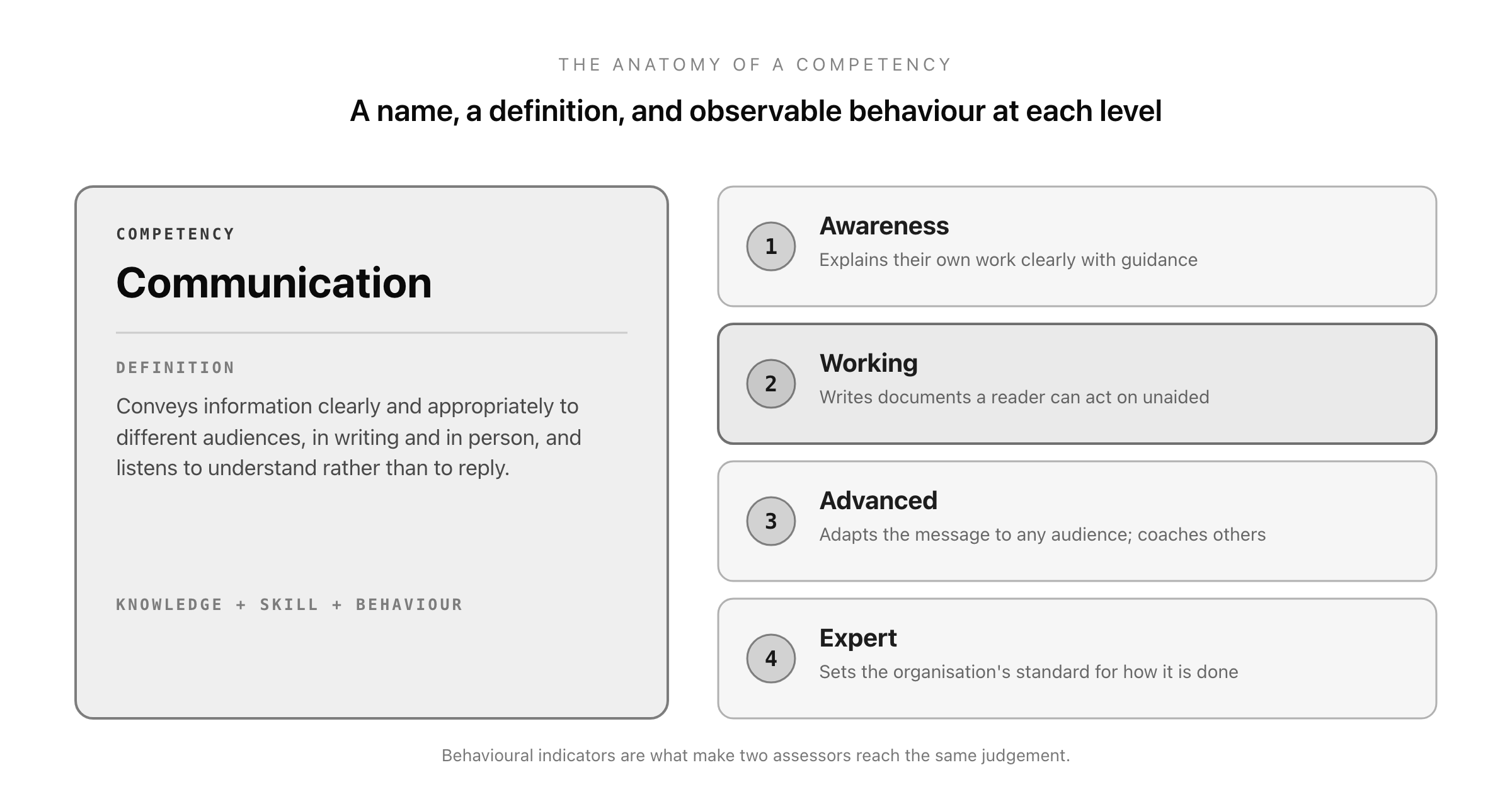
A competency is a defined capability that someone needs in order to perform a role successfully, described in observable terms. The key word is observable. "Good communicator" is a compliment; a competency called Communication would go further and say what it means here (conveys information clearly to different audiences, listens actively, adapts the message to the reader) and what it looks like in practice at different levels of seniority.
The standard way to think about it is that a competency bundles three things together:
Knowledge. What the person needs to know: the concepts, the regulations, the domain, the product.
Skill. What the person can do: the applied ability, developed through practice.
Behaviour. How the person habitually acts: the observable pattern of conduct that turns knowledge and skill into results.
That bundling is exactly why competencies are useful. Knowledge alone does not predict performance, and neither does a skill in isolation. It is the combination, plus the behaviour that shows up under real conditions, that determines whether someone actually does the job well. A competency captures the whole package and gives it a name everyone in the organisation can use to mean the same thing.
Competencies vs Skills, Knowledge, and Traits
The words get used interchangeably, which causes a lot of muddle in job adverts and appraisals. It is worth keeping them apart.
A skill is a specific learned ability: writing SQL, running payroll, negotiating a contract. Skills are relatively narrow and usually easy to verify. A competency is broader: it includes the relevant skills but also the knowledge behind them and the behaviours that make them effective in context. "Data analysis" as a competency covers not just the technical ability to query and model data but the judgement about which question to ask and the ability to explain the answer to someone who does not work with data.
A trait is a stable personal characteristic, like conscientiousness or extraversion. Traits influence competencies but are not the same thing, and they are much harder (and legally riskier) to assess in a hiring process. The practical rule is to assess what people do, not who you think they are.
A qualification is evidence that someone has met a standard at a point in time. It can be a useful proxy for knowledge but says little about behaviour, which is why a degree or certificate is a poor substitute for a competency assessment.
Keeping these apart matters because it changes how you assess. Skills can be tested, often directly, which is what a good skills assessment does. Competencies are best assessed through evidence of past behaviour and demonstrated results, which is what structured, behavioural interview questions are designed to elicit.
The Main Types of Competencies
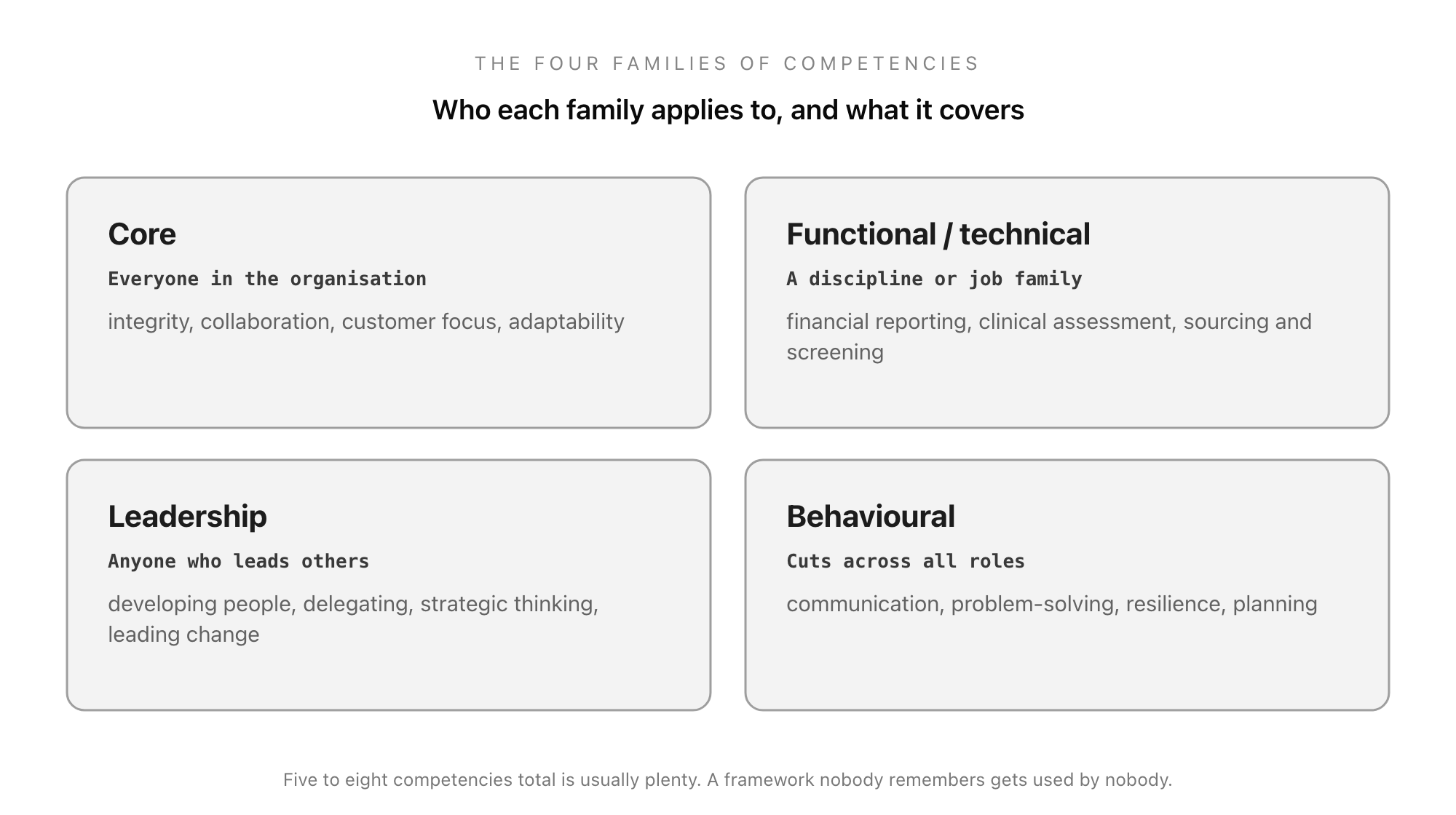
Most competency frameworks sort competencies into a few families. The names vary, but the categories are broadly consistent.
Core competencies apply to everyone in the organisation regardless of role. They express what the business expects of any employee: things like integrity, collaboration, customer focus, or adaptability. Core competencies are where an organisation's values become behavioural rather than decorative. If a value cannot be turned into observable behaviour, it is not doing any work.
Functional or technical competencies are specific to a job family or discipline: financial reporting for an accountant, clinical assessment for a nurse, software architecture for an engineer, sourcing and screening for a recruiter. These are the capabilities that make someone good at this particular kind of work rather than work in general.
Leadership or managerial competencies apply to people who lead others or set direction: developing people, delegating, strategic thinking, decision-making, managing change. These are usually defined separately because the step from doing the work to leading the work is a genuine change in what is required, and it is the transition most organisations handle worst.
Behavioural competencies cut across the others and describe how people work: communication, problem-solving, resilience, time management, teamwork. Some frameworks fold these into core competencies; others keep them separate. Either is fine as long as you are consistent.
A List of Common Competencies
A competency list is most useful when each entry has a short definition attached, because the name alone is where ambiguity hides. Here is a working list of common competencies with the kind of definition that makes them usable.
Communication. Conveys information clearly and appropriately to different audiences, in writing and in person, and listens to understand rather than to reply.
Collaboration and teamwork. Works effectively with others towards a shared goal, shares information proactively, and puts the team result ahead of individual credit.
Problem-solving. Breaks down unclear problems, identifies root causes rather than symptoms, and produces workable solutions with the information available.
Adaptability. Adjusts approach when circumstances, priorities, or information change, and stays effective through ambiguity.
Customer focus. Understands what customers actually need, anticipates it where possible, and makes decisions with the customer's experience in view.
Decision-making. Makes timely decisions using available evidence, weighs risks and trade-offs, and takes responsibility for the outcome.
Planning and organisation. Sets priorities, sequences work sensibly, anticipates obstacles, and delivers to agreed timescales.
Attention to detail. Produces accurate, complete work and checks it, particularly where errors carry cost or risk.
Initiative. Identifies what needs doing and acts without waiting to be told, within appropriate boundaries.
Resilience. Maintains effectiveness under pressure, recovers from setbacks, and manages own wellbeing sustainably.
Commercial awareness. Understands how the organisation makes money and how their work affects cost, revenue, and risk.
Developing others. Coaches, gives useful feedback, creates opportunities for growth, and takes genuine interest in people's progress.
Leading change. Explains why change is needed, brings people with them, and sustains momentum through the difficult middle.
Influence. Builds support for ideas through reasoning and relationships rather than authority alone.
Continuous improvement. Looks for better ways of working, learns from what goes wrong, and acts on the learning.
You will not use all of these. A framework with fifteen core competencies is a framework nobody remembers. Five to eight is usually plenty.
How to Define Competencies for a Role
Defining competencies well is mostly a matter of doing the analysis honestly rather than copying a list from elsewhere.
Start from what good performance actually looks like. Talk to the people who do the job well and the managers who see the difference between strong and weak performers. Ask what the strong performers do differently in concrete terms, not what qualities they have.
Name the competency plainly. Use language your organisation already uses. Invented vocabulary makes a framework feel like an HR artefact rather than a working tool.
Write a definition in behavioural terms. Describe what someone does, not what they are. "Anticipates problems and raises them early" is assessable. "Is proactive" is not.
Keep the list short. Identify the handful of competencies that genuinely distinguish success in the role. A long list dilutes attention and makes assessment a box-ticking exercise.
Test it against real people. Apply the draft to two or three current post-holders. If it does not distinguish between the excellent and the merely adequate, it needs sharpening.
Write them into the role from the start. The competencies should show up in the job description so candidates know what will be assessed, and in the interview so you assess it consistently.
Proficiency Levels and Behavioural Indicators
A competency is far more useful when it is expressed at levels, because the same competency means different things at different seniorities. Communication for a junior analyst is not communication for a director.
Most frameworks use three to five levels. A simple, workable scale:
- Awareness. Understands the basics and applies them with guidance.
- Working. Applies the competency independently in routine situations.
- Advanced. Applies it confidently in complex or ambiguous situations and helps others.
- Expert. Sets the standard for the organisation, shapes how the competency is practised, and develops others in it.
Under each level sit behavioural indicators: short, observable statements of what someone at that level actually does. For Communication at the working level: "explains their work clearly to colleagues outside their team", "writes documents that a reader can act on without follow-up questions", "checks understanding rather than assuming it". These indicators are the part that makes assessment consistent, because two different assessors reading the same indicators are far more likely to reach the same judgement than two assessors each applying their own idea of "good communication".
Where Competencies Actually Get Used
A framework that sits in a folder is worthless. Competencies earn their keep when they run through the whole employee lifecycle.
Hiring. Competencies define what the role requires, which shapes the job advert, the screening criteria, and the interview questions. A competency-based interview asks for specific past examples against a defined competency, and scores every candidate against the same indicators, which is both fairer and far more predictive than an unstructured conversation.
Performance reviews. Assessing against defined competencies gives a review substance beyond a general impression, and makes the standard the same for everyone at that level. Pairing competency assessment with objectives (the what alongside the how) is the pattern most performance review processes are built on.
Development and progression. Competency levels make development concrete. Instead of "work on your leadership", a person can see the specific behaviours that separate their current level from the next one, and target them. This is also what makes career paths transparent: the requirements for the next role are written down rather than implied.
Succession and workforce planning. With competencies mapped across roles, you can see where capability is concentrated, where it is thin, and who is close to being ready for a bigger role.
Goal setting. Competency gaps convert naturally into development goals, and a good goal-setting structure like SMART goals turns them into something measurable rather than aspirational.
Common Mistakes to Avoid
Too many competencies. The single most common failure. If people cannot recall the framework, they cannot use it.
Vague definitions. "Demonstrates excellence" tells an assessor nothing. Without behavioural indicators, competency assessment collapses back into personal impression, which is exactly what it was meant to replace.
Copying someone else's framework. Competencies encode what matters in your organisation. A borrowed list describes someone else's business.
Assessing personality instead of behaviour. Rating someone on being "confident" or "outgoing" drifts towards personality judgement and away from job relevance, with fairness and legal risk attached. Stay on what people do.
Writing it once and never revisiting it. Roles change. A framework built for the organisation of five years ago quietly stops describing the work.
Collecting the evidence inconsistently. If every interviewer records their assessment differently, on their own notes, the framework provides no comparability. Consistent capture is what makes the whole thing work.
Put Your Competencies into Structured Forms
Competencies only deliver fairness and comparability if the assessment is captured the same way every time. That is a forms problem as much as an HR one. When interview notes live in one person's notebook, review scores in a document template, and development plans in email, you lose the very thing competencies were meant to give you: the ability to compare like with like, across candidates, across teams, and over time.
You can build competency-based interview scorecards, review forms, and development-plan forms in minutes with the free form builder, scoring the same competencies against the same indicators for everyone and collecting the results in one structured place. The same approach supports the skills assessment you run at the screening stage and the performance review cycle later on. If you are choosing a tool to run your hiring and HR forms on, the guide to the best free form builders covers what to look for.
Build your competency scorecard in Good Form →
Competencies are not a piece of HR ceremony. They are the plain answer to a question every organisation has to answer anyway: what does it take to do this job well here, and how would we know? Define a short list honestly, write them in behavioural terms, express them at levels, and use them consistently from the job advert through to the development plan. Do that and hiring gets fairer, reviews get more useful, and people finally have something concrete to aim at.