A questionnaire is a structured set of written questions designed to collect information from people in a consistent, comparable way. It is one of the oldest and most useful research instruments there is, and also one of the easiest to get wrong. The difference between a questionnaire that produces trustworthy answers and one that produces confident nonsense usually comes down to a handful of design decisions made in the first twenty minutes: which questions to ask, how to phrase them, what answer options to offer, and what order to put them in. Nothing you do afterwards, no amount of analysis or charting, can rescue data collected through badly written questions.
This guide covers what a questionnaire is, how it differs from a survey, the question types and when each is appropriate, a step-by-step process for designing one, the rules for writing good questions, and the specific mistakes that quietly ruin results. It applies whether you are running a customer research study, an employee engagement round, a screening form for candidates, or a simple client intake.
What Is a Questionnaire?
A questionnaire is an instrument: a fixed list of questions, in a fixed order, with defined answer formats, given to every respondent in the same way. That standardisation is the entire point. Because everyone answers the same questions in the same form, the responses can be compared, counted, and aggregated, which is what turns a pile of individual opinions into something you can actually reason about.
Questionnaires are usually self-administered, meaning the respondent reads and answers on their own, without an interviewer present. This is what makes them cheap and scalable, and it is also what makes design so important: there is nobody there to clarify a confusing question, so every ambiguity in your wording becomes a permanent flaw in the data. A question that half your respondents interpret differently from the other half produces a number that means nothing, and you will not be able to tell from the results that it happened.
Questionnaires are used for research, feedback, screening, assessment, and administration. In a business context they show up as customer feedback forms, employee surveys, application screening questions, client intake forms, event registration, and post-purchase follow-ups. The underlying discipline is the same in every case.
Questionnaire vs Survey: The Difference That Matters
These two words get used interchangeably, and in casual use that is harmless. There is a real distinction though, and it is worth knowing because it clarifies what you are actually doing.
A questionnaire is the instrument: the set of questions itself. A survey is the whole research process: defining the objective, deciding who to ask, choosing a sample, distributing the questionnaire, collecting responses, and analysing the results. The questionnaire is a component of the survey, in the same way a thermometer is a component of taking someone's temperature.
The practical consequence is that a perfect questionnaire can still produce a useless survey. If you send an impeccably designed questionnaire only to your happiest customers, your data is worthless no matter how well the questions are written. Who you ask, and how many of them answer, matters as much as what you ask. Keep both halves in view: the instrument and the process around it.
The Question Types and When to Use Each
Questionnaire questions divide into closed questions, which offer fixed answer options, and open questions, which invite the respondent to write freely. Most good questionnaires are mostly closed, with a small number of open questions in strategic places.
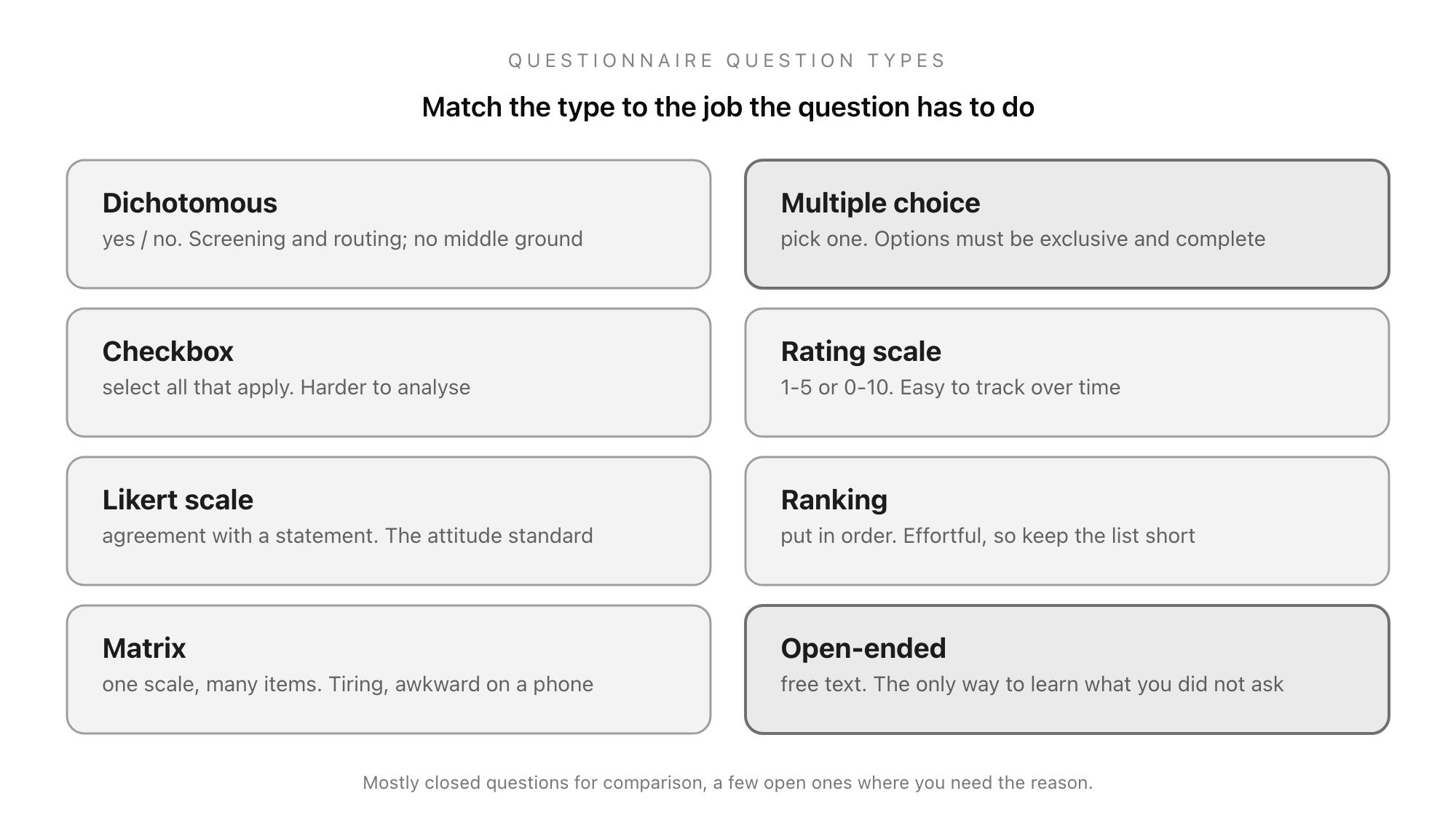
Dichotomous questions offer exactly two options, usually yes or no. Fast to answer and easy to analyse, and ideal for screening and routing, but they flatten anything that has a middle ground.
Multiple choice offers a list from which the respondent picks one. This is the workhorse of questionnaire design. The options must be mutually exclusive and cover the full range of realistic answers, which is what multiple choice questions are easy to get wrong.
Checkbox (multi-select) allows several answers from a list, for "select all that apply" situations. Useful, but harder to analyse than single-select, because the answer combinations multiply.
Rating scales ask for a score on a numeric scale, typically 1 to 5 or 0 to 10. Simple to complete and easy to track over time, which is why measures like satisfaction scores are built on them.
Likert scales measure agreement with a statement across a balanced set of options, typically from strongly disagree to strongly agree. They are the standard tool for measuring attitudes, and the design details, the number of points and whether to include a neutral middle, genuinely change the results. The guide to Likert scales covers those decisions.
Ranking questions ask respondents to put options in order of preference. They produce useful relative information but are effortful to answer, so keep the list short.
Matrix questions apply the same scale to several items at once in a grid. Efficient when you have many similar items, but tiring and easy to answer carelessly if the grid gets large, and awkward on a phone.
Open-ended questions invite a free text answer. They are the only way to capture reasons, surprises, and language you had not anticipated, and the only way to learn something you did not already think to ask about. The cost is analysis time, so use them deliberately, as covered in the guide to open-ended questions.
How to Design a Questionnaire
A reliable design process runs roughly like this.
1. Define what you need to know, and why. Write down the decision the data will inform. If you cannot say what you would do differently depending on the answer, you probably do not need the question. This single step removes most of the bloat from most questionnaires.
2. Identify your respondents. Who are they, what do they know, how much time will they give you, and what language do they use? A questionnaire written for the internal team will confuse customers, and vice versa.
3. List the questions you need, then cut. Draft everything you could ask, then remove anything that is nice-to-know rather than need-to-know. Every extra question costs you completion rate on all the others.
4. Choose the format for each question. Match the type to the job: closed for measurement and comparison, open for explanation and discovery, dichotomous for screening and routing.
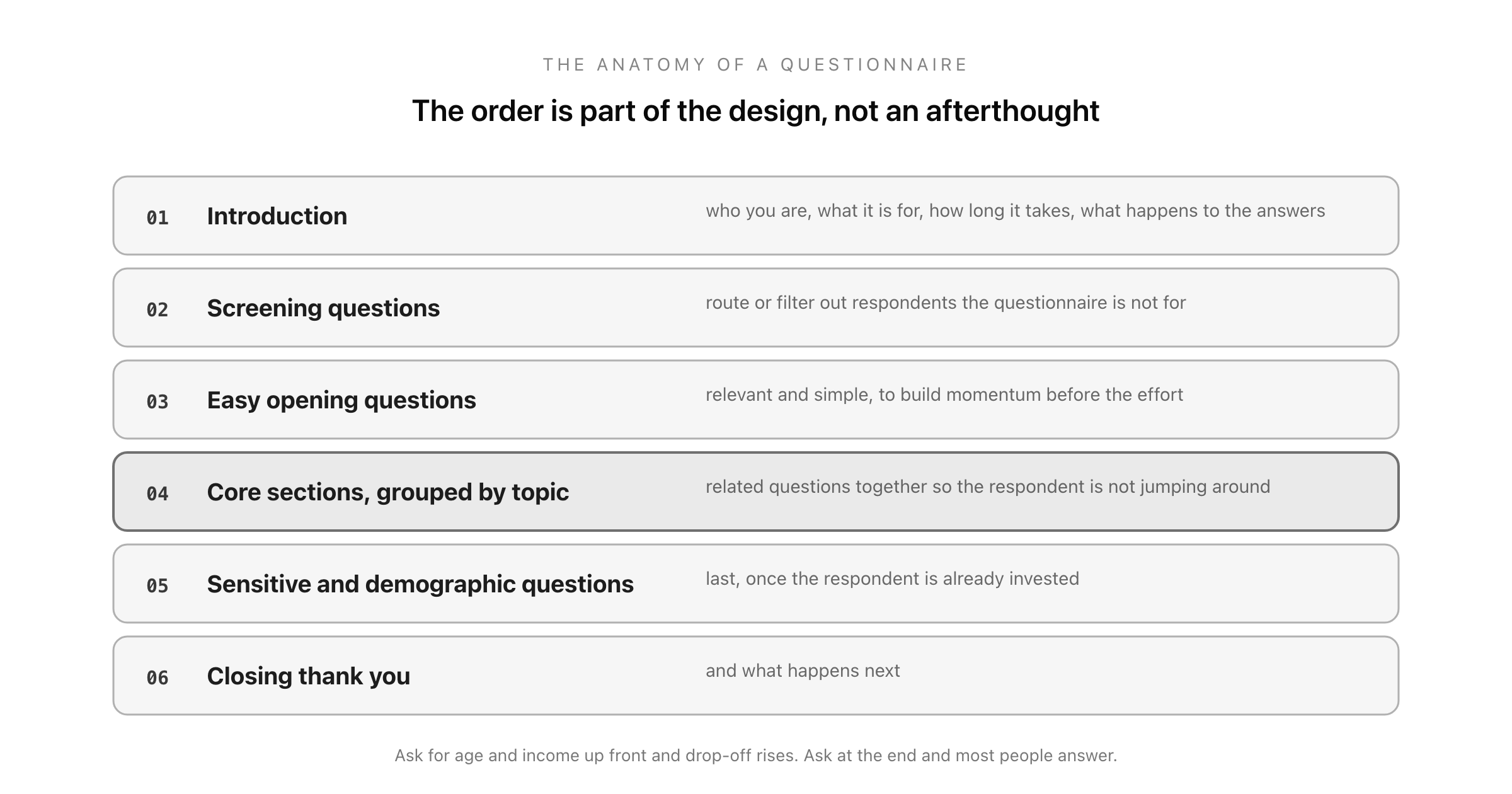
5. Order them deliberately. Start with easy, engaging, relevant questions to build momentum. Group related questions into sections so the respondent is not mentally jumping around. Put sensitive questions and demographics at the end, when the respondent is already invested, since asking for age and income up front increases drop-off.
6. Write the introduction. Say who you are, what the questionnaire is for, how long it takes, and what will happen to the answers. Honesty about length matters: an accurate "about four minutes" builds more trust than an optimistic "just a moment".
7. Pilot it. Give it to five to ten people who resemble your respondents, and ask them to think aloud. You will find ambiguities you cannot see yourself, because you already know what you meant. Piloting is the step most people skip and the one with the highest return.
The Rules for Writing Good Questions
Ask one thing at a time. "How satisfied are you with our speed and quality?" cannot be answered by someone who is happy with one and unhappy with the other. Split it.
Use plain, specific language. Avoid internal jargon, acronyms, and abstractions. "How often do you use the reporting dashboard?" beats "How would you characterise your engagement with our analytics suite?"
Keep it neutral. The phrasing must not suggest a preferred answer. "How would you rate our excellent support team?" is not a question, it is a request for agreement.
Make time frames explicit. "Recently" means different things to different people. "In the last 30 days" is answerable.
Balance your scales. The positive and negative options should mirror each other. A scale running from "acceptable" to "outstanding" has nowhere to put dissatisfaction, so it will report satisfaction that does not exist.
Cover every case in your options. Include "other", "not applicable", or "prefer not to say" where a respondent might genuinely fit none of your options. Forcing an inaccurate answer produces inaccurate data.
Make answering easy on a phone. Most questionnaires are now completed on a small screen. Long option lists, wide matrix grids, and lengthy text fields all suffer there.
The Mistakes That Ruin Your Data
Some design errors do not just weaken your results, they invert them. These are the ones to watch for.
Leading questions. Wording that steers the respondent towards an answer. This is the most common serious flaw and the hardest to see in your own drafts, because you are already sympathetic to the answer you expect.
Double-barrelled questions. Two questions bundled into one, producing an answer that cannot be interpreted.
Loaded questions. Questions containing an assumption the respondent may not accept, of the "how much do you enjoy our new layout?" variety, which offers no way to say they do not enjoy it at all.
Ambiguous wording. Any word that different respondents will read differently, which converts a clean number into an average of several different questions.
Unbalanced or missing options. Scales that lean positive, or option lists with gaps, both of which push respondents into answers that misrepresent them.
Acquiescence bias. A general tendency to agree with statements as presented, especially when a respondent is tired or the question is hard. Mixing in some reverse-worded items helps, but the deeper fix is a shorter questionnaire.
Order effects. Earlier questions colour later ones. Asking about a recent problem and then asking for an overall rating will produce a lower rating than asking in the reverse order. Neither order is neutral, so pick one deliberately and keep it consistent between rounds if you want comparable trends.
Excessive length. Completion rates fall as questionnaires get longer, and answer quality falls before completion does, as respondents start satisficing (picking the first acceptable answer rather than the accurate one). Long questionnaires do not just get abandoned, they get answered carelessly.
How Long Should a Questionnaire Be?
Short enough that people finish it thoughtfully. In practice that means aiming for under five minutes for general feedback, and treating anything beyond ten minutes as a research commitment that needs a real reason and probably an incentive.
The useful discipline is not counting questions but auditing them. For each one, ask what decision the answer would change. Questions that survive that test earn their place, and the ones that do not were costing you the quality of every other answer. A tight, well-ordered questionnaire of eight questions will out-perform a sprawling one of thirty almost every time, because the people who finish it will still be paying attention when they do.
Build Your Questionnaire in Good Form
Good questionnaire design is mostly thinking, but it still has to be built, distributed, and collected somewhere, and that part should be the easy bit. When responses arrive by email, in spreadsheets, and through three different tools, the comparability you designed for gets lost in the admin.
You can build a questionnaire in minutes with the free form builder, mixing multiple choice, rating scales, Likert items, and open text, ordering the sections properly, and collecting every response in one structured place ready to analyse. The same approach powers the specific instruments around it, like the customer satisfaction survey and the survey questions you reuse each round. If you are choosing a tool to run your research and feedback forms on, the guide to the best free form builders covers what to look for.
Build your questionnaire in Good Form →
A questionnaire is deceptively simple: it is only a list of questions. But it is also the instrument through which you learn what customers, candidates, and colleagues actually think, and a badly built instrument gives confident readings that happen to be wrong. Define the decision first, ask one thing at a time in plain words, offer balanced and complete options, order the questions with care, cut everything that is merely interesting, and pilot it before you send it. Do that and the answers you get back will be worth the trouble of collecting them.